MCQ
In the electrolytic cell, flow of electrons is from:
  • A
    Cathode to anode in solution.
  • B
    Cathode to anode through external supply.
  • Cathode to anode through internal supply.
  • D
    Anode to cathode through internal supply.
Answer

Correct option: C.
Cathode to anode through internal supply.
Hint: Electrons flow from the negative to a positive end.
Step $1:\ A$ cell in which Electrical energy is used to cause a non$-$spontaneous oxidation and reduction reaction is called an Electrolytic cell.
The electrolytic cell requires an energy input to proceed.
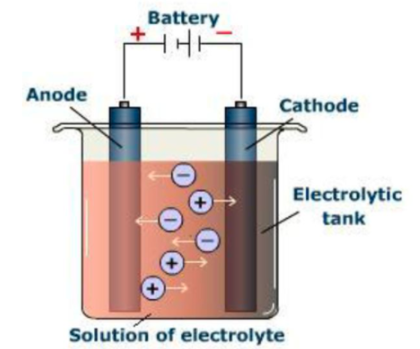
Step $2:\ $ Electrolytic cell contains three parts Cathode, Anode, and electrolyte.
Positive electrode is called anode.
Negative electrode is called Cathode.
An electrolyte is a substance in an aqueous or molten form that dissociates into ions and conducts electricity.
In a electrolytic cell, electrons are transferred from cathode to anode through internal supply.

Need a full question paper?

Generate a complete, print-ready paper with questions like this in minutes — across 16+ boards, with answer keys.

Start Generating Free

Similar questions

Which one of the following aldehydes will not form an aldol when treated with $dil. \,NaOH$ ?
$C _{6} H _{6}$ freezes at $5.5^{\circ} C$. The temperature at which a solution $10\, g$ of $C _{4} H _{10}$ in $200\, g$ of $C _{6} H _{6}$ freeze is ...... ${ }^{\circ} C$. (The molal freezing point depression constant of $C _{6} H _{6}$ is $5.12\,{ }^{\circ} C / m .$ )
The resistance of a conductivity cell with cell constant $1.14 \,\mathrm{~cm}^{-1}$, containing $0.001\, \mathrm{M}\, \mathrm{KCl}$ at $298\, \mathrm{~K}$ is $1500 \,\Omega$. The molar conductivity of $0.001\, \mathrm{M}\, \mathrm{KCl}$ solution at $298\, \mathrm{~K}$ in $\mathrm{S} \,\mathrm{cm}^{2}\, \mathrm{~mol}^{-1}$ is ...... . (Integer answer)
The osmotic pressure of a solution of $NaCl$ is $0.10$ $atm$ and that of a glucose solution is $0.20$ $atm.$ The osmotic pressure of a solution formed by mixing $1\, L$ of the sodium chloride solution with $2\, L$ of the glucose solution is $x \times 10^{-3}$ atm. $x$ is.......... (nearest integer)
Stacking $($a pile$)$ of square close packed layer gives rise to:
Assertion : Proteins on hydrolysis produce amino acids.
Reason : Amino acids contain $-NH_2$ and $-COOH$ groups.
The first order rate constant for a certain reaction increases from $1.667 \times 10^{-6}\, s^{-1}$ at $727\,^oC$ to $1.667 \times 10^{-4}\,s^{-1}$ at $1571\,^oC$. The rate constant at $1150\,^oC$, assuming constancy of activation energy over the given temperature range is [Given : $log \,19.9 = 1.299$ ]
Extra pure $N_2$ can be obtained by heating :-
Total vapour pressure of mixture of  $1\,\,mol\,$ $\,X(P_x^o\,=\,150\,torr)$  and $2\,\,mol \,Y(P_y^o\,=\,300\,torr)$  is $240\,\,torr.$  In this case
$2.0\,molar$ solution is obtained , when $ 0.5\,mole$ solute is dissolved in