In the experiment of potentiometer, at balance, there is no current in the
Easy


Download our appand get started for free
Experience the future of education. Simply download our apps or reach out to us for more information. Let's shape the future of learning together!No signup needed.*
Similar Questions
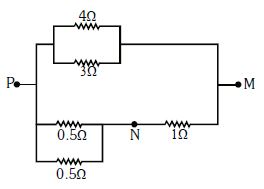
- 1In the circuit shown, the current through the $4\,\Omega $ resistor is $1\, amp$ when the points $P$ and $M$ are connected to a d.c. voltage source. The potential difference between the points $M$ and $N$ is ............... $volt$View Solution
- 2An electric bulb of $500 \,watt$ at $100\, volt$ is used in a circuit having a $200\, {V}$ supply. Calculate the resistance ${R}$ to be connected in series with the bulb so that the power delivered by the bulb is $500\, {W}$. (in $\Omega$)View Solution
- 3The length of a given cylindrical wire is increased to double of its original length. The percentage increase in the resistance of the wire will be..... $\%$.View Solution
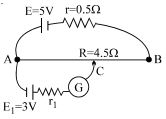
- 4In the given potentiometer circuit length of the wire $AB$ is $3\, m$ and resistance is $R = 4.5 \, \Omega$ . The length $AC$ for no deflection in galvanometer isView Solution
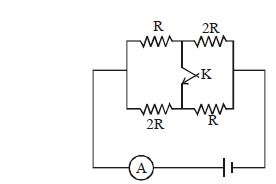
- 5View SolutionFind the ratio of currents as measured by ammeter in two cases when the key is open and when the key is closed
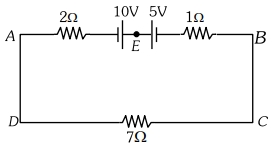
- 6View SolutionThe magnitude and direction of the current in the following circuit is :-
- 7Two electric bulbs marked $25\ W - 220\ V$ and $100\ W - 220\ V$ are connected in series to a $440\ V$ supply. Which of the bulbs will fuse?View Solution
- 8View SolutionAssertion : Free electrons always keep on moving in a conductor even then no magnetic force act on them in magnetic field unless a current is passed through it.
Reason : The average velocity of free electron is zero.
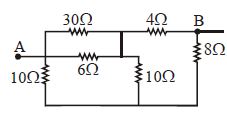
- 9The equivalent resistance across $AB$ would be ............ $\Omega$View Solution
- 10Two resistances ${R_1}$ and ${R_2}$ are made of different materials. The temperature coefficient of the material of ${R_1}$ is $\alpha $ and of the material of ${R_2}$ is $ - \beta $. The resistance of the series combination of ${R_1}$ and ${R_2}$ will not change with temperature, if ${R_1}/{R_2}$ equalsView Solution