Two resistances ${R_1}$ and ${R_2}$ are made of different materials. The temperature coefficient of the material of ${R_1}$ is $\alpha $ and of the material of ${R_2}$ is $ - \beta $. The resistance of the series combination of ${R_1}$ and ${R_2}$ will not change with temperature, if ${R_1}/{R_2}$ equals
Diffcult


Download our appand get started for free
Experience the future of education. Simply download our apps or reach out to us for more information. Let's shape the future of learning together!No signup needed.*
Similar Questions
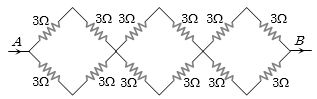
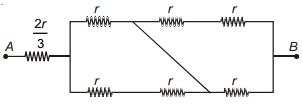
- 1In the network of resistors shown in the adjoining figure, the equivalent resistance between $A$ and $B$ is ............ $ohm$View Solution
- 2Two resistances ${R_1}$ and ${R_2}$ when connected in series and parallel with $120\, V$ line, power consumed will be $25\, W$ and $100\, W$ respectively. Then the ratio of power consumed by ${R_1}$ to that consumed by ${R_2}$ will beView Solution
- 3View SolutionWhen electric bulbs of same power, but different marked voltage are connected in series across the power line, their brightness will be :
- 4View SolutionAssertion : Free electrons always keep on moving in a conductor even then no magnetic force act on them in magnetic field unless a current is passed through it.
Reason : The average velocity of free electron is zero.
- 5A heater coil connected to a supply of a $220\, V$ is dissipating some power ${P_1}.$ The coil is cut into half and the two halves are connected in parallel. The heater now dissipates a power ${P_2}.$ The ratio of power ${P_1}\,\,:\,\,{P_2}$ isView Solution
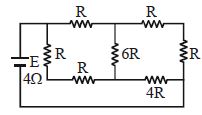
- 6A battery of internal resistance $4\, ohm$ is connected to the network of resistance as hown. In the order that the maximum power can be delivered to the network, the value of $R$ in ohm should be :-View Solution
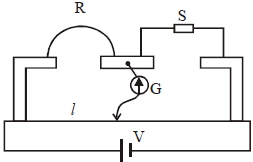
- 7In a meter bridge experiment $\mathrm{S}$ is a standard resistance. $\mathrm{R}$ is a resistance wire. It is found that balancing length is $l=25 \;\mathrm{cm} .$ If $\mathrm{R}$ is replaced by a wire of half length and half diameter that of $\mathrm{R}$ of same material, then the balancing distance $\left.l^{\prime} \text { (in } \mathrm{cm}\right)$ will now beView Solution
- 8The effective resistance of the network between points $A$ and $B$ isView Solution
- 9The reading of voltmeter in the circuit shown is ............. $V$View Solution
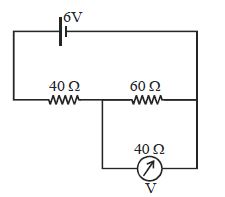
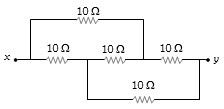
- 10The equivalent resistance between $x$ and $y$ in the circuit shown is ............. $\Omega$View Solution