MCQ
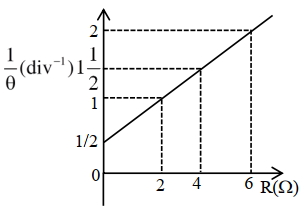
In the experiment to determine the galvanometer resistance by half-deflection method, the plot of $\frac{1}{\theta}$ vs the resistance $(R)$ of the resistance box is shown in the figure. The figure of merit of the galvanometer is .............. $\times 10^{-1} \mathrm{~A} /$ division. [The source has emf 2V]
  • A
    $5$
  • B
    $6$
  • C
    $7$
  • D
    $8$

Answer

$i=K \theta$

$\frac{2}{G+R}=K \theta$

$\Rightarrow \frac{1}{\theta}=\frac{(G+R) K}{2}=R\left(\frac{K}{2}\right)+\frac{K G}{2}$

$\text { Slope }=\frac{K}{2}=\frac{1}{4} \Rightarrow K=0.5=5 \times 10^{-1} A$

Need a full question paper?

Generate a complete, print-ready paper with questions like this in minutes — across 16+ boards, with answer keys.

Start Generating Free

Similar questions

A block of metal is heated to a temperature much higher than the room temperature and allowed to cool in a room free from air currents. Which of the following curves correctly represents the rate of cooling
In a streamline flow
A body of mass $m$ moving with velocity $v$ makes a head-on collision with another body of mass $2 \mathrm{~m}$ which is initially at rest. The loss of kinetic energy of the colliding body (mass $m$ ) is
An $L-R$ circuit has a cell of e.m.f. $E$, which is switched on at time $t=$ o. The current in the circuit after a long time will be
The difference in the lengths of a mean solar day and a sidereal day is about
A $2 \mathrm{~kg}$ mass starts from rest on an inclined smooth surface with inclination $30^{\circ}$ and length $2 \mathrm{~m}$. How much will it travel before coming to rest on a frictional surface with frictional coefficient of 0.25
Which of the following is true
A $5$ metre long wire is fixed to the ceiling. A weight of $10\  kg$ is hung at the lower end and is $1$ metre above the floor. The wire was elongated by $1 \ mm$. The energy stored in the wire due to stretching is
Match List-l with List-ll and select the correct answer using the codes given below the lists
List-1 List-ll
I. Joule A. Henry $\times$ Amp/sec
II. Watt B. Farad $\times$ Volt
III. Volt C. Coulomb $\times$ Volt
IV. Coulomb D. Oersted $\times cm$
E. Amp $\times$ Gauss
F. $A m p^2 \times Ohm$
If a cylinder of diameter $1.0 \mathrm{~cm}$ at $30^{\circ} \mathrm{C}$ is to be solid into a hole of diameter $0.9997 \mathrm{~cm}$ in a steel plate at the same temperature, then minimum required rise in the temperature of the plate is :(Coefficient of linear expansion of steel $=12 \times 10^{-6} /{ }^{\circ} \mathrm{C}$ )