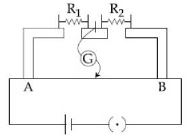
In the experimental setup of meter bridge shown in the figure, the null point is obtained at a distance of $40\,cm$ from $A$. If a $10\,\Omega $ resistor is connected in series with $R_1$, the null point shifts by $10\,cm$. The resistance that should be connected in parallel with $\left( {{R_1} + 10} \right)\,\Omega $ such that the null point shifts back to its initial position is .............. $\Omega$
JEE MAIN 2019, Diffcult
Download our app for free and get started
$\frac{R_{1}}{R_{2}}=\frac{2}{3}$ .....$(i)$
$\frac{R_{1}+10}{R_{2}}=1$
$\Rightarrow \quad R_{1}+10=R_{2}$ .....$(ii)$
$\frac{2 \mathrm{R}_{2}}{3}+10=\mathrm{R}_{2} \quad ; \quad 10=\frac{\mathrm{R}_{2}}{3}$
$\Rightarrow \quad \mathrm{R}_{2}=30\, \Omega \quad \& \quad \mathrm{R}_{1}=20\, \Omega$
$\frac{\frac{30 \times \mathrm{R}}{30+\mathrm{R}}}{30}=\frac{2}{3}$
$\mathrm{R}=60 \,\Omega$

Download our appand get started for free
Experience the future of education. Simply download our apps or reach out to us for more information. Let's shape the future of learning together!No signup needed.*
Similar Questions
- 1A heating element has a resistance of $100\,\Omega $ at room temperature. When it is connected to a supply of $220\,V,$ a steady current of $2\,A$ passes in it and temperature is $500\,^oC$ more than room temperature. What is the temperature coefficient resistance of the heating element?View Solution
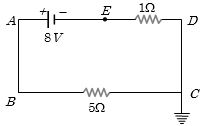
- 2In the given circuit, the potential of the point $E$ isView Solution
- 3In a hydrogen discharge tube it is observed that through a given cross-section $3.13 \times {10^{15}}$ electrons are moving from right to left and $3.12 \times {10^{15}}$ protons are moving from left to right. What is the electric current in the discharge tube and what is its directionView Solution
- 4In the following $'I'$ refers to current and other symbols have their usual meaning, Choose the option that corresponds to the dimensions of electrical conductivityView Solution
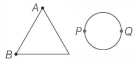
- 5A uniform metallic wire of length $L$ is mounted in two configurations. In configuration $1$ (triangle), it is an equilateral triangle and a voltage $V$ is applied to corners $A$ and $B$. In configuration $2$ (circle), it is bent in the form of a circle and the potential $V$ is applied at diametrically opposite points $P$ and $Q$. The ratio of the power dissipated in configuration $1$ to configuration $2$ isView Solution
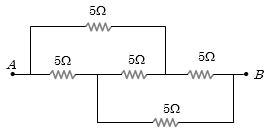
- 6Effective resistance between $A$ and $B$ is ........... $\Omega$View Solution
- 7A uniform metallic wire has a resistance of $18\,\Omega $ and is bent into an equilateral triangle. Then, the resistance between any two vertices of the triangle is .................. $\Omega$View Solution
- 8Consider the circuit shown below where all resistors are $1 \,k \Omega$. If a current of magnitude $1 \,mA$ flows through the resistor marked $X$, the potential difference measured between points $P$ and $Q$ are ..............$V$View Solution
- 9If a wire is stretched to make it $0.1 \%$ longer, its resistance willView Solution
- 10A metallic block has no potential difference applied across it, then the mean velocity of free electrons is $T$ = absolute temperature of the block)View Solution