In the figure, a ladder of mass $m$ is shown leaning against a wall. It is in static equilibrium making an angle $\theta$ with the horizontal floor. The coefficient of friction between the wall and the ladder is $\mu_1$ and that between the floor and the ladder is $\mu_2$. The normal reaction of the wall on the ladder is $N_1$ and that of the floor is $N_2$. If the ladder is about to slip, then
$Image$
$(A)$ $\mu_1=0 \mu_2 \neq 0$ and $N _2 \tan \theta=\frac{ mg }{2}$
$(B)$ $\mu_1 \neq 0 \mu_2=0$ and $N_1 \tan \theta=\frac{m g}{2}$
$(C)$ $\mu_1 \neq 0 \mu_2 \neq 0$ and $N _2 \tan \theta=\frac{ mg }{1+\mu_1 \mu_2}$
$(D)$ $\mu_1=0 \mu_2 \neq 0$ and $N _1 \tan \theta=\frac{ mg }{2}$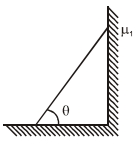
IIT 2014, Advanced
Download our app for free and get started
Since rod is about to slip so both friction will be limiting
$f _1=\mu_1 N _1 $
$f _2=\mu_2 N _2$
In option $(A)(D)$ $\mu_1=0$
Net torque about $A$ should be zero
$ mg \cos \theta \frac{\ell}{2}= N _1 \sin \theta \ell $
$\Rightarrow N _1=\frac{ mg \cot \theta}{2} $
$\Rightarrow N _1 \tan \theta=\frac{ mg }{2} $
$\text { and } N _2= mg $
$\text { (B) } \mu_2=0$
There is no force to balance $N _1$ so rod can not remain in equilibrium
$\text { (C) } \quad $ $N _1=\mu_2 N _2 $
$N _2+\mu_1 N _1= mg $
$N _2+\mu_1 \mu_2 N _2= mg $
$N _2=\frac{ mg }{1+\mu_1 \mu_2}$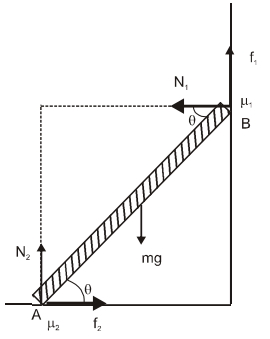

Download our appand get started for free
Experience the future of education. Simply download our apps or reach out to us for more information. Let's shape the future of learning together!No signup needed.*
Similar Questions
- 1In figure, two blocks $M$ and $m$ are tied together with an inextensible and light string. The mass $M$ is placed on a rough horizontal surface with coefficient of friction $\mu$ and the mass $m$ is hanging vertically against a smooth vertical wall. The pulley is frictionless. Choose the correct statement $(s)$View Solution

- 2A car is moving on a horizontal circular road of radius $0.1 \,km$ with constant speed. If coefficient of friction between tyres of car and road is $0.4$, then speed of car may be ......... $m / s$ $\left(g=10 \,m / s ^2\right)$View Solution
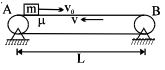
- 3With what minimum velocity should block be projected from left end $A$ towards end $B$ such that it reaches the other end $B$ of conveyer belt moving with constant velocity $v$. Friction coefficient between block and belt is $\mu$ .View Solution
- 4A block is placed on a rough horizontal plane. A time dependent horizontal force $F = Kt$ acts on the block. Here $K$ is a positive constant. Acceleration-time graph of the block isView Solution
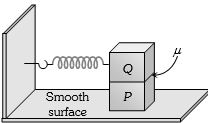
- 5$A$ block $P$ of mass m is placed on a frictionless horizontal surface. Another block Q of same mass is kept on $P$ and connected to the wall with the help of a spring of spring constant k as shown in the figure. ${\mu _s}$ is the coefficient of friction between$ P$ and $ Q$. The blocks move together performing SHM of amplitude $A$. The maximum value of the friction force between $P$ and $Q$ isView Solution
- 6If acceleration of $A$ is $2 \,m / s ^2$ which is smaller than acceleration of $B$ then the value of frictional force applied by $B$ on $A$ is ......... $N$View Solution
- 7Put a uniform meter scale horizontally on your extended index fingers with the left one at $0.00 cm$ and the right one at $90.00 cm$. When you attempt to move both the fingers slowly towards the center, initially only the left finger slips with respect to the scale and the right finger does not. After some distance, the left finger stops and the right one starts slipping. Then the right finger stops at a distance $x_R$ from the center ( $50.00 cm$ ) of the scale and the left one starts slipping again. This happens because of the difference in the frictional forces on the two fingers. If the coefficients of static and dynamic friction between the fingers and the scale are $0.40$ and $0.32$ , respectively, the value of $x_R($ in $cm )$ is. . . . . . .View Solution
- 8One end of string of length $l$ is connected to a particle of mass $'m'$ and the other end is connected to a small peg on a smooth horizontal table. If the particle moves in circle with speed $'v',$ the net force on the particle (directed towards centre) will be ($T$ represents the tension in the string)View Solution
- 9A car of mass $m$ is moving on a level circular track of radius $R.$ If $\mu_s $ represents the static friction between the road and tyres of the car, the maximum speed of the car in circular motion is given byView Solution
- 10A block of mass $m$ is placed on a surface with a vertical coss section given by $y = \frac{{{x^3}}}{6}$ . If the coefficient of friction is $0.5$, the maximum height above the ground at which the block can be placed without slipping isView Solution