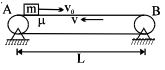
With what minimum velocity should block be projected from left end $A$ towards end $B$ such that it reaches the other end $B$ of conveyer belt moving with constant velocity $v$. Friction coefficient between block and belt is $\mu$ .
Medium
Download our app for free and get started
$a=\mu g$
$0^{2}=v_{0}^{2}-2 \mu g L$ or $v_{0}^{2}=2 \mu g L$
$\therefore V_{0}=\sqrt{2 \mu g L}$

Download our appand get started for free
Experience the future of education. Simply download our apps or reach out to us for more information. Let's shape the future of learning together!No signup needed.*
Similar Questions
- 1View SolutionA body is revolving with a constant speed along a circle. If its direction of motion is reversed but the speed remains the same, then which of the following statement is true
- 2......... $m/s^2$ is magnitude of acceleration of a block moving with speed $10\,m/s$ on a rough surface if coefficient of friction is $0.2$.View Solution
- 3$A$ block of mass $M$ is placed on $a$ horizontal surface and it is tied with an inextensible string to $a$ block of mass, as shown in figure. A block of mass $m_0$ is also placed on $M$ The minimum value of $\mu$ between the block $M$ and $m_0$ (taking horizontal surface frictionless) for which all the three blocks move together, isView Solution

- 4A fireman of mass $60\, kg$ slides down a pole. He is pressing the pole with a force of $600 \,N$. The coefficient of friction between the hands and the pole is $0.5$, with what acceleration will the fireman slide down ........ $m/s^2$View Solution
- 5A $2 \mathrm{~kg}$ brick begins to slide over a surface which is inclined at an angle of $45^{\circ}$ with respect to horizontal axis. The co-efficient of static friction between their surfaces is:View Solution
- 6A car of mass $m$ is moving on a level circular track of radius $R.$ If $\mu_s $ represents the static friction between the road and tyres of the car, the maximum speed of the car in circular motion is given byView Solution
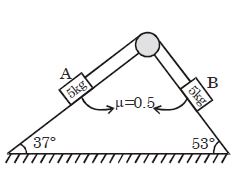
- 7In the shown arrangement if $f_A\,,\, f_B$ and $T$ be the frictional forces on $A$ Block, $B$ Block and tension in the string respectively, then their values areView Solution
- 8View SolutionMaximum force of friction is called
- 9A car is moving with a constant speed of $20\,m / s$ in a circular horizontal track of radius $40\,m$. A bob is suspended from the roof of the car by a massless string. The angle made by the string with the vertical will be : (Take $g =10$ $\left.m / s ^2\right)$View Solution
- 10A block of mass $m$ lying on a rough horizontal plane is acted upon by a horizontal force $P$ and another force $Q$ inclined at an angle $\theta $ to the vertical. The block will remain in equilibrium, if the coefficient of friction between it and the surface isView Solution