Question
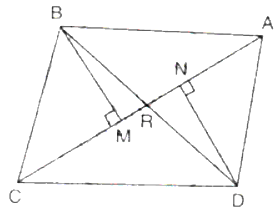
In the figure, $BM$ and $DN$ are both perpendiculars on $AC$ and $BM = DN.$ Prove that $AC$ bisects $BD.$
​​​​​​​

Answer

In $\triangle BMR$ and $DNR$
$BM = DN$
$\angle BMR = \angle DNR = 90^\circ $
$\angle BRM = \angle DRN = ...($vertically opposite angles$)$
Hence, $\angle MBR = \angle NDR ...($sum of angles of a triangle $= 180^\circ )$
$\triangle BMR ≅ \triangle DNR ...(\text{ASR}$ criteria$)$
Therefore, $BR = DR$
So, $AC$ bisects $BD.$

Need a full question paper?

Generate a complete, print-ready paper with questions like this in minutes — across 16+ boards, with answer keys.
Start Generating Free

Similar questions

Is it possible to have a polygon whose sum of interior angles is $780^\circ ?$
If an angle of a parallelogram is two-third of its adjacent angle, find the angles of the parallelogram.
Each of the equal sides of an isosceles triangle is 2 cm more than its height and the base of the triangle is 12 cm. Find the area of the triangle.
Find the area of a circle inscribed in an equilateral triangle of side 18 cm. [Take $\pi$ = 3.14 ]
The perimeter of a rectangular board is $70 \ cm$. Taking its length as $x \ cm$, find its width in terms of $x.$
If the area of the rectangular board is $300 \ cm^2;$ find its dimensions.
Solve the equations:
$\frac{22}{x+y}+\frac{15}{x-y}=5, \frac{55}{x+y}+\frac{40}{x-y}=13$
A copper wire when bent in the form of a square encloses an area of $272.25 cm ^2$ If the same wire is bent into the form of a circle, what will be the area enclosed by the wire?
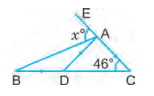
In the given figure, side CA of $\triangle ABC$ has been produced to E . If $AC = AD = BD ; \angle ACD =46^{\circ}$ and $\angle BAE =x^{\circ}$; find the value of $x$.
Image
If $2^x=3^y=12^z$, show that $: \frac{1}{z}=\frac{1}{y}+\frac{2}{x}$.
[ Hint. Let $2^x=3^y=12^z=k$. Then, $2=k^{\frac{1}{x}}, 3=k^{\frac{1}{y}}$ and $12=k^{\frac{1}{z}}$.
Now, $\left.12=2^2 \times 3 \Rightarrow k^{\frac{1}{2}}=\left(k^{\frac{1}{x}}\right)^2 \times\left(k^{\frac{1}{y}}\right) \Rightarrow k^{\frac{1}{2}}=k^{\left(\frac{2}{x}+\frac{1}{y}\right)}\right]$
In a trapezium the parallel sides are $12\ cm$ and $8\ cm.$ If the distance between them is $6\ cm,$ find the area of the trapezium.