Question
✓
Answer
Need a full question paper?
Generate a complete, print-ready paper with questions like this in minutes — across 16+ boards, with answer keys.
Explore more
More "3 Marks Question" from Semiconductor Electronics: Materials, Devices and Simple Circuits→Semiconductor Electronics: Materials, Devices and Simple Circuits — all question types→Physics STD 12 Science question papers→Gujarat Board STD 12 Science question papers→Gujarat Board question paper generator→
Similar questions
A rectangular wire loop of sides 8cm and 2cm with a small cut is moving out of a region of uniform magnetic field of magnitude 0.3T directed normal to the loop. What is the emf developed across the cut if the velocity of the loop is $1\ cms^{–1}$ in a direction normal to the:
→- Longer side,
- shorter side of the loop?
A parallel beam of light of wavelength 600nm is incident normally on a slit of width ‘a’. If the distance between the slit and the screen is 0.8 and the distance of 2nd order maximum from the centre of the screen is 1.5mm, calculate the width of the slit.
Consider a variation of the previous problem (figure). Suppose the circular loop lies in a vertical plane. The rod has a mass m. The rod and the loop have negligible resistances but the wire connecting O and C has a resistance R. The rod is made to rotate with a uniform angular velocity $\omega$ in the clockwise direction by applying a force at the midpoint of OA in a direction perpendicular to it. Find the magnitude of this force when the rod makes an angle $\theta$ with the vertical.
→ An electric bulb, when connected across a power supply of 220V, consumes a power of 60W. If the supply drops to 180V, what will be the power consumed? If the supply is suddenly increased to 240V, what will be the power consumed?
Three point charges +Q, -2Q and -3Q are placed at the vertices of an equilateral triangle ABC of side l.
If these charges are displaced to the mid points $A_1, B_1$ and $C_1$ respectively, calculate the amount of work done in shifting the charges to the new locations.
→If these charges are displaced to the mid points $A_1, B_1$ and $C_1$ respectively, calculate the amount of work done in shifting the charges to the new locations.
A particular particle created in a nuclear reactor leaves a 1cm track before decaying. Assuming that the particle moved at 0.995c, calculate the life of the particle:
- In the lab frame and.
- In the frame of the particle.
Calculate the energy that can be obtained from 1kg of water through the fusion reaction
$^2H + ^2H → ^3H + p.$
Assume that $1.5 \times 10^{-2}%$ of natural water is heavy water $D_2O$ (by number of molecules) and all the deuterium is used for fusion.
→$^2H + ^2H → ^3H + p.$
Assume that $1.5 \times 10^{-2}%$ of natural water is heavy water $D_2O$ (by number of molecules) and all the deuterium is used for fusion.
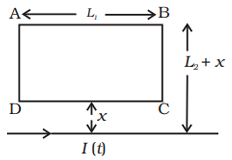
A rectangular loop of wire $\text{ABCD}$ is kept close to an infinitely long wire carrying a current $I ( t )= l _0\left(1-\frac{t}{T}\right)$ for $0 \leq t \leq T$ and $I (0)=0$ for $t > T ($Figure$)$. Find the total charge passing through a given point in the loop, in time $T$ . The resistance of the loop is $R$.
→Sketch a graph between frequency of incident radiations and stopping potential for a given photosensitive material. What information can be obtained from the value of the intercept on the potential axis? A source of light of frequency greater than the threshold frequency is placed at a distance of 1 m from the cathode of a photo-cell. The stopping potential is found to be V. If the distance of the light source from the cathode is reduced, explain giving reasons, what change will you observe in the.
- photoelectric current,
- stopping potential.
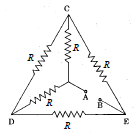
- Calculate the equivalent resistance of the given electrical network between points A and B.
- Also calculate the current through CD and ACB, if a 10 V d.c. source is connected between A and B, and the value of R is assumed as 2 Ω.