Question
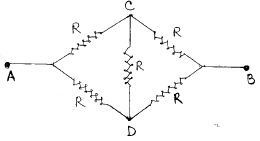
  1. Calculate the equivalent resistance of the given electrical network between points A and B.
  2. Also calculate the current through CD and ACB, if a 10 V d.c. source is connected between A and B, and the value of R is assumed as 2 Ω.

Answer

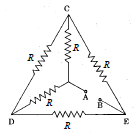
  1. Circuit:


Calculation of $\frac{1}{\text{R}_{AB}} = \frac{1}{2\text{R}} + \frac{1}{2\text{R}}\text{ or }\text{R}_{AB} = \text{R}$
  1. Current through CD = 0
Current through ACB = $\frac{10\text{V}}{4\Omega} = 2.5\text{A}.$

Need a full question paper?

Generate a complete, print-ready paper with questions like this in minutes — across 16+ boards, with answer keys.
Start Generating Free

Similar questions

Calculate the energy released if $U^{238}$ -nucleus emits an $\alpha-$particle.
OR
Calculate the energy released in MeV in the following nuclear reaction.
$^{238}_{92}\text{U}\ \rightarrow\ ^{234}_{90}\text{Th}\ +\ ^4_2\text{He}\ +\ \text{Q}$
Given Atomic mass of $^{238}U = 238.05079u$
Atomic mass of $^{234}Th = 234.04363u$
Atomic mass of alpha particle $= 4.00260u$
$1u = 931.5MeV/ c^2$
IS the decay spontaneous? Give reason.
  1. Write the expression for the force $ \overrightarrow{\text{F}}$ acting on a particle of mass m and charge q moving with velocity $ \overrightarrow{\text{V}} $ in a magnetic field $ \overrightarrow{\text{B}}$ Under what conditions will it move in (i) a circular path and (ii) a helical path?
  2. Show that the kinetic energy of the particle moving in a magnetic field remains constant.
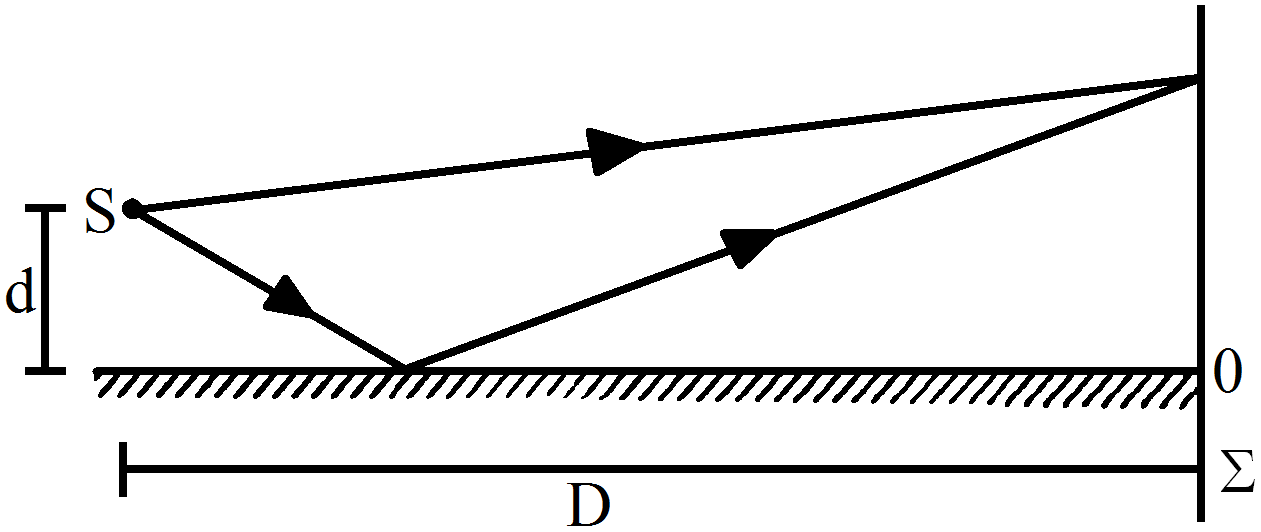
A narrow slit S transmitting light of wavelength $\lambda$ is placed a distance d above a large plane mirror as shown in figure (17-E1). The light coming directly from the slit and that coming after the reflection interfere at a screen $\sum$ placed at a distance D from the slit.
  1. What will be the intensity at a point just above the mirror, i.e., just above O?
  2. At what distance from 0 does the first maximum occur?
A coil of inductance 5.0mH and negligible resistance is connected to the oscillator of the previous problem. Find the peak currents in the circuit for $\omega=100\text{s}^{-1},500\text{s}^{-1},1000\text{s}^{-1}.$
Consider two pairs of neutrons. In each pair, the separation between the neutrons is the same. Can the force between the neutrons have different magnitudes for the two pairs?
Write symbolically the nuclear $\beta^{+}$decay process of $^{11}_{6}\text{C}$ . Is the decayed product X an isotope or isobar of $^{11}_{6}\text{C}$?
Given the mass values m $(^{11}_{6}\text{C})$ = 11·011434 u and m (X) = 11·009305 u. Estimate the Q-value in this process.
Consider the circular motion of the earth around the sun. Which of the following statements is more appropriate?
  1. Gravitational attraction of the sun on the earth is equal to the centripetal force.
  2. Gravitational attraction of the sun on the earth is the centripetal force.
What is the energy of a hydrogen atom in the first excited state if the potential energy is taken to be zero in the ground state?
The number density of free electrons in a copper conductor estimated in Example 3.1 is $8.5 \times 10^{28}m^{-3}.$ How long does an electron take to drift from one end of a wire 3.0 m long to its other end? The area of cross-section of the wire is $2.0 \times 10^{-6} m^2$ and it is carrying a current of 3.0 A.
A 5.0 diopter lens forms a virtual image which is 4 times the object placed perpendicularly on the principal axis of the lens. Find the distance of the object from the lens.