MCQ
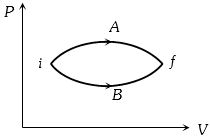
In the figure given two processes $A$ and $B$ are shown by which a thermo-dynamical system goes from initial to final state $F.$ If $\Delta {Q_A}$ and $\Delta {Q_B}$ are respectively the heats supplied to the systems then
  • A
    $\Delta {Q_A} = \Delta {Q_B}$
  • B
    $\Delta {Q_A} \ge \Delta {Q_B}$
  • C
    $\Delta {Q_A} < \Delta {Q_B}$
  • $\Delta {Q_A} > \Delta {Q_B}$

Answer

Correct option: D.
$\Delta {Q_A} > \Delta {Q_B}$
d
(d) $\Delta Q = \Delta U + \Delta W;$       $\Delta  U$ does not depend upon path.

 $\because  \Delta {W_A} > \Delta {W_B}$ ==> $\Delta {Q_A} > \Delta {Q_B}$

Need a full question paper?

Generate a complete, print-ready paper with questions like this in minutes — across 16+ boards, with answer keys.

Start Generating Free

Similar questions

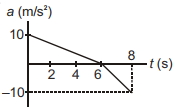
The acceleration-time graph for a particle moving along $x$-axis is shown in figure. If the initial velocity of particle is $-5 \,m / s$, the velocity at $t=8 \,s$ is ....... $m / s$
If the velocity of light $c$, universal gravitational constant $G$ and planck's constant $h$ are chosen as fundamental quantities. The dimensions of mass in the new system is
A combination of two thin convex lenses of focal length $0.3 m$ and $0.1 m$ will have minimum spherical and chromatic aberrations if the distance between them is......$m$
A $16\, \Omega$ wire is bend to form a square loop. A $9 \,{V}$ supply having internal resistance of $1 \,\Omega$ is connected across one of its sides. The potential drop across the diagonals of the square loop is $.......\,\times 10^{-1} \,{V}$
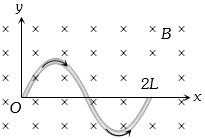
A wire carrying a current $i$ is placed in a uniform magnetic field in the form of the curve $y = a\sin \,\left( {\frac{{\pi x}}{L}} \right)\,0 \le x \le 2L.$ The force acting on the wire is
A cell of internal resistance $3\, ohm$ and $emf$ $10\, volt$ is connected to a uniform wire of length $500 \,cm$ and resistance $3\, ohm$. The potential gradient in the wire is .............. $mV/cm$
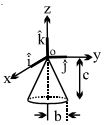
$A$ solid cone hangs from $a$ frictionless pivot at the origin $O$, as shown. If $\hat i$ , $\hat j$ and $\hat k$ are unit vectors, and $a, b$, and $c$ are positive constants, which of the following forces $F$ applied to the rim of the cone at a point $P$ results in a torque $\tau$ on the cone with a negative component $\tau_Z$ 
In comparison to a half wave rectifier, the full wave rectifier gives lower
A wave is represented by the equation$y = 7\sin \left( {7\pi t - 0.04\,x\pi + \frac{\pi }{3}} \right)$ $x$ is in metres and $ t$ is in seconds. The speed of the wave is
Current in a circuit falls from $5.0\, A$ to $0\, A$ in $0.1\, s$. If an average $emf$ of $200\, V$ is induced, estimate the self-inductance of the circuit.....$H$