A cell of internal resistance $3\, ohm$ and $emf$ $10\, volt$ is connected to a uniform wire of length $500 \,cm$ and resistance $3\, ohm$. The potential gradient in the wire is .............. $mV/cm$
Medium


Download our appand get started for free
Experience the future of education. Simply download our apps or reach out to us for more information. Let's shape the future of learning together!No signup needed.*
Similar Questions
- 1View SolutionA wire of non-uniform cross-section is carrying a steady current. Along the wire
- 2View SolutionThe internal resistance of a cell is the resistance of
- 3A heater draws a current of $2\,A$ when connected to a $250\,V$ source. The rate of energy dissipation is ............. $W$View Solution
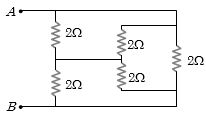
- 4Find the equivalent resistance across $AB$ .............. $\Omega$View Solution
- 5The resistance of hot tungsten filament is about $10$ times the cold resistance. What will be the resistance of $100\, W$ and $200\, V$ lamp when not in use ............. $\Omega $View Solution
- 6A resistor develops $500\, J$ of thermal energy in $20 \,s$ when a current of $1.5\, A$ is passed through it. If the current is increased from $1.5 \,A$ to $3\, A$ what will be the energy (in $J$) developed in $20\, s$.View Solution
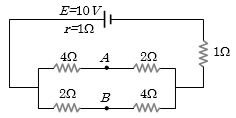
- 7In the circuit shown below, the cell has an $e.m.f.$ of $10\,V$ and internal resistance of $1\, ohm$. The other resistances are shown in the figure. The potential difference ${V_A} - {V_B}$ is ................ $V$View Solution
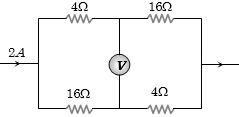
- 8In the circuit shown below, The reading of the voltmeter $V$ is ...........View Solution
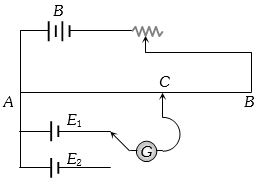
- 9The circuit shown here is used to compare the $e.m.f.$ of two cells ${E_1}$ and ${E_2}({E_1} > {E_2})$. The null point is at $C$ when the galvanometer is connected to ${E_1}$. When the galvanometer is connected to ${E_2}$, the null point will beView Solution
- 10If you are provided three resistances $2 \,\Omega$, $3 \,\Omega$ and $6 \,\Omega$. How will you connect them so as to obtain the equivalent resistance of $4 \,\Omega$View Solution