MCQ
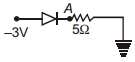
In the figure given, voltage of point $A$ is ............ $V$
  • $0$
  • B
    $-3$
  • C
    $-2.3$
  • D
    $-2.7$

Answer

Correct option: A.
$0$
a
(a)

The diode is reverse biased.

Since no current flows in circuit no voltage drop occurs in resistor.

Need a full question paper?

Generate a complete, print-ready paper with questions like this in minutes — across 16+ boards, with answer keys.
Start Generating Free

Similar questions

If the net electric flux through a closed surface is zero, then we can infer:
In hydrogen spectrum the wavelength of $H _\alpha$ line is 656 nm whereas in the spectrum of a distant galaxy, $H _\alpha$ line wavelength is 706 nm . Estimated speed of the galaxy with respect to earth is
A layer of oil $3\,cm$ thick is floating on a layer of coloured water $5\,cm$ thick. Refractive index of coloured water is $5/3$ and the apparent depth of the two liquids  appears to be $36/7\,cm.$ Find the refractive index of oil.
Two charges each of 1 coulomb are at a distance 1 km apart, the force between them is
Which of the following best describe the electromagnetic induction?
Electric lines of force about a negative point charge are:
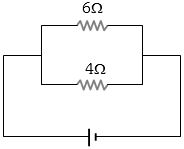
In the circuit shown below, the power developed in the $6$ $\Omega$ resistor is $6\, watt$. The power in watts developed in the $4$ $ \Omega$ resistor is
The radii of the inner and outer spheres of a condenser are $9\,cm$ and $10\,cm$ respectively. If the dielectric constant of the medium between the two spheres is $6$ and charge on the inner sphere is $18 \times {10^{ - 9}}\;coulomb$, then the potential of inner sphere will be, if the outer sphere is earthed........$volts$
Which of following can induce the maximum induced voltage?
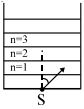
$A$ point source $S$ is placed at the bottom of different layers as shown in the figure. The refractive index of bottom most layer is $\mu_0$. The refractive index of any other upper layer is $\mu (n) = \mu_0$ $-\frac{{{\mu _0}}}{{4n - 18}}$  where $n = 1, 2........$, $A$ ray of light with angle i slightly more than $30^o$ starts from the source $S$. Total internal reflection takes place at the upper surface of a layer having $n$ equal to