MCQ
Which of following can induce the maximum induced voltage?
- A$1$ amp $dc.$
- B$1$ amp $1 Hz.$
- ✓$1$ amp $100 Hz.$
- D$20$ amp $dc.$
If we apply a high$-$frequency supply of the same peak voltage to the coil, the current still is being delayed by $90o$ but the time it requires to reach its maximum value has been reduced due to the increase in frequency. Because the frequency is inversely proportional to time $(T).$ Hence, the rate of change of the flux within the coil has also increased due to the increase in frequency. Hence, the induced $\text{EMF}$ is maximum in case of $1$ amp $100 \ Hz$ supply source in the coil.
Generate a complete, print-ready paper with questions like this in minutes — across 16+ boards, with answer keys.
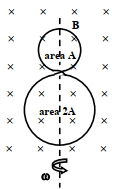
axis with a constant angular velocity $\omega$ in the magnetic field. Which of the following options is/are correct?
(image)
[$A$] The rate of change of the flux is maximum when the plane of the loops is perpendicular to plane of the paper.
[$B$] The net emf induced due to both the loops is proportional to $\cos \omega t$.
[$C$] The emf induced in the loop is proportional to the sum of the areas of the two loops.
[$D$] The amplitude of the maximum net emf induced due to both the loops is equal to the amplitude of maximum emf induced in the smaller loop alone.