MCQ
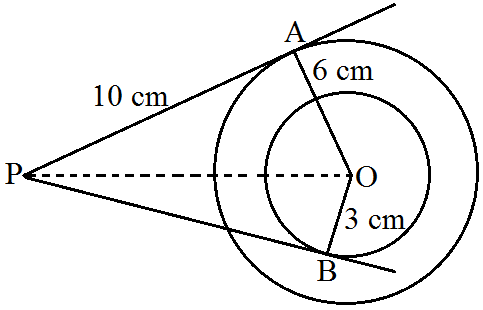
In the figure, if $AP = 10\ cm,$ then $BP =$​​​​​​​
  • A
    $\sqrt{91}\text{ cm}$
  • $\sqrt{127}\text{ cm}$
  • C
    $\sqrt{119}\text{ cm}$
  • D
    $\sqrt{109}\text{ cm}$ 

Answer

Correct option: B.
$\sqrt{127}\text{ cm}$

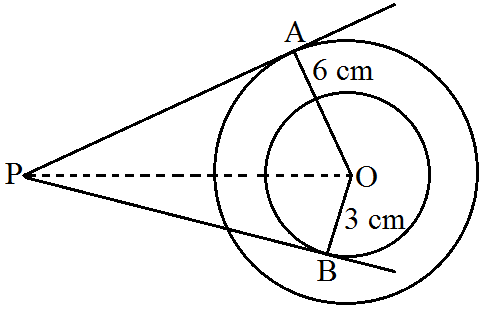
In the figure,
$OA = 6\ cm, OB = 3\ cm$ and $AP = 10\ cm$
$OA$ is radius and $AP$ is the tangent
$OA \perp AP$
Now in right $\triangle\text{OAP}$
$O P^2=A P^2+O A^2=(10)^2+(6)^2$
$=100+36=136$
Similarly $BP$ is tangent and $OB$ is radius
$ O P^2=O B^2+B P^2 $
$ 136=(3)^2+B P^2$
$136=9+B P^2$
$\Rightarrow BP^2= 136 – 9 = 127$
$BP = \sqrt{127}\text{ cm}$

Need a full question paper?

Generate a complete, print-ready paper with questions like this in minutes — across 16+ boards, with answer keys.
Start Generating Free

Similar questions

The area of the triangle formed by the line $\frac{\text{x}}{\text{a}}+\frac{\text{y}}{\text{b}}=1$ with the coordinate axes is :
A man is standing on the deck of a ship, which is 10 m above water level. He observes the angle of elevation of the top of a hill as $45^{\circ}$ and the angle of depression of the base of the hill as $30^{\circ}$. Calculate the distance of the hill from the ship and the height of the hill. (use $\sqrt{3}=1.732$ )
If every term of the statistical data consisting of n terms is decreased by 2, then the mean of the data:
The algebraic sum of the deviations of a frequency distribution from its mean is :
A system of linear equations is said to be consistent, if it has :
A ladder $15 m$ long just reaches the top of a vertical wall. If the ladder makes an angle of $60^{\circ}$ with the wall then height of the wall is
Two lines are given to be parallel. The equation of one of these lines is $5 x-3 y=2$. The equation of second line can be
A reservoir is in the shape of a frustum of a right circular cone. It is $8\ m$ across at the top and 4m across at the bottom. If it is $6\ m$ deep, then its capacity is :
In $\triangle\text{ABC}$ and $\triangle\text{DEF},$ we have $\frac{\text{AB}}{\text{DE}}=\frac{\text{BC}}{\text{EF}}=\frac{\text{AC}}{\text{DF}}=\frac{5}{7},$ then $\text{ar}(\triangle\text{ABC}):\text{ar}(\triangle\text{DEF})=?$
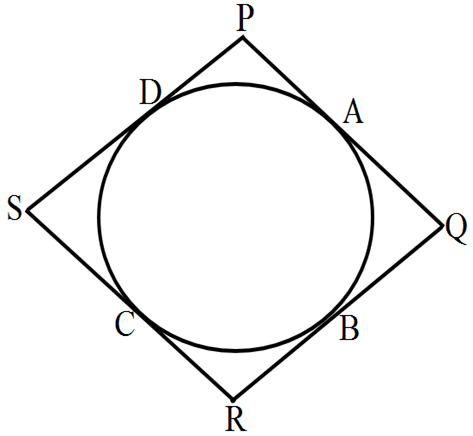
Quadrilateral $\text{PQRS}$ circumscribes a circle as shown in the figure. The side of the quadrilateral which is equal to $PD + QB$ is :