Question types

Circles question types

268 questions across 9 question groups — pick any mix to generate a Maths paper with step-by-step answer keys.

268
Questions
9
Question groups
5
Question types
Sample Questions

Circles questions

One sample from each question group in this chapter. Select any group above to see the full set with answer keys.

In a right triangle $\text{ABC},$ right $-$ angled at $B, BC = 12\ cm$ and $AB = 5 \ cm.$ The radius of the circle inscribed in the triangle $($in $\ cm)$ is :
  • A
    $4$
  • B
    $3$
  • $2$
  • D
    $1$

Answer: C.

View full solution
Two circles touch each other externally at $P. AB$ is a common tangent to the circles touching them at $A$ and $B$. The value of $\angle\text{APB}$ is :
  • A
    $30^{\circ}$
  • B
    $45^{\circ}$
  • C
    $60^{\circ}$
  • $90^{\circ}$

Answer: D.

View full solution
In a right triangle $\text{ABC},$ right $-$ angled at $B, BC = 12\ cm$ and $AB = 5\ cm.$ The radius of the circle inscribed in the triangle $($in $\ cm)$ is :
  • A
    $4$
  • B
    $3$
  • $2$
  • D
    $1$

Answer: C.

View full solution
From a point $Q, 13\ cm$ away from the centre of a circle, the length of tangent $PQ$ to the circle is $12\ cm$. The radius of the circle $($in $\ cm)$ is :
  • A
    $25$
  • B
    $\sqrt{313}$
  • $5$
  • D
    $1$

Answer: C.

View full solution
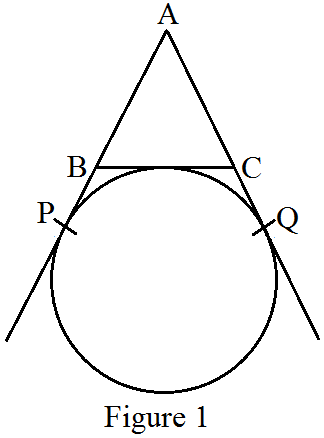
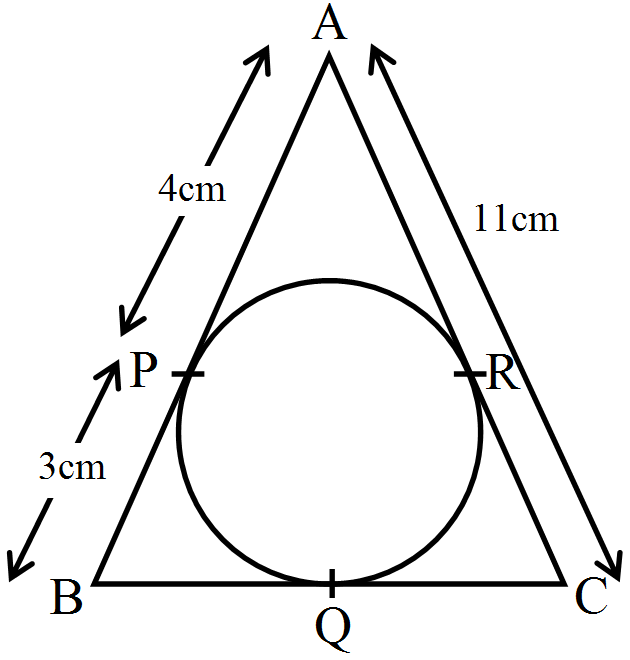
In Figure $1, AP, AQ$ and $BC$ are tangents to the circle. If $AB = 5\ cm, AC = 6\ cm$ and $BC = 4\ cm,$ then the length of $AP\ ($in $\ cm)$ is :​​​​​​​
  • $7.5$
  • B
    $15$
  • C
    $10$
  • D
    $9$

Answer: A.

View full solution
Directions : In the following questions, a statement of assertion $(A)$ is followed by a statement of reason $(R).$ Mark the correct choice as:
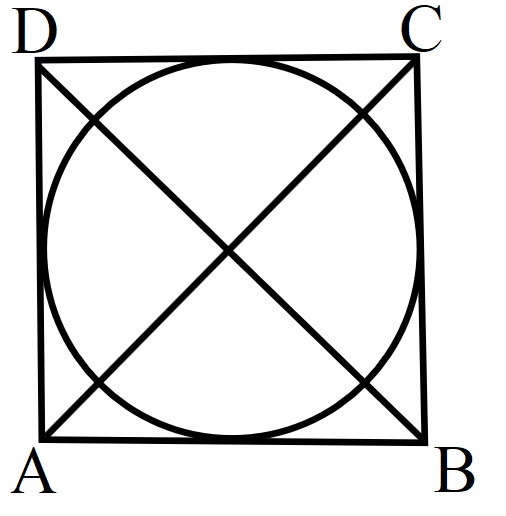
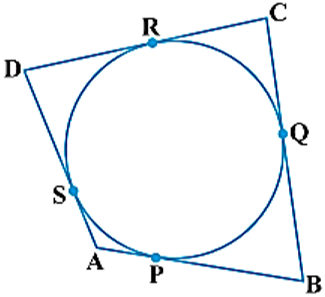
Assertion : In the given figure, all the sides of a quadrilateral $\text{ABCD}$ touch a circle with centre $O.$ Then, $\angle\text{AOB}+\angle\text{COD}=180^\circ$
Reason : The opposite sides of a quadrilateral circumscribing a circle does not subtend supplementary angles at the centre of the circle.
  • A
    Assertion and Reason both are correct statements and Reason is the correct explanation of Assertion.
  • B
    Assertion and Reason both are correct statements but Reason is not the correct explanation of Assertion.
  • Assertion is correct statement but Reason is wrong statement.
  • D
    Assertion is wrong statement but Reason is correct statement.

Answer: C.

View full solution
Directions : In the following questions, a statement of assertion $(A)$ is followed by a statement of reason $(R).$ Mark the correct choice as:
Assertion : At a point $P$ of a circle with centre $O$ and radius $12\ cm,$ a tangent $PQ$ of length $16\ cm$ is drawn.Then $, OQ = 20\ cm.$
Reason : The tangent at any point of a circle is perpendicular to the radius through the point of contact.
  • Assertion and Reason both are correct statements and Reason is the correct explanation of Assertion.
  • B
    Assertion and Reason both are correct statements but Reason is not the correct explanation of Assertion.
  • C
    Assertion is correct statement but Reason is wrong statement.
  • D
    Assertion is wrong statement but Reason is correct statement.

Answer: A.

View full solution
Directions : In the following questions, a statement of assertion $(A)$ is followed by a statement of reason $(R).$ Mark the correct choice as:
Assertion : If $\text{TP}$ and $\text{TQ}$ are the two tangents to a circle with centre $\text{O}$ so that $\angle\text{POQ} = 123^\circ$, then $\angle\text{PTQ} = 57^\circ$
Reason : The tangent at any point of a circle is perpendicular to the radius through the point of contact.
  • Assertion and Reason both are correct statements and Reason is the correct explanation of Assertion.
  • B
    Assertion and Reason both are correct statements but Reason is not the correct explanation of Assertion.
  • C
    Assertion is correct statement but Reason is wrong statement.
  • D
    Assertion is wrong statement but Reason is correct statement.

Answer: A.

View full solution
Directions : In the following questions, a statement of assertion $(A)$ is followed by a statement of reason $(R)$. Mark the correct choice as :
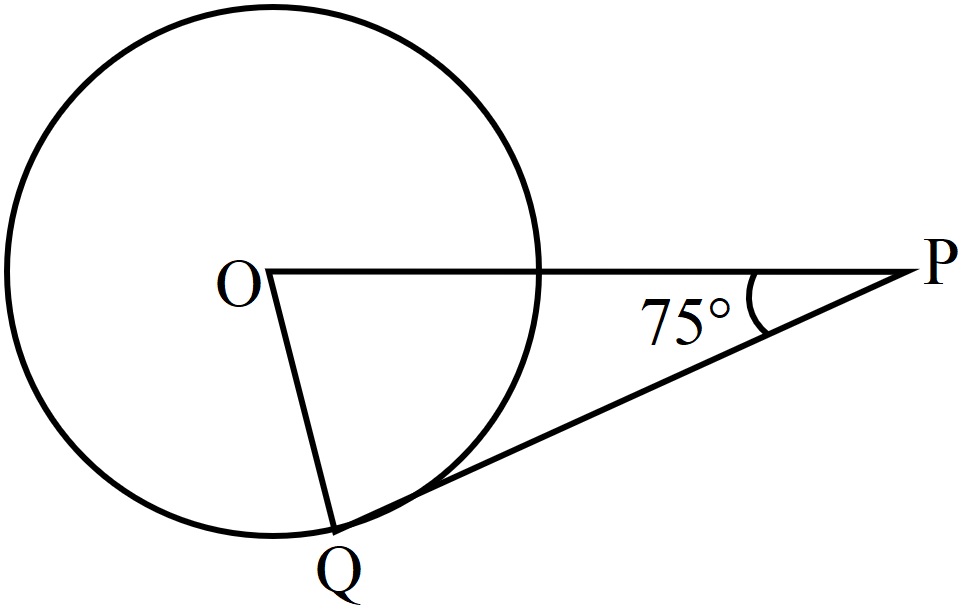
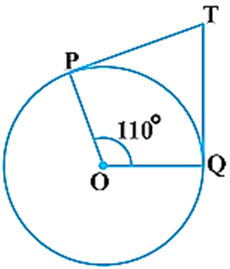
Assertion : In the given figure, if $PQ$ is a tangent to the circle with centre $O,$ then the value of $\angle\text{POQ}$ is $25^\circ$
Reason : If two tangents are drawn to a circle from an external point, then they subtend equal angles at the centre.
  • A
    Assertion and Reason both are correct statements and Reason is the correct explanation of Assertion.
  • B
    Assertion and Reason both are correct statements but Reason is not the correct explanation of Assertion.
  • C
    Assertion is correct statement but Reason is wrong statement.
  • Assertion is wrong statement but Reason is correct statement.

Answer: D.

View full solution
Directions : In the following questions, a statement of assertion $(A)$ is followed by a statement of reason $(R).$ Mark the correct choice as:
Assertion : The secant of circle is perpendicular to the radius of the circle.
Reason : A line that intersects the given circle in two points is called a secant.
  • A
    Assertion and Reason both are correct statements and Reason is the correct explanation of Assertion.
  • B
    Assertion and Reason both are correct statements but Reason is not the correct explanation of Assertion.
  • C
    Assertion is correct statement but Reason is wrong statement.
  • Assertion is wrong statement but Reason is correct statement.

Answer: D.

View full solution
Write ‘True’ or ‘False’ and justify your answer.
If angle between two tangents drawn from a point P to a circle of radius a and centre O is 90°, then $\text{OP}=\text{a}\sqrt{2}.$
View full solution
Write ‘True’ or ‘False’ and justify your answer.
The tangent to the circumcircle of an isosceles triangle$\triangle\text{ABC}$ at A, in which AB = AC, is parallel to BC.
View full solution
Write ‘True’ or ‘False’ and justify your answer.
AB is a diameter of a circle and AC is its chord such that $\angle\text{BAC}=30^\circ.$ If the tangent at C intersects AB extended at D, then BC = BD.
View full solution
Q 293 Marks Question3 Marks
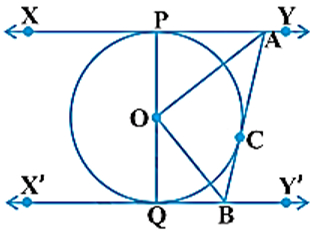
In Figure, $XY$ and $X'Y$' are two parallel tangents to a circle with centre $O$ and another tangent $AB$ with point of contact $C$ intersects $XY$ at A and $X'Y$' at $B$. Prove that $\angle A O B = 90^\circ.$
Image
View full solution
Q 323 Marks Question3 Marks
Prove that the angle between the two tangents drawn from an external point to a circle is supplementary to the angle subtended by the line-segment joining the points of contact at the centre.
View full solution
In Figure, XY and X'Y' are two parallel tangents to a circle with centre O and another tangent AB with point of contact C intersects XY at A and X'Y' at B. Prove that $\angle A O B$ = 90°.

View full solution
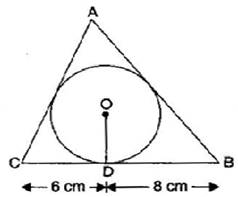
A triangle ABC is drawn to circumscribe a circle of radius 4 cm such that the segments BD and DC into which BC is divided by the point of contact D are of lengths 8 cm and 6 cm respectively (see figure). Find the sides AB and AC.
View full solution

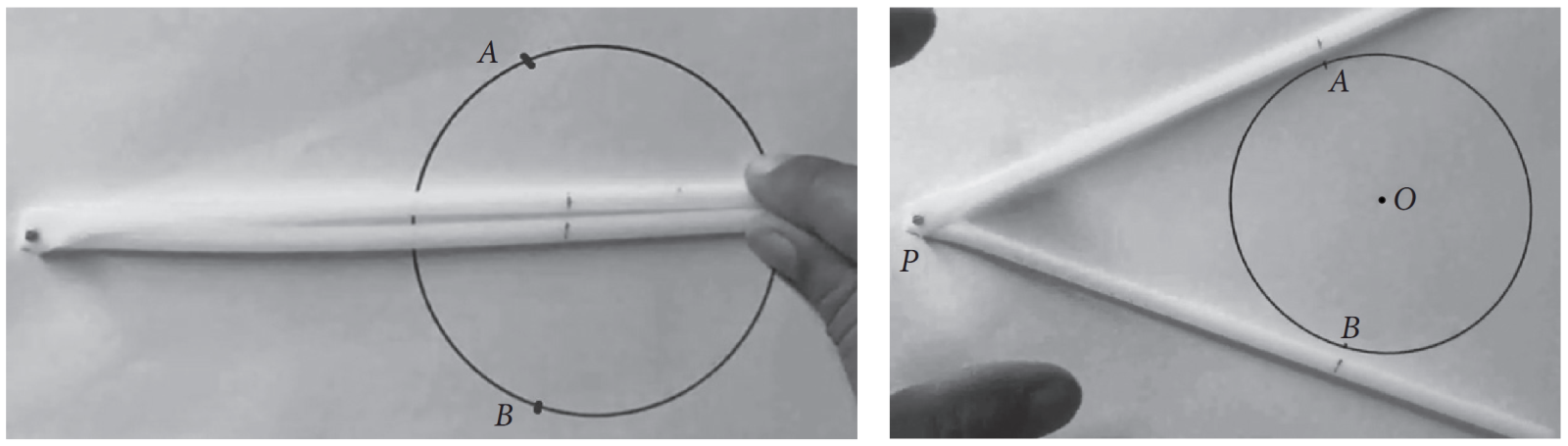
Prem did an activity on tangents drawn to a circle from an external point using 2 straws and a nail for maths project as shown in figure.

Based on the above information, answer the following questions.
  1. Number of tangents that can be drawn to a circle from an external point is:
  2. On the basis of which of the following congruency criterion, $\triangle\text{OAP}\cong\triangle\text{OBP}?$
  3. $\text{If }\angle\text{AOB}=150^\circ,\text{then }\angle\text{APB}=$
    Or
    $\text{If }\angle\text{APB}=40^\circ,\text{then }\angle\text{BAO}=$
View full solution

Following are questions of section-A in assessment test on circle that Eswar attend last month in school. He scored 5 out of 5 in this section. Answer the questions and check your score if I mark is allotted to each question.
  1. A parallelogram circumscribing a circle is called a:
  2. Is PQ a tangent to both the circles ?
  3. Number of tangents that can be drawn to a circle from a point inside it, is:
    Or
    If l is a tangent to the circle with center O and line m is passing through O intersects the tangent l at point of contact, determine the answer:
View full solution

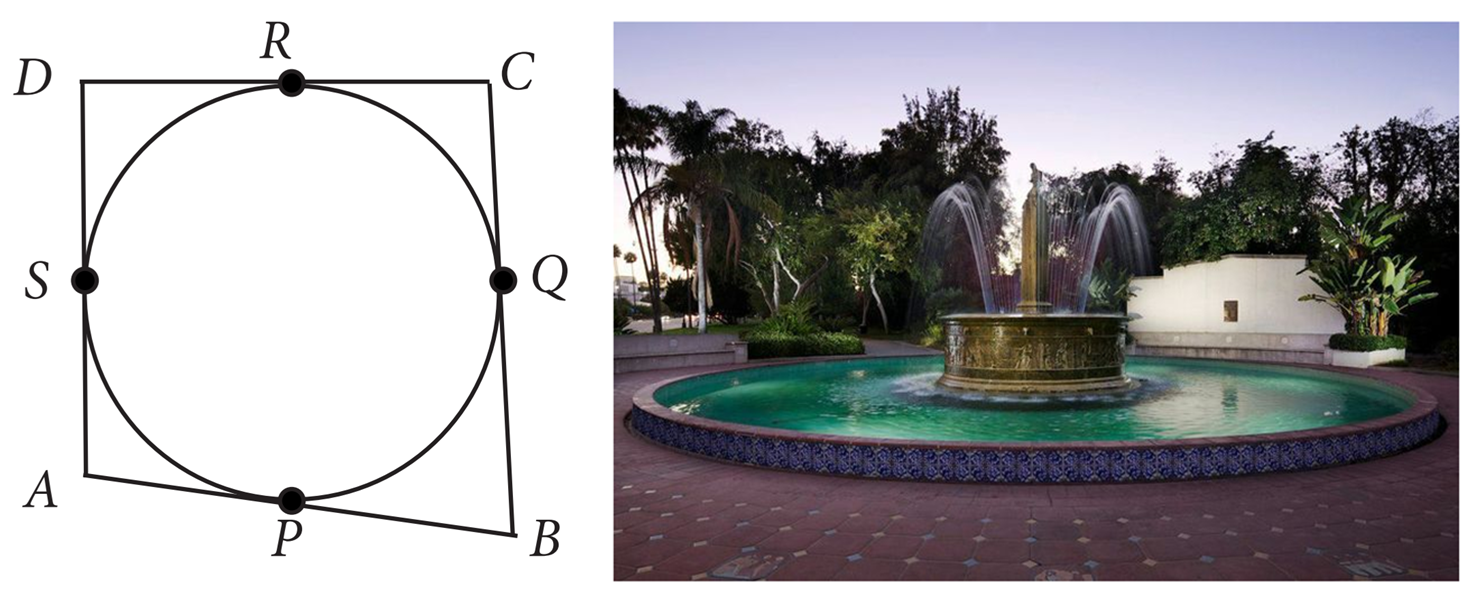
In a park, four poles are standing at positions A, B, C and D around the fountain such that the cloth joining the poles AB, BC, CD and DA touches the fountain at P, Q, R and S respectively as shown in the figure.

Based on the above information, answer the following questions.
  1. If O is the centre of the circular fountain, then $\angle\text{OSA}=$
  2. Which of the following is correct?
  3. If DR = 7cm and AD= 11cm, then AP =
    Or
    If O is the centre of the fountain, with $\angle\text{QCS}=60^\circ, \text{then }\angle\text{QOS}=$
View full solution

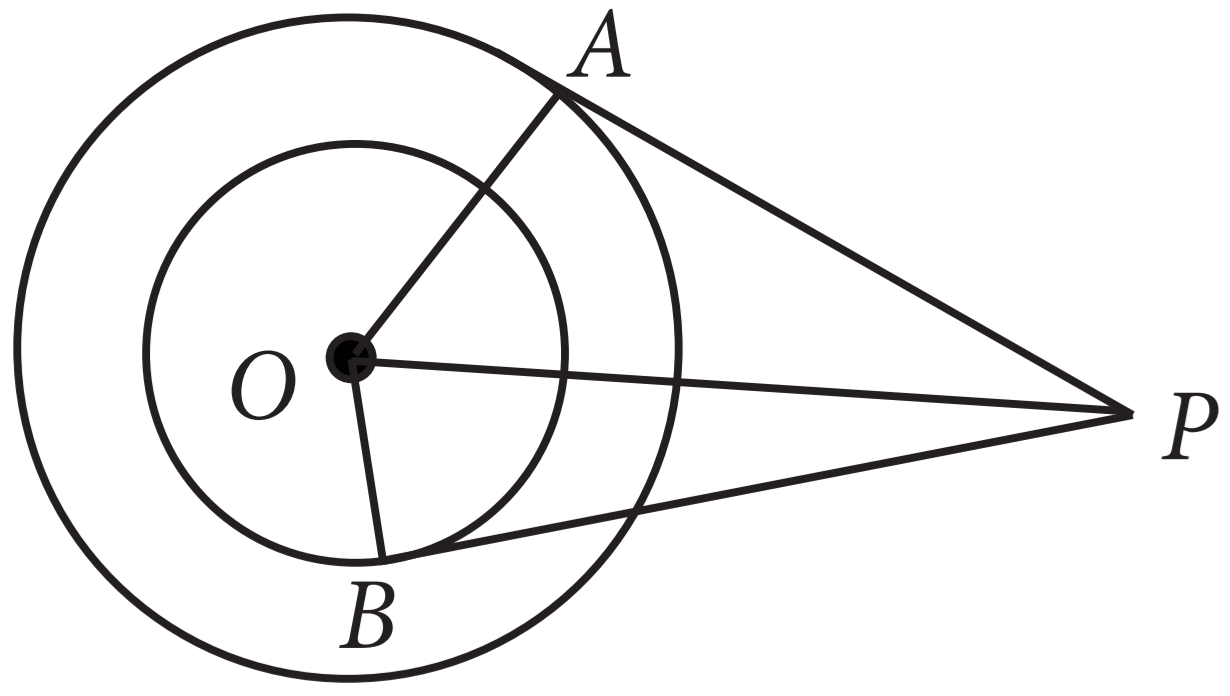
If a tangent is drawn to a circle from an external point, then the radius at the point of contact is perpendicular to the tangent. Answer the following questions using the above condition.
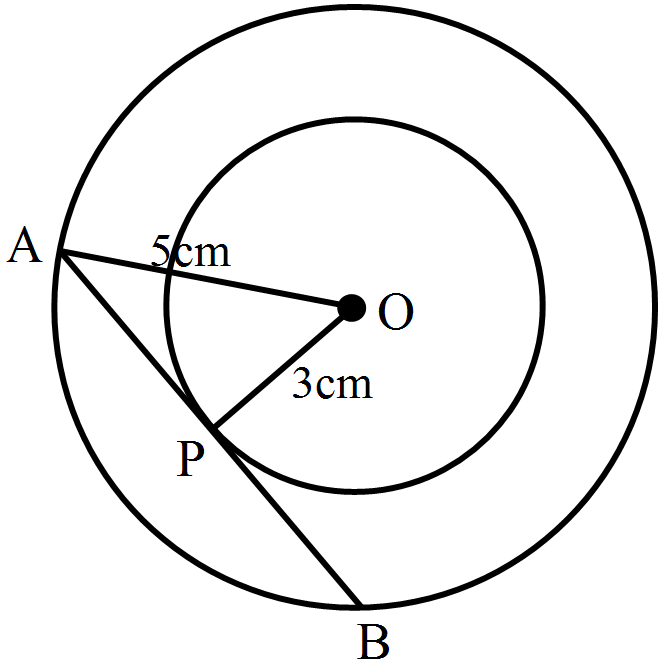
  1. Two concentric circles are of radii 5cm and 3cm. Find the length of the chord of the larger circle which touches the smaller circle.
  2. Two concentric circles are such that the difference between their radii is 4cm and the length of the chord of the larger circle which touches the smaller circle is 24cm. Then the radius of the smaller circle is:
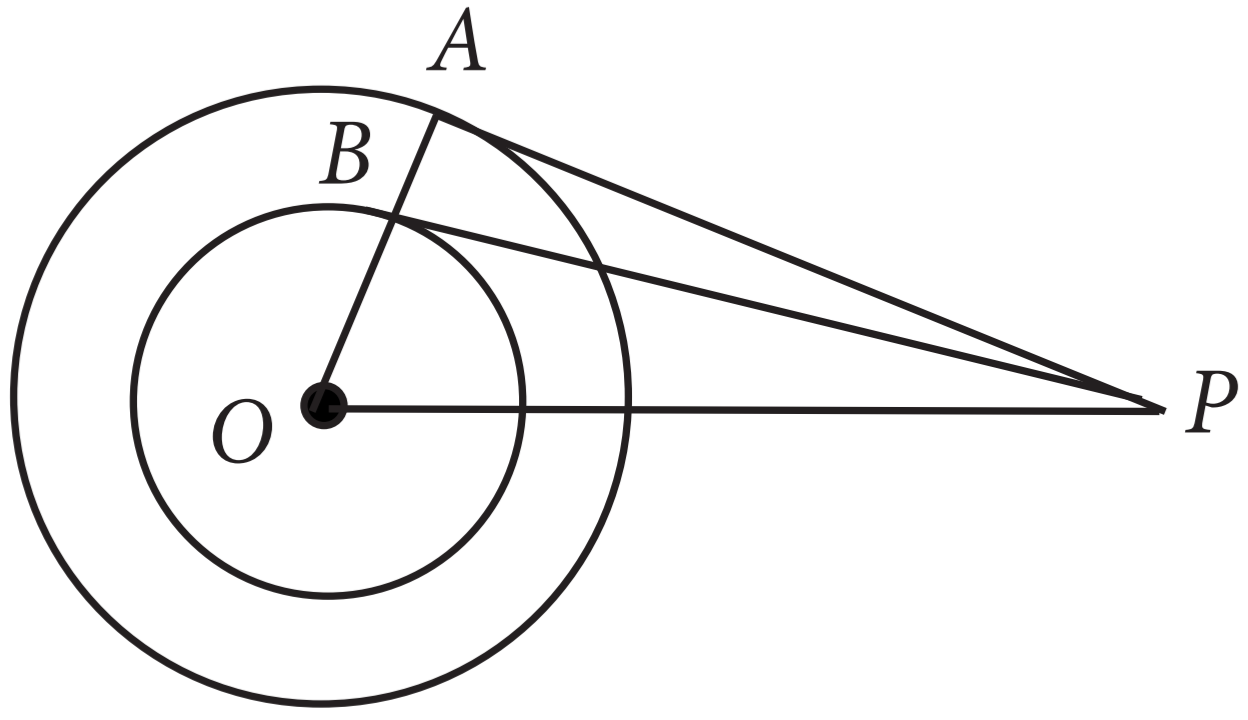
  3. In the given figure, O is the center of two concentric circles of radii 5cm and 3cm. From an external point P, tangents PA and PB are drawn to these circles. If PA = 12cm, then PB =

Or
In the given figure, O is the center of two concentric circles. From an external point P, tangents PA and PB are drawn to these circles, such that PA = 6cm and PB = 8cm. If OP = 10cm, then AB =
View full solution

Smita always finds it confusing with the concepts of tangent and secant of a circle. But this time she has determined herself to get concepts easier. So, she started listing down the differences between tangent and secant of a circle, along with their relation. Here, some points in question form are listed by Smita in her notes. Try answering them to clear your concepts also.
  1. A line that intersects a circle exactly at two points is called:
  2. Number of tangents that can be drawn on a circle is:
  3. Number of tangents that can be drawn to a circle from a point not on it, is:
    Or
    Number of secants that can be drawn to a circle from a point on it is:
View full solution

Generate a Circles paper free

Pick question groups from the list above, set marks and difficulty, and export a branded PDF with step-by-step answer keys. First 3 chapters free — no signup.

Download App