Question
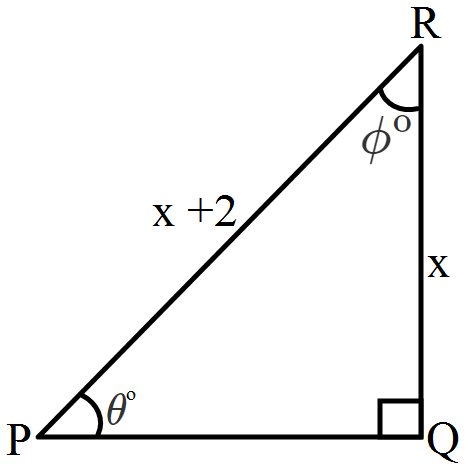
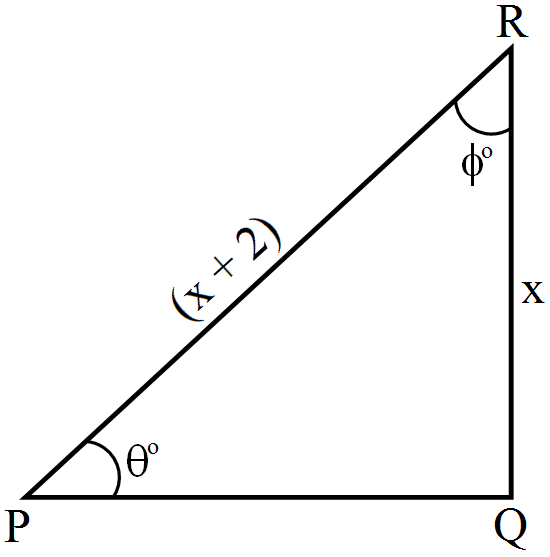
In the figure of $\triangle\text{PQR},\angle\text{P}=\theta^\circ$and $\angle\text{R}=\phi^\circ.$
Find:
  1. $\big(\sqrt{\text{x}+1}\big)\cot\phi$
  2. $\big(\sqrt{\text{x}^3+\text{x}^2}\big)\tan\theta$
  3. $\cos\theta$

Answer


In $\triangle\text{PQR},\angle\text{Q}=90^\circ,\angle\text{P}=\theta^\circ$ and $\angle\text{R}=\phi^\circ$
By Pythagoras theorem, we have
$\text{PQ}^2=\text{PR}^2-\text{QR}^2$
$=\big(\text{x}+2\big)^2-\text{x}^2=\text{x}^2+4\text{x}+4-\text{x}^2=4(\text{x}+1)$
$\Rightarrow\text{PQ}=2\sqrt{\text{x}+1}$
Now, $\cot\phi=\frac{\text{QR}}{\text{PQ}}=\frac{\text{x}}{2\sqrt{\text{x}+1}}$ and $\tan\theta=\frac{\text{QR}}{\text{PQ}}=\frac{\text{x}}{2\sqrt{\text{x}+1}}$
$\big(\sqrt{\text{x}+1}\big)\cot\phi=\big(\sqrt{\text{x}+1}\big)\times\frac{\text{x}}{2\sqrt{\text{x}+1}}=\frac{\text{x}}{2}$
$\big(\sqrt{\text{x}^3+\text{x}^2}\big)\tan\theta=\big(\sqrt{\text{x}^2(\text{x}+1)}\big)\\\tan\theta=\text{x}\big(\sqrt{\text{x}+1}\big)\times\frac{\text{x}}{2\sqrt{\text{x}+1}}=\frac{\text{x}^2}{2}$
$\cos\theta=\frac{\text{PQ}}{\text{PR}}=\frac{2\sqrt{\text{x}+1}}{\text{x}+2}$

Need a full question paper?

Generate a complete, print-ready paper with questions like this in minutes — across 16+ boards, with answer keys.

Start Generating Free

Similar questions

$A(6, 1), B(8, 2)$ and $C(9, 4)$ are the vertices of a parallelogram ABCD. If E is the midpoint of DC, find the area of $\triangle\text{ADE}.$
A right circular cone is divived into three parts by trisecting its height by two planes drawn parallel to the base. show that the volumes of the three portions starting from top are in ratio 1 : 7 : 19.
If $(\text{cosec }\theta+\sin\theta)=\text{a}^3$ and $(\sec\theta-\cos\theta)=\text{b}^3,$ prove that $\big(\text{a}^2\text{b}^2\big)\big(\text{a}^2+\text{b}^2\big)=1.$
If $\sec\theta+\tan\theta=\text{p},$ prove that:$\sec\theta=\frac12\Big(\text{p}+\frac{1}{\text{p}}\Big)$
The following table gives the daily income of 50 workers of a factory:
Daily income (in Rs) 100-120 120-140 140-160 160-180 180-200
Number of workers 12 14 8 6 10
Find the mean, mode and median of the above data.
If $\cos\theta+\sin\theta)=\sqrt{2}\sin\theta,$ show that $\sin\theta-\cos\theta=\sqrt{2}\cos\theta.$
Compute the meanof the following data using direct method:
Class
0-100
100-200
200-300
300-400
400-500
Frequency
6
9
15
12
8
Draw a circle of radius 3cm. From a point P, 7cm away from the centre of the circle, draw two tangents to the circle. Also, measure the lengths of the tangents.
Find the roots of the following equation, if they exist, by applying the quadratic formula:
$4x^2 - 4a^2x + (a^4 - b^4) = 0$
The area of a rectangle gets reduced by 67 square metres, when its length is increased by 3 m and breadth is decreased by 4 m. If the length is reduced by 1 m and breadth is increased by 4 m, the area is increased by 89 square metres. Find the dimensions of the rectangle.