MCQ
In the figure shown $ABC$ is a uniform wire . If centre of mass of wire lies vertically below point $A$ , then $\frac{{BC}}{{AB}}$ is close to
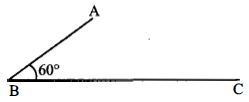
- A$1.85$
- B$1.5$
- ✓$1.37$
- D$3$
$\begin{array}{l}
{x_{cm}} = \frac{x}{2} = \frac{{\left( {\rho x} \right)\left( {\frac{x}{2}} \right)\frac{1}{2} + \rho y\left( {\frac{y}{2}} \right)}}{{\rho \left( {x + y} \right)}}\\
\Rightarrow \frac{1}{2} + \frac{y}{x} = \frac{{{y^2}}}{{{x^2}}}\\
\therefore \frac{{BC}}{{AB}} = \frac{y}{x} = \frac{{1 + \sqrt 3 }}{2} = 1.37
\end{array}$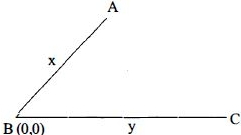
Generate a complete, print-ready paper with questions like this in minutes — across 16+ boards, with answer keys.
$x = at + bt^2 -ct^3$
where $a, b$ and $c$ are constants of the motion. The velocity of the particle when its acceleration is zero is given by