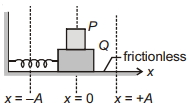
In the figure shown, there is friction between the blocks $P$ and $Q$ but the contact between the block $Q$ and lower surface is frictionless. Initially the block $Q$ with block $P$ over it lies at $x=0$, with spring at its natural length. The block $Q$ is pulled to right and then released. As the spring - blocks system undergoes $S.H.M.$ with amplitude $A$, the block $P$ tends to slip over $Q . P$ is more likely to slip at
Medium


Download our appand get started for free
Experience the future of education. Simply download our apps or reach out to us for more information. Let's shape the future of learning together!No signup needed.*
Similar Questions
- 1A particle is executing $SHM$ with amplitude $A,$ time period $T,$ maximum acceleration $a_o$ and maximum velocity $v_0.$ Its starts from mean position at $t=0$ and at time $t,$ it has the displacement $A/2,$ acceleration $a$ and velocity $v$ thenView Solution
- 2The displacement of an oscillating particle varies with time (in seconds) according to the equation $y (cm) = sin \frac{\pi }{2}\left( {\frac{t}{2} + \frac{1}{3}} \right)$. The maximum acceleration of the particle is approximately ..... $cm/s^2$View Solution
- 3A book is resting on a shelf that is undergoing vertical simple harmonic oscillations with an amplitude of $2.5 \,cm$. What is the minimum frequency of oscillation of the shelf for .......... $Hz$ the book will lose contact with the shelf? (Assume that, $g=10 \,ms ^{-2}$ )View Solution
- 4A body is executing $S.H.M.$ When its displacement from the mean position is $4\, cm$ and $5\, cm$, the corresponding velocity of the body is $10 \,cm/sec$ and $8\, cm/sec$. Then the time period of the body isView Solution
- 5$2$ particles $p$ and $q$ describe $SHM$ of same amplitude $a$ and same frequency $f$ along straight line, the maximum distance between the two particle $a\sqrt 2 $ . The initial phase difference between particle isView Solution
- 6View SolutionThe total energy of a particle executing simple harmonic motion is
- 7The potential energy of a particle of mass $4\,kg$ in motion along the $x$-axis is given by $U =4(1-\cos 4 x )\,J$. The time period of the particle for small oscillation $(\sin \theta \simeq \theta)$ is $\left(\frac{\pi}{ K }\right)\,s$. The value of $K$ is .......View Solution
- 8The bob of a simple pendulum of mass m and total energy $E$ will have maximum linear momentum equal toView Solution
- 9A particle is performing simple harmonic motion along $x$ -axis with amplitude $4\, cm$ and time period $1.2\, sec$. The minimum time taken by the particle to move from $x = 2\, cm$ to $x =+ 4 \,cm$ and back again is given by .... $s$View Solution
- 10$Assertion :$ The time-period of pendulum, on a satellite orbiting the earth is infinity.View Solution
$Reason :$ Time-period of a pendulum is inversely proportional to $\sqrt g$