The potential energy of a particle of mass $4\,kg$ in motion along the $x$-axis is given by $U =4(1-\cos 4 x )\,J$. The time period of the particle for small oscillation $(\sin \theta \simeq \theta)$ is $\left(\frac{\pi}{ K }\right)\,s$. The value of $K$ is .......
JEE MAIN 2022, Diffcult


Download our appand get started for free
Experience the future of education. Simply download our apps or reach out to us for more information. Let's shape the future of learning together!No signup needed.*
Similar Questions
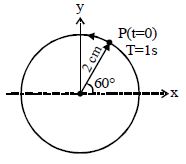
- 1Figure shows the circular motion of a particle. The radius of the circle, the period, sense of revolution and the initial position are indicated in the figure. The simple harmonic motion of the $x-$ projection of the radius vector of the rotating particle $P$ isView Solution
- 2A man is swinging on a swing made of $2$ ropes of equal length $L$ and in direction perpendicular to the plane of paper. The time period of the small oscillations about the mean position isView Solution

- 3A simple perdulum performs simple harmonic motion about $x=0$ with an amplitude $a$ and time period $T$. The speed of the pendulum at $x=a/2$ will beView Solution
- 4$Y = A \sin \left(\omega t +\phi_{0}\right)$ is the time-displacement equation of a SHM. At $t=0$ the displacement of the particle is $Y =\frac{ A }{2}$ and it is moving along negative $x$ -direction. Then the initial phase angle $\phi_{0}$ will be ...... .View Solution
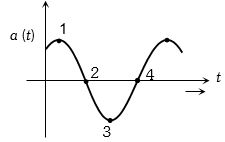
- 5The acceleration $a$ of a particle undergoing $S.H.M.$ is shown in the figure. Which of the labelled points corresponds to the particle being at -$x_{max}$View Solution
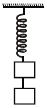
- 6Two small bodies of mass of $2\, kg$ each attached to each other using a thread of length $10\, cm$, hang on a spring whose force constant is $200\, N/m$, as shown in the figure. We burn the thread. What is the distance between the two bodies when the top body first arrives at its highest position .... $cm$ ? (Take $\pi^2 = 10$)View Solution
- 7The displacement of a particle executing periodic motion is given by :View Solution
$y = 4cos^2\,(t/2)sin\,(1000t)$
This expression may be considered to be a result of superposition of - 8If two similar springs each of spring constant $K _{1}$ are joined in series, the new spring constant and time period would be changed by a factorView Solution
- 9The position, velocity and acceleration of a particle executing simple harmonic motion are found to have magnitudes of $4 \mathrm{~m}, 2 \mathrm{~ms}^{-1}$ and $16 \mathrm{~ms}^{-2}$ at a certain instant. The amplitude of the motion is $\sqrt{\mathrm{x}} \mathrm{m}$ where $\mathrm{x}$ is. . . . . . .View Solution
- 10The motion of a particle represented by $y\ =$ $\sin \omega t - \cos \omega t$ isView Solution