Question
In the following diagram; $A D=A B$ and $A E$ bisect $\angle A$.
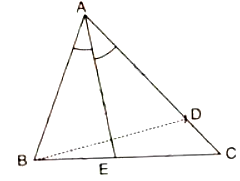
Prove that:$(i) BE = DE,(ii) \angle A B D>\angle C$
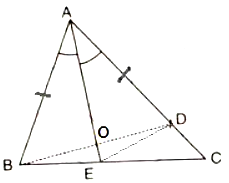
Answer


Const: Join $ED.$
In $\triangle AOB$ and $\triangle AOD$,
$A B=A D\dots ...[$ Given$]$
$A O=A O\dots ....[$ Common $]$
$\angle BAO =\angle DAO\dots ....[ AO$ is bisector of $A]$
$\therefore \triangle AOB \cong \triangle AOD ....[\text{SAS}$ criterion $]$
Hence,
$B O=O D\dots ...(i) [\text{ c.p.c.t.} ]$
$\angle AOB =\angle AOD \dots...(ii)[ \text{c.p.c.t.} ]$
$\angle ABO =\angle ADO \Rightarrow \angle ABD =\angle ADB \dots...(iii)[ \text{c.p.c.t. }]$
Now,
$\angle AOB =\angle DOE\dots ...[$Vertically opposite angles$]$
$\angle AOD =\angle BOE\dots ...[$Vertically opposite angles$]$
$\angle BOE =\angle DOE\dots ...(iv)[$ From $(ii)]$
$(i)$ In $\triangle BOE$ and $\triangle DOE$,
$B O=C D \dots...[$ From $(i) ]$
$OE = OE \dots...$[ Common $]$
$\angle BOE =\angle DOE\dots ... [$ From $(iv) ][ \text{SAS}$ criterion$]$
Hence, $BE = DE\dots ...[\text{ c.p.c.t.} ]$
$(ii)$ In $BCD$
$\angle ADB =\angle C+\angle C B D$
$\ldots[$ Ext. angle $=$ sum of opp. int. angles $]$
$\Rightarrow \angle A D B>\angle C$
$\Rightarrow \angle ABD >\angle C \dots...[$ From $(iii) ]$

Need a full question paper?

Generate a complete, print-ready paper with questions like this in minutes — across 16+ boards, with answer keys.
Start Generating Free

Similar questions

The cost of a machine depreciated by $Rs. 4,000$ during the first year and by $Rs. 3,600$ during the second year. Calculate :
  1. The rate of depreciation.
  2. The original cost of the machine.
  3. Its cost at the end of the third year.
The area of cross-section of a rectangular pipe is $5.4 cm^2$ and water is pumped out of it at the rate of 27 kmph . Find, in litres, the volume of water which flows out of the pipe in 1 minute.
Solve :$4 x+\frac{6}{y}=15$ and $3 x-\frac{4}{y}=7$. Hence, find $a$ if $y=a x-2$
Two cubes, each of volume $512 cm ^3$ are joined end to end. Find the surface area of the resulting cuboid.
Evaluate : $\left(\frac{a}{2 b}+\frac{2 b}{a}\right)^2-\left(\frac{a}{2 b}-\frac{2 b}{a}\right)^2-4$
The sides of a triangular field are in the ratio $5: 3: 4$ and its perimeter is $180\ m.$ Find :$(i)$ its area.$(ii)$ the altitude of the triangle corresponding to its largest side.$(iii)$ the cost of leveling the field at the rate of $Rs. 10$ per square meter.
Arrange $-\frac{5}{7}, \frac{7}{12},-\frac{2}{3}$ and $\frac{11}{18}$ in ascending order of their magnitudes.Also, find the difference between the largest and smallest of these rational numbers. Express this difference as a decimal fraction correct to one decimal place.
In the following, the coordinates of the three vertices of a rectangle $\text{ABCD}$ are given. By plotting the given points; find, in case, the coordinates of the fourth vertex:$A (- 4, - 6), C(6, 0)$ and $D(- 4, 0).$
The following data have been arranged in ascending order. If their median is $63,$ find the value of $x.34, 37, 53, 55, x, x + 2, 77, 83, 89$ and $100.$
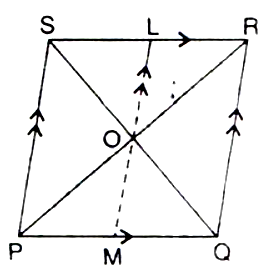
In the given figure, diagonals $PR$ and $QS$ of the parallelogram $\text{PQRS}$ intersect at point $O$ and $LM$ is parallel to $PS$. Show that:

$(i) 2$ Area $\text{(POS)} =$ Area $( gm\ \text{PMLS)};(ii) $ Area $\text{(POS)} +$ Area $\text{(QOR)} =$ Area $( gm\ \text{ PQRS)};(iii) $ Area $\text{(POS)} +$ Area $\text{(QOR)}=$ Area $\text{(POQ) } +$ Area $\text{(SOR)}.$