Questions

[4 marks sum]

🎯

Test yourself on this topic

14 questions · timed · auto-graded

Question 14 Marks
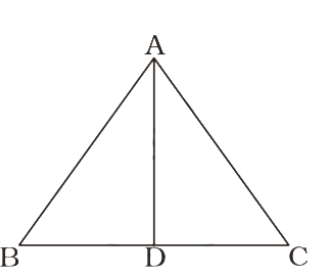
$D$ is a point in side $BC$ of $\triangle ABC.$ If $AD > AC$, show that $AB > AC.$
Answer
Image
$A D>A C \dots...($Given $)$
$\Rightarrow \angle C>\angle ADC \ldots(1)$
Now, $\angle ADC >\angle B +\angle BAC \ldots ($ Exterior Angel Property $)$
$\Rightarrow \angle A D C>\angle B \ldots(2)$
From $( 1 )$ and $( 2 ),$ we have
$\Rightarrow \angle C>\angle A D C>\angle B$
$ \Rightarrow \angle C>\angle B$
$ \Rightarrow A B>A C$
View full question & answer
Question 24 Marks
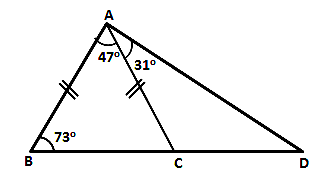
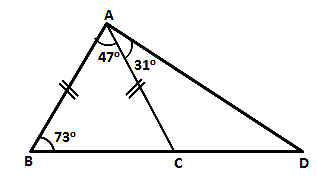
In the following figure, write $BC , AC$, and $CD$ in ascending order of their lengths.
Answer

In $\triangle ABC$
$\angle BAC <\angle ABC$
$BC < AC \dots...... (1)$
Now, $\angle ACB =180^{\circ}-\angle ABC -\angle BAC$
$\angle ACB =180^{\circ}-73^{\circ}-47^{\circ} $
$\angle ACB =60^{\circ}$
Now, $\angle ACD =180^{\circ}-\angle ACB$
$ \angle ACD =180^{\circ}-60^{\circ}=120^{\circ} $
Now, in $\triangle ACD$,
$\angle ADC =180^{\circ}-\angle ACD -\angle CAD$
$ \angle ADC =180^{\circ}-120^{\circ}-31^{\circ} $
$ \angle ADC =29^{\circ} $
Since $\angle A D C<\angle C A D$, we have $AC < CD \dots....... (2)$
From $( 1 )$ and $(2),$ we have
​​​​​​​ $BC < AC < CD$.
View full question & answer
Question 34 Marks
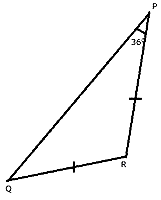
In a $\triangle P Q R ; Q R=P R$ and $\angle P=36^{\circ}$. Which is the largest side of the triangle?
Answer


In $\triangle PQR$
$QR = PR \ldots [$ Given $]$
$\therefore \angle P =\angle Q \dots...[$ angles opposite to equal sides are equal $]$
$\Rightarrow \angle P =36^{\circ} \dots..[$Given$]$
$\Rightarrow \angle Q=36^{\circ}$
In $\triangle PQR$,
$\angle P +\angle Q +\angle R =180^{\circ}$
$ \Rightarrow 36^{\circ}+36^{\circ}+\angle R =180^{\circ}$
$ \Rightarrow \angle R +72^{\circ}=180^{\circ}$
$ \Rightarrow \angle R =108^{\circ}$
Now,
$\angle R =108^{\circ}$
$ \angle P =36^{\circ}$
$ \angle Q =36^{\circ}$
Since $\angle R$ is the greatest,
therefore, $PQ$ is the largest side.
View full question & answer
Question 44 Marks
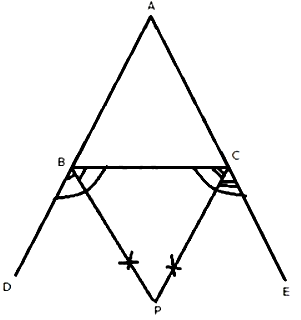
The sides$ AB$ and $AC$ of a $\triangle ABC$ are produced; and the bisectors of the external angles at $B$ and $C$ meet at $P.$Prove that if $AB > AC,$ then $PC > PB.$
Answer

In $\triangle ABC $
$AB > AC $
$ \Rightarrow \angle ABC <\angle ACB$
$ \therefore 180^{\circ}-\angle ABC >180^{\circ}-\angle ACB$
$\angle BCF <\angle CBF $
$ \frac{\angle B C F}{2}<\frac{\angle C B F}{2}$
$ <\angle BCP <\angle CBP $
$\angle BCP <\angle CBP$
$\Rightarrow BP < CP $
$ \Rightarrow PC > PB$
View full question & answer
Question 54 Marks
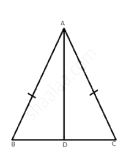
Prove that the straight line joining the vertex of an isosceles triangle to any point in the base is smaller than either of the equal sides of the triangle.
Answer
Image
We know that the exterior angle of a triangle is always greater than each of the interior opposite angles.
$\therefore$ In $\triangle ABD$
$\angle A D C>\angle B \ldots (i)$
In $\triangle A B C$
$ A B=A C$
$\therefore \angle B=\angle C \dots...(ii)$
From $(i)$ and $(ii)$
$\angle A D C>\angle C$
$(i)$ In $\triangle ADC$,
$\angle A D C>\angle C$
$\therefore A C>A D \dots....(iii)[$ side opposite to greater angle is greater $]$
$(ii)$ In $\triangle ABC$
$AB = AC$
$\Rightarrow A B>A D \dots...[$ From $(iii) ]$
View full question & answer
Question 64 Marks
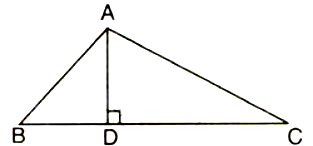
From the following figure;

prove that:$(i) \ AB > BD,(ii) \ A C>C D,(iii) \ A B+A C>B C$
Answer
$(i)\angle ADC + \angle ADB = 180^\circ ...[\text{BDC}$ is a straight line $]$
$\angle ADC = 90^\circ\dots ...[$ Given $]$
$90^\circ + \angle ADB = 180^\circ $
$\angle ADB = 90^\circ\dots ....(i)$
In $\triangle ADB,$
$\angle ADB = 90^\circ\dots ....[$ From $(i)]$
$\therefore \angle B + \angle BAD = 90^\circ $
Therefore, $\angle B$ and $\angle BAD$ are both acute$,$ that is less than $90^\circ $.
$\therefore AB > BD\dots ….(ii)[$ Side opposite $90^\circ $ angle is greater than the side opposite acute angle $]$
$(ii)$ In $\triangle ADC,$
$\angle ADB = 90^\circ $
$\therefore \angle C + \angle DAC = 90^\circ $
Therefore$, \angle C$ and $\angle DAC$ are both acute$,$ which is less than $90^\circ $.
$\therefore AC > CD\dots ...(iii)[$ Side opposite $90^\circ $ angle is greater than side opposite acute angle $]$
Adding $(ii)$ and $(iii)$
$AB + AC > BD + CD$
$\Rightarrow AB + AC > BC$
View full question & answer
Question 74 Marks
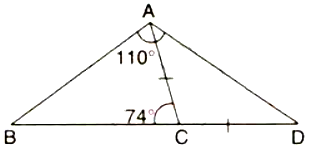
In the following figure $; A C=C D ; \angle B A D=110^{\circ}$ and $\angle A C B=74^{\circ}$.

Prove that: $BC > CD$.
Answer
$\angle ACB = 74^\circ\dots ...(i)[$ Given $]$
$\angle ACB + \angle ACD = 180^\circ \dots....[\text{ BCD}$ is a straight line $]$
$\Rightarrow 74^\circ + \angle ACD = 180^\circ $
$\Rightarrow \angle ACD = 106^\circ\dots …..(ii)$
In $\triangle ACD,$
$\angle ACD + \angle ADC+ \angle CAD = 180^\circ $
Given that $AC = CD$
$\Rightarrow \angle ADC= \angle CAD$
$\Rightarrow 106^\circ + \angle CAD + \angle CAD = 180^\circ\dots ....[$From $(ii)]$
$\Rightarrow 2\angle CAD = 74^\circ $
$\Rightarrow \angle CAD = 37^\circ = \angle ADC\dots ...(iii)$
Now$,$
$\angle BAD = 110^\circ\dots ....[$Given$]$
$\angle BAC + \angle CAD = 110^\circ $
$\angle BAC + 37^\circ = 110^\circ $
$\angle BAC = 73^\circ\dots ….(iv)$
In $ABC,$
$\angle B + \angle BAC + \angle ACB = 180^\circ $
$\angle B + 73^\circ + 74^\circ = 180^\circ\dots ...[$From $(i)$ and $(iv)]$
$\angle B + 147^\circ = 180^\circ $
$\angle B = 33^\circ \dots…..(v)$
$\therefore \angle BAC > \angle B\dots ...[$ From $(iv)$ and $(v)]$
$\Rightarrow BC > AC$
But$,$
$AC = CD\dots ...[$ Given $]$
$\Rightarrow BC > CD$
View full question & answer
Question 84 Marks
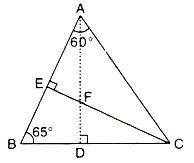
In the following figure$, \angle B A C=60^{\circ}$ and $\angle A B C=65^{\circ}$.

Prove that:$(i) \ CF > AF(ii) \ DC > DF$
Answer
In $\triangle BEC,$
$\angle B + \angle BEC + \angle BCE = 180^\circ $
$\angle B = 65^\circ\dots ...[$Given$]$
$\angle BEC = 90^\circ\dots ...[CE$ is perpendicular to $AB]$
$\Rightarrow 65^\circ + 90^\circ + \angle BCE = 180^\circ $
$\Rightarrow \angle BCE = 180^\circ - 155^\circ $
$\Rightarrow \angle BCE = 25^\circ = \angle DCF\dots …(i)$
In $\triangle CDF,$
$\angle DCF + \angle FDC + \angle CFD = 180^\circ $
$\angle DCF = 25^\circ \dots....[$From $(i)]$
$\angle FDC = 90^\circ\dots ...[ AD$ is perpendicular to $BC]$
$\Rightarrow 25^\circ + 90^\circ + \angle CFD = 180^\circ $
$\Rightarrow \angle CFD = 180^\circ - 115^\circ $
$\Rightarrow \angle CFD = 65^\circ \dots…(ii)$
Now$, \angle AFC + \angle CFD = 180^\circ ....[\text{AFD}$ is a straight line$]$
$\Rightarrow \angle AFC + 65^\circ = 180^\circ $
$\Rightarrow \angle AFC = 115^\circ \dots…(iii)$
In $\triangle ACE,$
$\angle ACE + \angle CEA + \angle BAC = 180^\circ $
$\angle BAC = 60^\circ \dots....[$Given$]$
$\Rightarrow \angle CEA = 90^\circ ...[CE$ is perpendicular to $AB]$
$\Rightarrow \angle ACE + 90^\circ + 60^\circ = 180^\circ $
$\Rightarrow \angle ACE = 180^\circ - 150^\circ $
$\angle ACE = 30^\circ\dots …(iv)$
In $\triangle AFC,$
$\angle AFC + \angle ACF + \angle FAC = 180^\circ $
$\angle AFC = 115^\circ\dots ....[$From $(iii)]$
$\angle ACF = 30^\circ\dots ...[$From $(iv)]$
$\Rightarrow 115^\circ + 30^\circ + \angle FAC = 180^\circ $
$\Rightarrow \angle FAC = 180^\circ - 145^\circ $
$\Rightarrow \angle FAC = 35^\circ \dots…(v)$
In $\triangle AFC,$
$\Rightarrow \angle FAC = 35^\circ\dots ...[$ From $(v)]$
$\Rightarrow \angle ACF = 30^\circ \dots...[$ From $(iv)]$
$\therefore \angle FAC > \angle ACF$
$\Rightarrow CF > AF$
In $\triangle CDF,$
$\angle DCF = 25^\circ \dots...[$From $(i)]$
$\angle CFD = 65^\circ\dots ...[$From $(ii)]$
$\therefore \angle CFD > \angle DCF$
$\Rightarrow DC > DF$
View full question & answer
Question 94 Marks
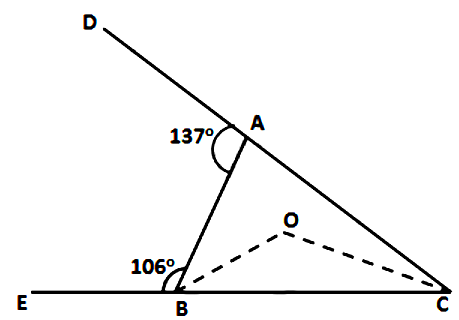
Arrange the sides of $\triangle BOC$ in descending order of their lengths. $BO$ and $C O$ are bisectors of angles $\text{ABC}$ and $\text{ACB}$ respectively.
Answer

$\angle BAC =180^{\circ}-\angle BAD =180^{\circ}-137^{\circ}=43^{\circ}$
$ \angle ABC =180^{\circ}-\angle ABE =180^{\circ}-106^{\circ}=74^{\circ}$
Thus, in $\triangle ABC$,
$\angle ACB =180^{\circ}-\angle BAC -\angle ABC$
$ \Rightarrow \angle ACB =180^{\circ}-43^{\circ}-74^{\circ}=63^{\circ}$
Now, $\angle ABC =\angle OBC +\angle ABO$
$\Rightarrow \angle A B C=2 \angle O B C$
$\ldots( OB$ is biosector of $\angle ABC )$
$\Rightarrow 74^{\circ}=2 \angle OBC$
$ \Rightarrow \angle OBC =37^{\circ}$
Similarly,
$\angle A C B=\angle O C B+\angle A C O$
$\Rightarrow \angle A C B=2 \angle O C B\dots ... (OC$ is bisector of $\text{ACB})$
$\Rightarrow 63^{\circ}=2 \angle OCB$
$ \Rightarrow \angle O C B=31.5^{\circ}$
Now, in $\triangle BOC$,
$\angle BOC =180^{\circ}-\angle OBC -\angle OCB$
$ \Rightarrow \angle BOC =180^{\circ}-37^{\circ}-31.5^{\circ}$
$ \Rightarrow \angle BOC =111.5^{\circ}$
Since, $\angle B O C>\angle O B C>\angle O C B$, we have
$BC > OC > OB$
View full question & answer
Question 104 Marks
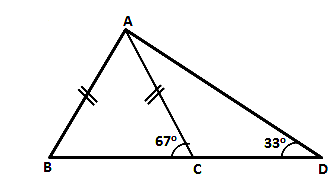
In the following figure, write $BC , AC$, and $CD$ in ascending order of their lengths.
Answer

In $\triangle ABC$
$A B=A C$
$\Rightarrow \angle ABC =\angle ACB\dots..($angles opposite to equal sides are equal$)$
$\Rightarrow \angle ABC =\angle ACB =67^{\circ}$
$\Rightarrow \angle BAC =180^{\circ}-\angle ABC -\angle ACB\dots..($angle sum property$)$
$\Rightarrow \angle BAC =180^{\circ}-67^{\circ}-67^{\circ}=46^{\circ}$
Since $\angle B A C<\angle A B C$, we have
$B C$
$\Rightarrow \angle ACD =180^{\circ}-67^{\circ}=113^{\circ}$
Thus, in $\triangle ACD$,
$\angle C A D=180^{\circ}-\angle A C D-\angle A D C$
$ \Rightarrow \angle C A D=180^{\circ}-113^{\circ}-33^{\circ}=34^{\circ}$
Since $\angle A D C<\angle C A D$, we have
$AC$ From $(1)$ and $(2)$, we have
$BC < AC < CD.$
View full question & answer
Question 114 Marks
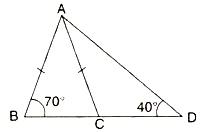
From the following figure, prove that: $A B>C D$.
Answer
In $\triangle ABC,$
$AB = AC \dots...[$ Given $]$
$\therefore \angle ACB = \angle B\dots ...[$ angles opposite to equal sides are equal $]$
$\angle B = 70^\circ\dots ...[$ Given $]$
$\Rightarrow \angle ACB = 70^\circ\dots ...(i)$
Now$,$
$\angle ACB +\angle ACD = 180^\circ\dots ...[\text{BCD}$ is a straight line$]$
$\Rightarrow 70^\circ + \angle ACD = 180^\circ $
$\Rightarrow \angle ACD = 110^\circ \dots...(ii)$
In $\triangle ACD,$
$\angle CAD + \angle ACD + \angle D = 180^\circ $
$\Rightarrow \angle CAD + 110^\circ + \angle D = 180^\circ\dots ...[$ From $(ii) ]$
$\Rightarrow \angle CAD + \angle D = 70^\circ $
But $\angle D = 40^\circ\dots ...[$ Given $]$
$\Rightarrow \angle CAD + 40^\circ = 70^\circ $
$\Rightarrow \angle CAD = 30^\circ\dots …(iii)$
In $\triangle ACD,$
$\angle ACD = 110^\circ\dots ...[$ From $(ii) ]$
$\angle CAD = 30^\circ\dots ...[$ From $(iii) ]$
$\angle D = 40^\circ \dots...[$ Given $]$
$\therefore D > \angle CAD$
$\Rightarrow AC > CD\dots ....[$Greater angle has greater side opposite to it$]$
Also$,$
$AB = AC\dots ...[$ Given $]$
Therefore$, AB > CD$
View full question & answer
Question 124 Marks
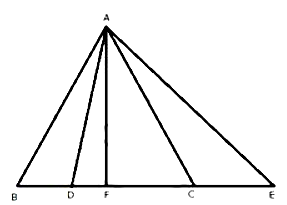
In an isosceles $\triangle ABC,$ sides $AB$ and $AC$ are equal. If point $D$ lies in base $BC$ and point $E$ lies on $BC$ produced $(BC$ being produced through vertex $C)$, prove that$:(i) AC > AD'(ii) AE > AC'(iii) AE > AD$
Answer

We know that the bisector of the angle at the vertex of an isosceles triangle bisects the base at the right angle.
Using Pythagoras theorem in $\text{AFB},$
$A B^2=A F^2+B F^2\ldots (i)$
In $\text{AFD},$
$A D^2=A F^2+D F^2\dots ...(ii)$
We know $\text{ABC}$ is isosceles triangle and $A B=A C$
$A C^2=A F^2+B F^2\dots ..(iii)[$From $(i)]$
Subtracting $(ii)$ from $(iii)$
$A C^2-A D^2=A F^2+B F^2-A F^2-D F^2$
$ A C^2-A D^2=B F^2-D F^2$
 Let $2 D F=B F$
$ A C^2-A D^2=(2 D F)^2-D F^2$
$ A C^2-A D^2=4 D F^2-D F^2$
$ A C^2=A D^2+3 D F^2$
$ \Rightarrow A C^2>A D^2$
$ \Rightarrow A C>A D$
Similarly, $A E>A C$ and $A E>A D$.
View full question & answer
Question 134 Marks
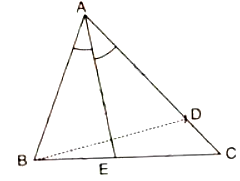
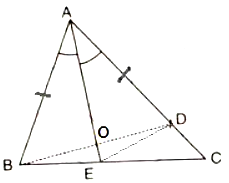
In the following diagram; $A D=A B$ and $A E$ bisect $\angle A$.

Prove that:$(i) BE = DE,(ii) \angle A B D>\angle C$
Answer

Const: Join $ED.$
In $\triangle AOB$ and $\triangle AOD$,
$A B=A D\dots ...[$ Given$]$
$A O=A O\dots ....[$ Common $]$
$\angle BAO =\angle DAO\dots ....[ AO$ is bisector of $A]$
$\therefore \triangle AOB \cong \triangle AOD ....[\text{SAS}$ criterion $]$
Hence,
$B O=O D\dots ...(i) [\text{ c.p.c.t.} ]$
$\angle AOB =\angle AOD \dots...(ii)[ \text{c.p.c.t.} ]$
$\angle ABO =\angle ADO \Rightarrow \angle ABD =\angle ADB \dots...(iii)[ \text{c.p.c.t. }]$
Now,
$\angle AOB =\angle DOE\dots ...[$Vertically opposite angles$]$
$\angle AOD =\angle BOE\dots ...[$Vertically opposite angles$]$
$\angle BOE =\angle DOE\dots ...(iv)[$ From $(ii)]$
$(i)$ In $\triangle BOE$ and $\triangle DOE$,
$B O=C D \dots...[$ From $(i) ]$
$OE = OE \dots...$[ Common $]$
$\angle BOE =\angle DOE\dots ... [$ From $(iv) ][ \text{SAS}$ criterion$]$
Hence, $BE = DE\dots ...[\text{ c.p.c.t.} ]$
$(ii)$ In $BCD$
$\angle ADB =\angle C+\angle C B D$
$\ldots[$ Ext. angle $=$ sum of opp. int. angles $]$
$\Rightarrow \angle A D B>\angle C$
$\Rightarrow \angle ABD >\angle C \dots...[$ From $(iii) ]$
View full question & answer
Question 144 Marks
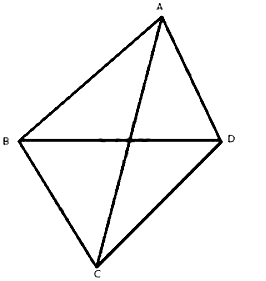
In a quadrilateral $\text{ABCD};$ prove that:$(i) AB+ BC + CD > DA,(ii) AB + BC + CD + DA > 2AC,(iii) AB + BC + CD + DA > 2BD$
Answer

Const: Join $AC$ and $BD$.
$(i)$ In $\triangle ABC$
$A B+B C>A C\dots....(i)[$ Sum of two sides is greater than the third side$ ]$
In $\triangle A C D$,
$AC + CD > DA \dots....(ii)[$ Sum of two sides is greater than the third side $]$
Adding $(i)$ and $(ii)$
$AB + BC + AC + CD > AC + DA$
$ AB + BC + CD > AC + DA - AC$
$AB + BC + CD > DA\dots ....(iii)$
$(ii)$ In $\triangle A C D$,
$CD + DA > AC\dots....(iv) [$ Sum of two sides is greater than the third side$]$
Adding $(i)$ and $(iv)$
$A B+B C+C D+D A>A C+A C$
$ A B+B C+C D+D A>2 A C$
$(iii)$ In $\triangle ABD$,
$AB + DA > BD \dots....(v)[$Sum of two sides is greater than the third side$]$
In $\triangle B C D$,
$B C+C D>B D\dots ....(vi)[$Sum of two sides is greater than the third side$]$
Adding $(v)$ and $(vi)$
$ A B+D A+B C+C D>B D+B D$
$ A B+D A+B C+C D>2 B D$
View full question & answer
[4 marks sum] - MATHEMATICS STD 9 Questions - Vidyadip