Question
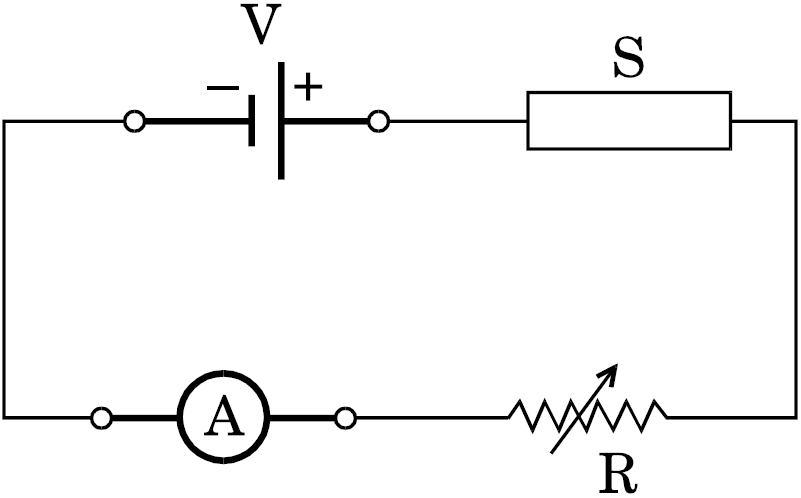
  1. In the following diagram ‘S’ is a semiconductor. Would you increase or decrease the value of R to keep the reading of the ammeter A constant when S is heated? Give reason for your answer.
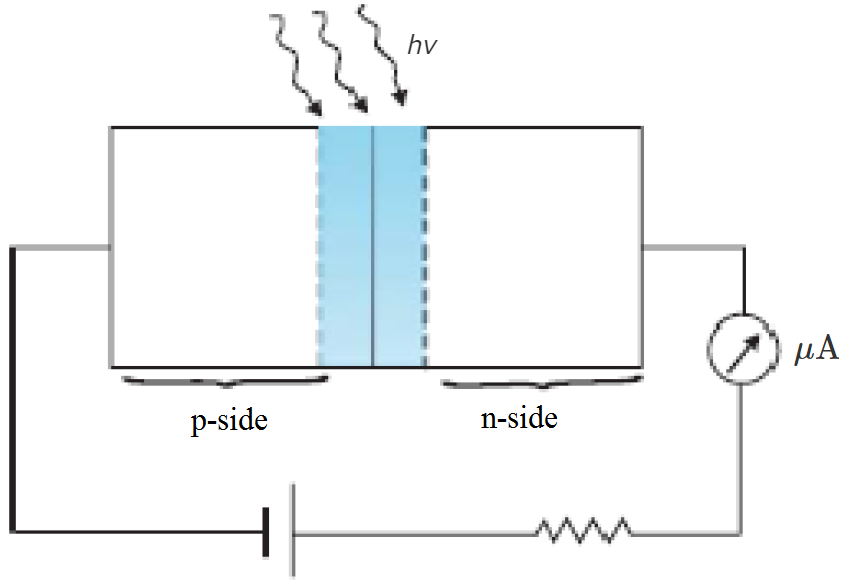
  1. Draw the circuit diagram of a photodiode and explain its working. Draw its I - V characteristics.
Answer

  1. R would be increased.

Resistance of S (a semi conductor) decreases on heating.

  1. Photodiode diagram:

When the photodiode is illuminated with light (photons) (with energy (hv) greater than the energy gap (Eg) of the semiconductor), then electron-hole pairs are generated due to the absorption of photons. Due to junction field, electrons and holes are separated before they recombine. Electrons are collected on n-side and holes are collected on p-side giving rise to an emf. When an external load is connected, current flows.

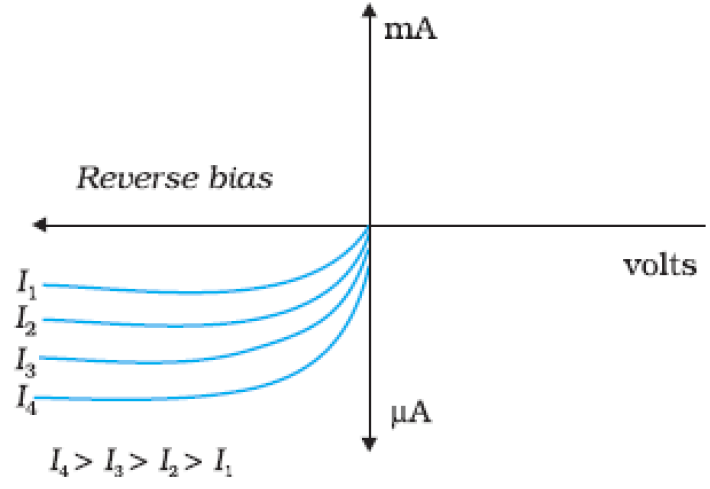
V-I Characteristics of the diode:

Need a full question paper?

Generate a complete, print-ready paper with questions like this in minutes — across 16+ boards, with answer keys.

Start Generating Free

Similar questions

Find the temperature at which the average thermal kinetic energy is equal to the energy needed to take a hydrogen atom from its ground state to n = 3 state. Hydrogen can now emit red light of wavelength 653.1nm. Because of Maxwellian distribution of speeds, a hydrogen sample emits red light at temperatures much lower than that obtained from this problem. Assume that hydrogen molecules dissociate into atoms.
How much energy is released in the following reaction?
$\text{ }^7\text{Li + p}\rightarrow\alpha+\alpha.$
Atomic mass of 7Li = 7.0160u and that of 4He = 4.0026u.
(a) Calculate the potential at a point P due to a charge of $4 \times 10^{-7} C$ located 9 cm away.
(b) Hence obtain the work done in bringing a charge of $2 \times 10^{-9} C$ from infinity to the point $P$. Does the answer depend on the path along which the charges is brought?
n-identical cells, each of emf $\varepsilon,$ internal resistance r connected in series are charged by a dc source of emf $\varepsilon'$ using a resistance R.
  1. Draw the circuit arrangement.
  2. Deduce expressions for (a) the charging current and (b) the potential difference across the combination of cells.
Calculate the ratio of the angular momentum of the earth about its axis due to its spinning motion to that about the sun due to its orbital motion. Radius of the earth = 6400km and radius of the orbit of the earth about the sun = 1.5 × 10⁸km.
A human body excretes (removes by waste discharge, sweating, etc.) certain materials by a law similar to radioactivity. If technetium is injected in some form in a human body, the body excretes half the amount in 24 hours. A patient is given an injection containing 99Tc. This isotope is radioactive with a half-life of 6 hours. The activity from the body just after the injection is $6\mu\text{Ci}.$ How much time will elapse before the activity falls to $3\mu\text{Ci}?$
A convex lens produces a double size real image when an object is placed at a distance of 18cm from it. Where should the object be placed to produce a triple size real image?
Calculate the maximum kinetic energy of the beta particle emitted in the following decay scheme:
$\text{ }^{12}\text{N}\rightarrow{ }^{12}\text{C}^*+\text{e}^++\text{v}$
$\text{ }^{12}\text{C}^*\rightarrow\text{ }^{12}\text{C}+\gamma(4.43\text{MeV}).$
The atomic mass of 12N is 12.018613u.
An electric bulb is marked $220 V, 100 W$. Calculate : (i) resistance of the bulb (ii) peak voltage of the source (iii) rms current flowing through the bulb.
Write some properties of electromagnetic waves.