Question
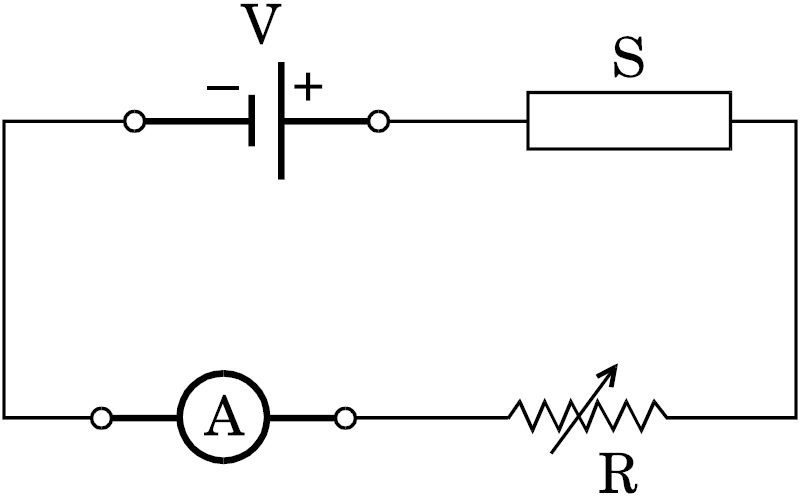
  1. In the following diagram ‘S’ is a semiconductor. Would you increase or decrease the value of R to keep the reading of the ammeter A constant when S is heated? Give reason for your answer.
  1. Draw the circuit diagram of a photodiode and explain its working. Draw its I - V characteristics.
Answer

  1. R would be increased.
Resistance of S (a semi conductor) decreases on heating.
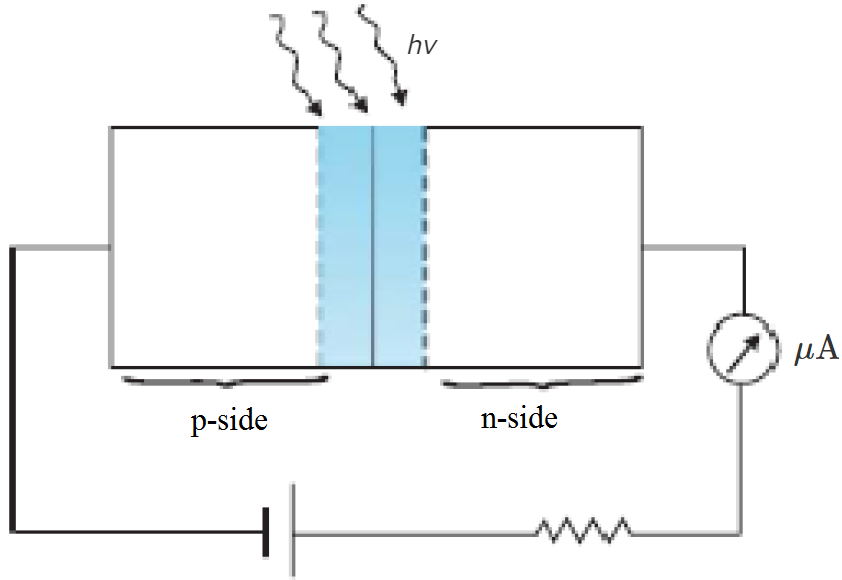
  1. Photodiode diagram:

When the photodiode is illuminated with light (photons) (with energy (hv) greater than the energy gap (Eg) of the semiconductor), then electron-hole pairs are generated due to the absorption of photons. Due to junction field, electrons and holes are separated before they recombine. Electrons are collected on n-side and holes are collected on p-side giving rise to an emf. When an external load is connected, current flows.
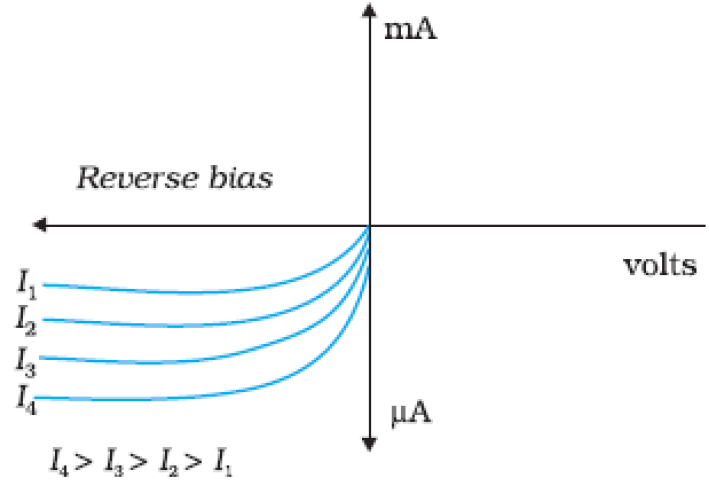
V-I Characteristics of the diode:

Need a full question paper?

Generate a complete, print-ready paper with questions like this in minutes — across 16+ boards, with answer keys.

Start Generating Free

Similar questions

A network of four capacitors each of 12 μF capacitance is connected to a 500 V supply as shown in the figure. Determine (a) equivalent capacitance of the network and (b) charge on each capacitor.
A parallel-plate capacitor of plate-area A and plate separation d is joined to a battery of emf $\in$ and internal resistance R at t = 0. Consider a plane surface of area $\frac{\text{A}}{2}$ parallel to the plates and situated symmetrically between them. Find the displacement current through this surface as a function of time.
There are two sources of light A and B. The wavelength of light emitted from A is from $8000\mathring{\text{A}}$ to $11000\mathring{\text{A}},$ while that from B is from $3000\mathring{\text{A}}$ to $6000\mathring{\text{A}}.$ The intensity of A is 4 times that of B. But when light of A falls on metal, photoelectrons are not emitted whereas light of B can eject photoelectrons from the same metal. Explain its reason.
The critical angle for a given piece of glass is 45°. Calculate the polarising angle for it. Also calculate the angle of refraction when light is incident on this glass at an angle of incidence equal to $i_p.$
$i.$ Define the term self$-$inductance and write its $S.I.$ unit.
$ii.$ Obtain the expression for the mutual inductance of two long co$-$axial solenoids $S_1$ and $S_2$ wound one over the other, each of length $L$ and radii $r_1$ and $r_2$ and $n_1$ and $n_2$ number of turns per unit length, when a current $I$ is set up in the outer solenoid $S _2$.
Suppose the frequency of the source in the previous example can be varied. (a) What is the frequency of the source at which resonance occurs? (b) Calculate the impedance, the current, and the power dissipated at the resonant condition.
(i) What is meant by electric power? Prove that $P=\frac{V^2}{R}$ or $P=I^2 R$. Define one-watt electric power.(ii) Define electric energy. Prove that $P = I ^2 R \Delta t$
A circular coil of wire consisting of 100 turns, each of radius 8.0 cm carries a current of 0.40 A. What is the magnitude of the magnetic field B at the centre of the coil?
Consider a sample of oxygen at 300K. Find the average time taken by a molecule to travel a distance equal to the diameter of the earth.
A transverse wave described by$\text{y}=(0.02\text{m})\sin\Big[(1.0\text{m}^{-1})\text{x}+(30\text{s}^{-1})\text{t}\Big]$
propagates on a stretched string having a linear mass density of $1.2 \times 10^{-4}kg/m$. Find the tension in the string.