What will happen when a $40\, watt$, $220\, volt$ lamp and $100\, watt$, $220\, volt$ lamp are connected in series across $40\, volt$ supply
Diffcult


Download our appand get started for free
Experience the future of education. Simply download our apps or reach out to us for more information. Let's shape the future of learning together!No signup needed.*
Similar Questions
- 1An electric wire is connected across a cell of $e.m.f.$ The current $I$ is measured by an ammeter of resistance $R$. According to ohm's lawView Solution
- 2A current of two amperes is flowing through a cell of $e.m.f.$ $5\, volts$ and internal resistance $0.5\, ohm$ from negative to positive electrode. If the potential of negative electrode is $10\,V$, the potential of positive electrode will be .............. $V$View Solution
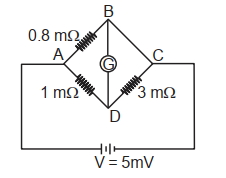
- 3To measure the temperature coefficient of resistivity $\alpha$ of a semiconductor, an electrical arrangement shown in the figure is prepared. The arm BC is made up of the semiconductor. The experiment is being conducted at $25^{\circ} \mathrm{C}$ and resistance of the semiconductor arm is $3 \mathrm{~m} \Omega$. Arm BC is cooled at a constant rate of $2^{\circ} \mathrm{C} / \mathrm{s}$. If the galvanometer $\mathrm{G}$ shows no deflection after $10 \mathrm{~s}$, then $\alpha$ is :View Solution
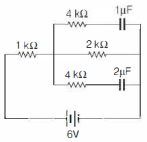
- 4What are the charges stored in the $1 \,\mu F$ and $2 \,\mu F$ capacitors in the circuit below, once the currents become steady?View Solution
- 5If $2.2\, Kwatt$ power is transmitted through a $10\, ohm$ line at $22000\, volt$, the power loss in the form of heat will be ............. $watt$View Solution
- 6An electrical circuit consists of ten $100 \,\Omega$ resistors. Out of these $10$ resistors, a group of $n _1$ resistors are connected in parallel and another group of $n _2$ resistors are separately connected in parallel. These two groups are then connected in series and this combination is connected to a voltage source of $100 \,V$. If the net current though the circuit is $2.5 \,A$. The values of $n _1$ and $n _2$ areView Solution
- 7Four bulbs $B_1 , B_2, B_3$ and $B_4$ of $100\, W$ each are connected to $220\, V$ main as shown in the figure. The reading in an ideal ammeter will be ............... $A$View Solution
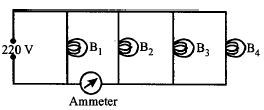
- 8View SolutionIt is easier to start a car engine on a hot day than on a cold day. This is because the internal resistance of the car battery
- 9A strip of copper and another of germanium are cooled from room temperature to $80\, K$. The resistance ofView Solution
- 10Calculate the net resistance of the circuit between $A$ and $B$View Solution