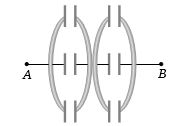
All six capacitors shown are identical, Each can withstand maximum $200\, volts$ between its terminals. The maximum voltage that can be safely applied between $A$ and $B$ is.....$V$
Medium
Download our app for free and get started
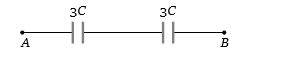
(b) Given circuit can be reduced as follows
($C$ $=$ capacitance of each capacitor)
The capacitor $3\,C$, $3\,C$ shown in figure can with stand maximum $200 \,V$.
So maximum voltage that can be applied across $A$ and $B$ equally shared. Hence maximum voltage applied cross $A$ and $B$ be equally shared. Hence max. voltage applied across $A$ and $B$ will be $(200 + 200)$ = $400\, volt$.
Download our app
and get started for free
Experience the future of education. Simply download our apps or reach out to us for more information. Let's shape the future of learning together!No signup needed.*
Charges $+q$ and $-q$ are placed at points $A$ and $B$ respectively which are a distance $2\,L$ apart, $C$ is the midpoint between $A$ and $B.$ The work done in moving a charge $+Q$ along the semicircle $CRD$ is
A particle of mass $m$ and charge $q$ is placed at rest in a uniform electric field $E$ and then released. The kinetic energy attained by the particle after moving a distance $y$ is
The potential due to an electrostatic charge distribution is $V(r)=\frac{q e^{-\alpha e r}}{4 \pi \varepsilon_{0} r}$, where $\alpha$ is positive. The net charge within a sphere centred at the origin and of radius $1/ \alpha$ is
Two insulating plates are both uniformly charged in such a way that the potential difference between them is $V_2 - V_1 = 20\ V$. (i.e., plate $2$ is at a higher potential). The plates are separated by $d = 0.1\ m$ and can be treated as infinitely large. An electron is released from rest on the inner surface of plate $1. $ What is its speed when it hits plate $2?$
$(e = 1.6 \times 10^{-19}\ C, m_e= 9.11 \times 10^{-31}\ kg)$
An electric charge $10^{-6} \mu \mathrm{C}$ is placed at origin $(0,0)$ $\mathrm{m}$ of $\mathrm{X}-\mathrm{Y}$ co-ordinate system. Two points $\mathrm{P}$ and $\mathrm{Q}$ are situated at $(\sqrt{3}, \sqrt{3}) \mathrm{m}$ and $(\sqrt{6}, 0) \mathrm{m}$ respectively. The potential difference between the points $P$ and $Q$ will be :
A medium having dielectric constant $K>1$ fills the space between the plates of a parallel plate capacitor. The plates have large area, and the distance between them is $d$. The capacitor is connected to a battery of voltage $V$. as shown in Figure ($a$). Now, both the plates are moved by a distance of $\frac{d}{2}$ from their original positions, as shown in Figure ($b$).
In the process of going from the configuration depicted in Figure ($a$) to that in Figure ($b$), which of the following statement($s$) is(are) correct?
The figure shows a family of parallel equipotential surfaces and four paths along which an electron is made to move from one surface to another as shown in the figur
$(I)$ What is the direction of the electric field ?
$(II)$ Rank the paths according to magnitude of work done, greatest first
A parallel plate capacitor of area ' $A$ ' plate separation ' $d$ ' is filled with two dielectrics as shown. What is the capacitance of the arrangement?
Two particles each of mass $m$ and charge $q$ are separated by distance $r_1$ and the system is left free to move at $t = 0$. At time $t$ both the particles are found to be separated by distance $r_2$. The speed of each particle is