Question
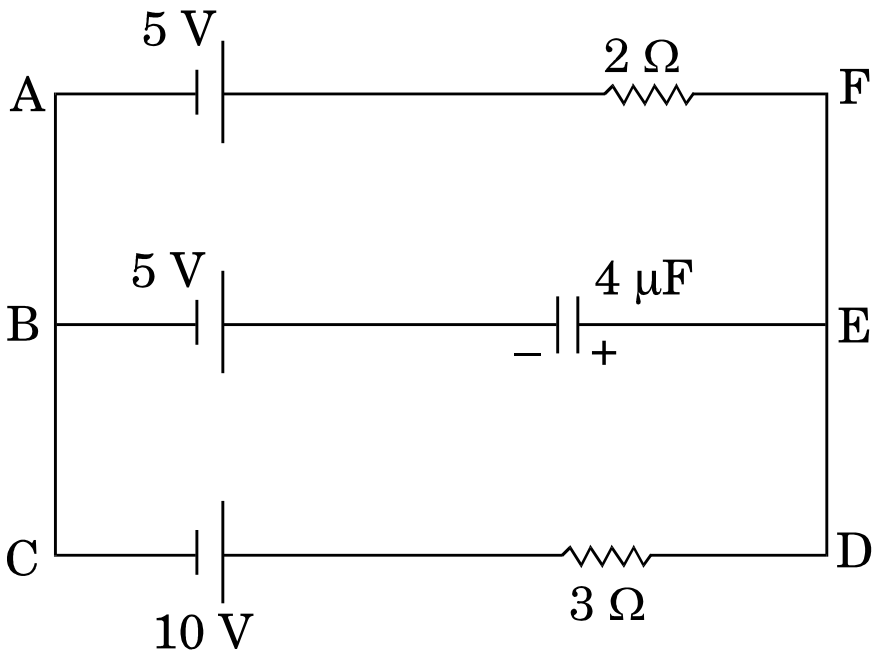
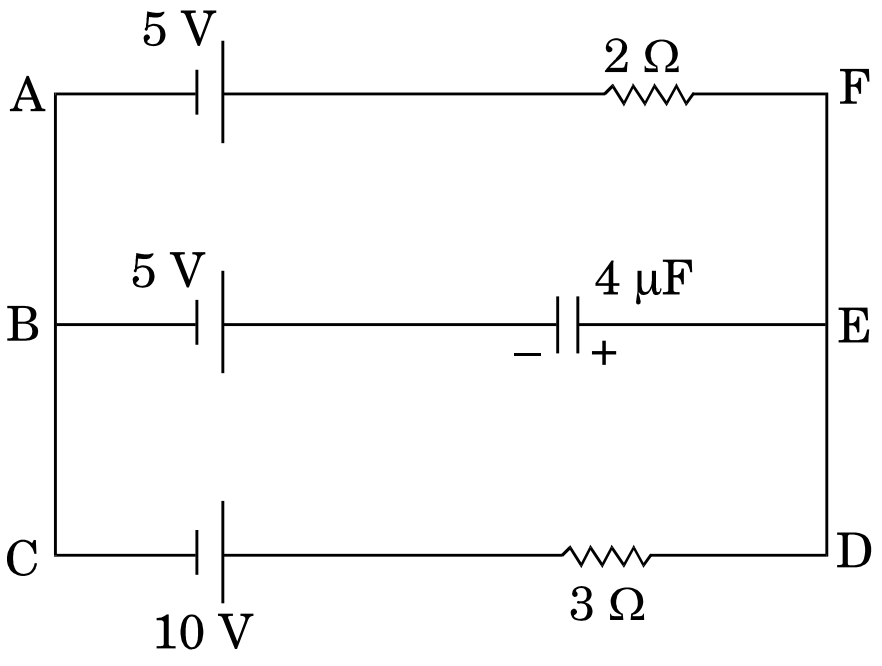
In the given circuit, with steady current, calculate the potential drop across the capacitor in terms of V.
Answer


In steady state branch BE is eliminated
$ \text{I}=\frac{10{\text{V}}-5\text{V}}{(3+2){\Omega}}\text{A}$
$=\text{1A}$
For loop EBCDE
$-v_c{-5+10-3\times1}=0$
$-{\text{V}}_c+10-8=0$
$\therefore{\text{V}_c}=2\text{ }\text{volt}$

Need a full question paper?

Generate a complete, print-ready paper with questions like this in minutes — across 16+ boards, with answer keys.
Start Generating Free

Similar questions

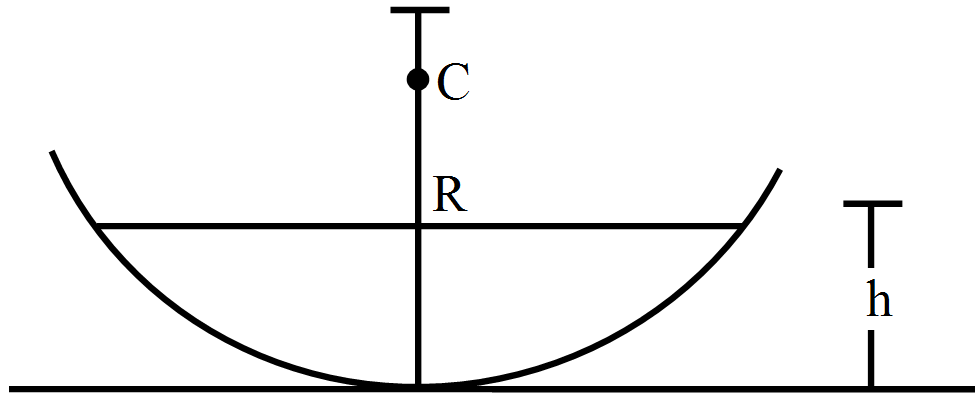
A concave mirror of radius R is kept on a horizontal. Water $\big($refractive index $=\mu\big)$ is poured into it upto a height h. Where should an object be placed so that its image is formed on itself?
Three capacitors of capacitances 2 pF, 3 pF and 4 pF are connected in parallel.
  1. What is the total capacitance of the combination?
  2. Determine the charge on each capacitor if the combination is connected to a 100 V supply.
A zener diode is fabricated by heavily doping both p- and n- sides of the junction. Explain, why? Briefly explain the use of zener diode as a de voltage regulator with the help of a circuit diagram.
How many time constants will elapse before the power delivered by a battery drops to half of its maximum value in an RC circuit?
A 5.0 diopter lens forms a virtual image which is 4 times the object placed perpendicularly on the principal axis of the lens. Find the distance of the object from the lens.
An electron microscope uses electrons accelerated by a voltage of 50 kV. Determine the de Broglie wavelength associated with the electrons. If other factors (such as numerical aperture, etc.) are taken to be roughly the same, how does the resolving power of an electron microscope compare with that of an optical microscope which uses yellow light?
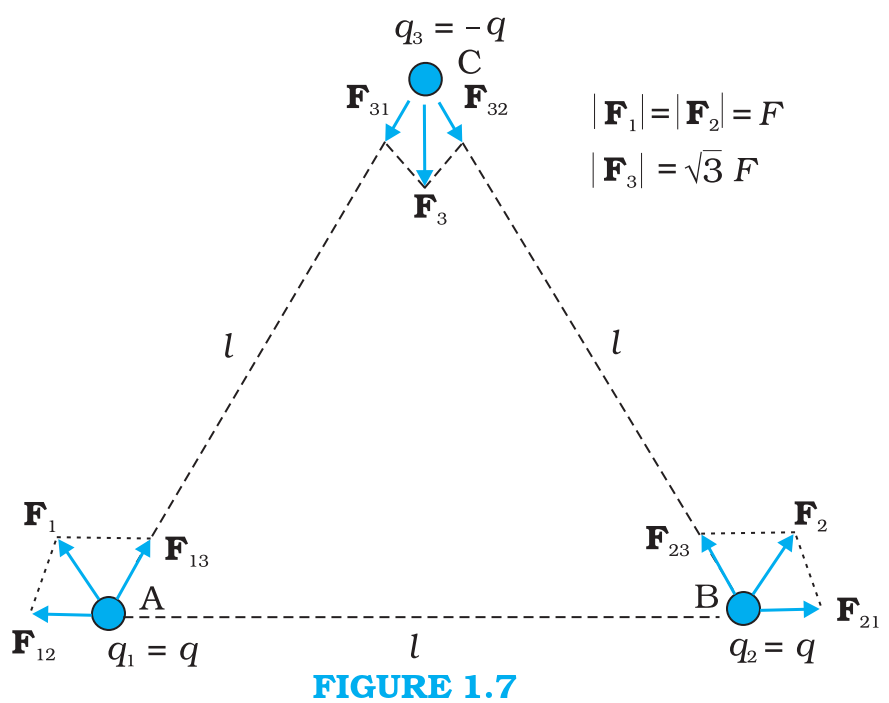
Consider the charges q, q, and –q placed at the vertices of an equilateral triangle, as shown in Fig. 1.7. What is the force on each charge?
Image
In a common emitter mode of a transistor, the d.c. current gain is 20, the emitter current is 7mA. Calculate (i) base current and (ii) collector current.
A spherical conductor of radius 12 cm has a charge of 1.6 × 10⁻⁷C distributed uniformly on its surface. What is the electric field:
  1. Inside the sphere
  2. Just outside the sphere
  3. At a point 18 cm from the centre of the sphere?
Four point charges $q_A = 2 \mu\ C, q_B = –5 \mu\ C, q_C = 2 \mu\ C,$ and $q_D = –5 \mu\ C$ are located at the corners of a square ABCD of side 10 cm. What is the force on a charge of 1 μC placed at the centre of the square?