Question
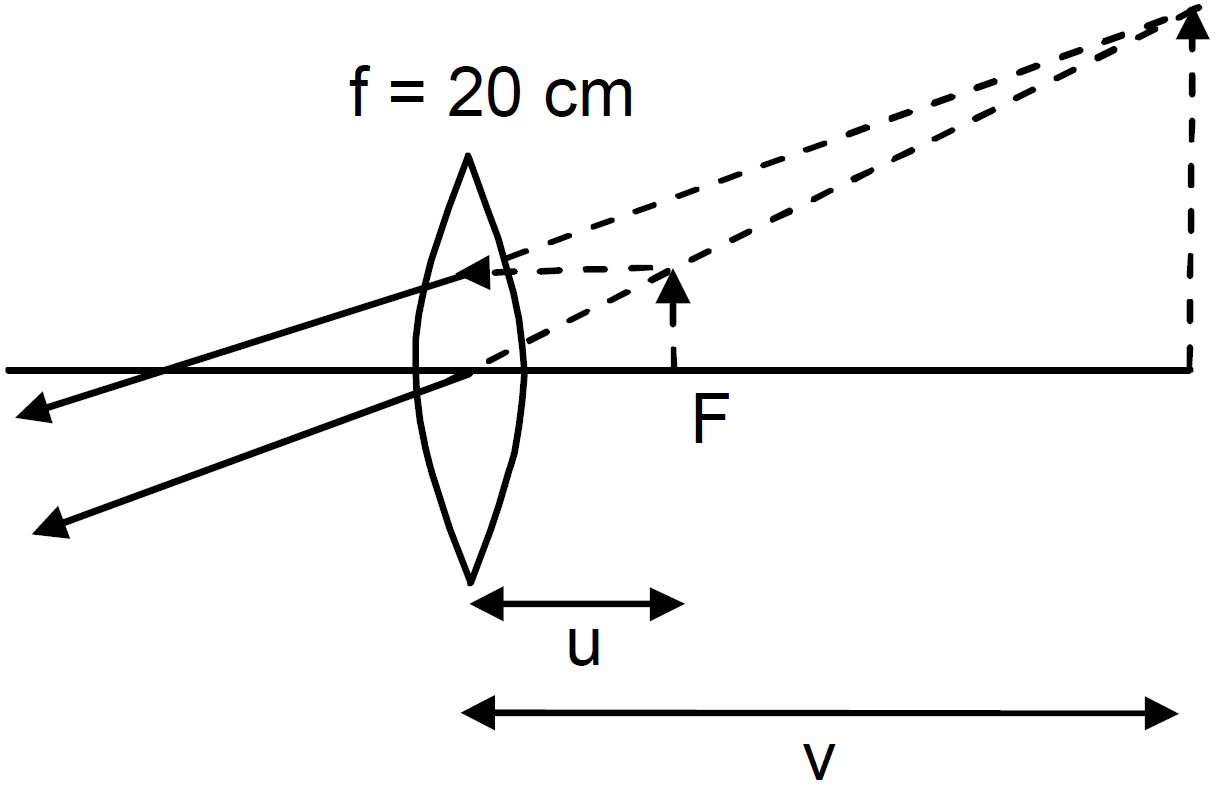
A 5.0 diopter lens forms a virtual image which is 4 times the object placed perpendicularly on the principal axis of the lens. Find the distance of the object from the lens.
Answer


Given, P = 5 diopter (convex lens)
$\Rightarrow\text{f}=\frac{1}{5}\text{m}=20\text{cm}$
Since, a virtual image is formed, u and v both are negative.Given, $\frac{\text{v}}{\text{u}}=4$
$\Rightarrow\text{v}=4\text{u} \ ...(1)$
From lens formula, $\frac{1}{\text{v}}-\frac{1}{\text{u}}=\frac{1}{\text{f}}$
$​​\Rightarrow\frac{1}{\text{f}}=\frac{1}{4\text{u}}-\frac{1}{\text{u}}​​\Rightarrow\frac{1}{20}=\frac{1-4}{4\text{u}}=-\frac{3}{4\text{u}}$
$\Rightarrow\text{u}=-15\text{cm}$
$\therefore$ Object is placed 15cm away from the lens.

Need a full question paper?

Generate a complete, print-ready paper with questions like this in minutes — across 16+ boards, with answer keys.

Start Generating Free

Similar questions

Use Huygens's principle to explain the formation of diffraction pattern due to a single slit illuminated by a monochromatic source of light.
When the width of the slit is made double the original width, how would this affect the size and intensity of the central diffraction band?
Calculate the amount of energy released during the $\alpha - $ decay of $^{238}_{92}\text{U}\to ^{234}_{92}\text{Th} + ^{4} _{2}\text{He}$Given:
  1. Atomic mass of $^{238}_{92}\text{U}= 238.05079u$
  2. Atomic mass of $^{234}_{90}\text{Th}= 234.04363u$
  3. Atomic mass of $^{4}_{2}\text{He}= 4.00260\text{ u}$
$\text{1u} = 931.5 \text{MeV/c}^{2}$
Is this decay spontaneous? Give reason.
What is the de Broglie wavelength associated with $(a)$ an electron moving with a speed of $5.4 \times 10^6 m / s$, and $(b)$ a ball of mass $150 g$ travelling at $30.0 m / s$ ?
A network of four 10 $\mu$F capacitors is connected to a 500 V supply as shown in the figure. Determine the
  1. equivalent capacitance of the network and
  2. charge on each capacitor
Draw the intensity distributions for (i) the fringes produced in interference, and (ii) the diffraction bands produced due to single slit. Write two points of difference between the phenomena of interference and diffraction.
  1. Three photo diodes $D_1, D_2$ and $D_3$ are made of semiconductors having band gaps of 2.5eV, 2eV and 3eV respectively. Which of them will not be able to detect light of wavelength 600nm?
  2. Why photodiodes are required to operate in reverse bias? Explain.
Figure shows a 11.7ft wide ditch with the approach roads at an angle of 15° with the horizontal. With what minimum speed should a motorbike be moving on the road so that it safely crosses the ditch?
Assume that the length of the bike is 5ft, and it leaves the road when the front part runs out of the approach road.
Explain the de-Broglie wavelength by explaining the waveform of matter.
A violin player riding on a slow train plays a 440Hz note. Another violin player standing near the track plays the same note. When the two are close by and the train approaches the person on the ground, he hears 4.0 beats per second. The speed of sound in air = 340m/s.
  1. Calculate the speed of the train.
  2. What beat frequency is heard by the player in the train?
  1. A parallel plate capacitor $(C_1)$ having charge Q is connected, to an identical uncharged capacitor $C_2$ in series. What would be the charge accumulated on the capacitor $C_2?$
  2. Three identical capacitors each of capacitance 3mF are connected, in tern, in series and in parallel combination to the common source of V volt. Find out the ratio of the energies stored in two configurations.