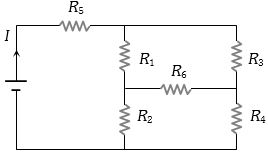
In the given circuit, it is observed that the current $I$ is independent of the value of the resistance $R_6$. Then the resistance values must satisfy
IIT 2001, Medium
Download our app for free and get started
c
(c) As $I$ is independent of ${R_6},$ no current flows through ${R_6}$ this requires that the junction of ${R_1}$ and ${R_2}$ is at the same potential as the junction of ${R_3}$ and ${R_4}$. This must satisfy the condition $\frac{{{R_1}}}{{{R_2}}} = \frac{{{R_3}}}{{{R_4}}},$ as in the Wheatstone bridge.
(c) As $I$ is independent of ${R_6},$ no current flows through ${R_6}$ this requires that the junction of ${R_1}$ and ${R_2}$ is at the same potential as the junction of ${R_3}$ and ${R_4}$. This must satisfy the condition $\frac{{{R_1}}}{{{R_2}}} = \frac{{{R_3}}}{{{R_4}}},$ as in the Wheatstone bridge.

Download our appand get started for free
Experience the future of education. Simply download our apps or reach out to us for more information. Let's shape the future of learning together!No signup needed.*
Similar Questions
- 1When two resistance $R_1$ and $R_2$ connected in series and introduced into the left gap of a meter bridge and a resistance of $10 \Omega$ is introduced into the right gap, a null point is found at $60 cm$ from left side. When $R_1$ and $R_2$ are connected in parallel and introduced into the left gap, a resistance of $3 \Omega$ is introduced into the right-gap to get null point at 40 cm from left end. The product of $R_1 R_2$ is $.............\Omega$View Solution
- 2A potentiometer consists of a wire of length $4\, m$ and resistance $10 \,\Omega$. It is connected to cell of $emf$ $2\, V$. The potential difference per unit length of the wire will be ............ $V/m$View Solution
- 3View SolutionWhich of the following is not equal to watt
- 4At room temperature, copper has free electron density of $8.4 \times {10^{28}}$ per ${m^3}$. The copper conductor has a cross-section of $10^{-6} \,m^2$ and carries a current of $5.4\, A$. The electron drift velocity in copper isView Solution
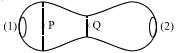
- 5Ametallic conductor of irregular cross-section is as shown in the figure. Aconstant potential difference is applied across the ends $(1)$ and $(2)$. Then :View Solution
- 6A button battery is rated $3 \,V$ and $225 \,mAh . A$ cricket ball (mass $=0.163 \,kg$ ) having energy equal to that stored in the battety will have speed closest to ............ $\,m / s$View Solution
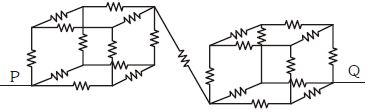
- 7Find the equivalent resistance between $P$ and $Q.$ (If each wire has a resistance $R$ )View Solution
- 8An insulating pipe of cross-section area $'A'$ contains an electrolyte which has two types of ions $\rightarrow$ their charges being $-e$ and $+2e$. $A$ potential difference applied between the ends of the pipe result in the drifting of the two types of ions, having drift speed $= v$ ($-ve$ ion) and $v/4$ ($+ve$ ion). Both ions have the same number per unit volume $= n$. The current flowing through the pipe isView Solution
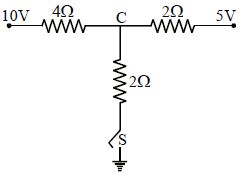
- 9As the switch $S$ is closed in the circuit shown in figure, current passed through it is .............View Solution
- 10A railway compartment is lit up by thirteen lamps each taking $2.1\, amp$ at $15\, volts$. The heat generated per second in each lamp will be ............ $cal$View Solution