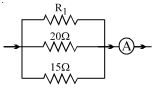
In the given circuit the current flowing through the resisitance $20$ $\mathrm{ohms}$ is $0.3$ $\mathrm{ampere}$ while the ammeter reads $0.8$ $\mathrm{ampere}.$ What is the value of $R_1$? ................ $\mathrm{ohm}$
Medium
Download our app for free and get started
Total current in ammeter is $0.8 \mathrm{A}$
Current through $20\, ohm$ resistor is $0.3 \mathrm{A},$ hence the voltage across it is
$V=0.3 \times 20=6 V$
Current through $15 \,ohm$ resistor is
$I=\frac{V}{R}=\frac{6}{15}=0.4 A$
Hence current through $\mathrm{R} 1$ is, $\mathrm{I}^{\prime}=0.8-(0.3+0.4)=0.1 \mathrm{A}$
Therefore,
$R 1=\frac{V}{I^{\prime}}=\frac{6}{0.1}=60 \Omega$

Download our appand get started for free
Experience the future of education. Simply download our apps or reach out to us for more information. Let's shape the future of learning together!No signup needed.*
Similar Questions
- 1Electric room radiator which operates at $225\, volts$ has resistance of $50\, ohms$. Power of the radiator is approximately ............... $W$View Solution
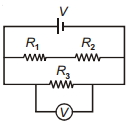
- 2In the circuit shown, $R_1$ is increased. What happens to the reading of the voltmeter (ideal)?View Solution
- 3If a wire of resistance $R$ is melted and recasted to half of its length, then the new resistance of the wire will beView Solution
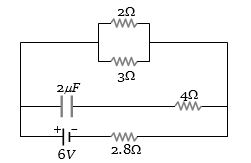
- 4In the figure shown, the capacity of the condenser $C$ is $2\,\mu F$. The current in $2\,\Omega $ resistor is ............... $A$View Solution
- 5A $1\,m$ long copper wire carries a current of $1\,A$. If the cross section of the wire is $2.0\,mm ^{2}$ and the resistivity of copper is $1.7 \times 10^{-8}\,\Omega\,m$. the force experienced by moving electron in the wire is $\times 10^{-23}\,N$. (charge on electron $=1.6 \times 10^{-19}\,C$ )View Solution
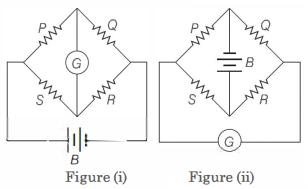
- 6Figure $(i)$ below shows a Wheatstone's bridge in which $P, Q, R$ and $S$ are fixed resistances, $G$ is a galvanometer and $B$ is a battery. For this particular case, the galvanometer shows zero deflection. Now, only the positions of $B$ and $G$ are interchanged, as shown in figure $(ii)$. The new deflection of the galvanometerView Solution
- 7The electric resistance of a certain wire of iron is $R$. If its length and radius are both doubled, thenView Solution
- 8Two conductors made of the same material are connected across a common potential difference. Conductor $A$ has twice the diameter and twice the length of conductor $B$. The power delivered to the two conductors ${P_A}$ and ${P_B}$ respectively is such that ${P_A}/{P_B}$ equals toView Solution
- 9View SolutionThe maximum current that flows through a fuse wire before it blows out varies with its radius as
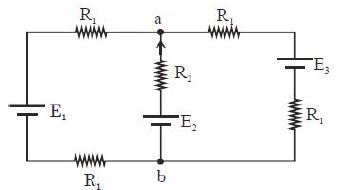
- 10For the circuit shown, with ${R_1} = 1.0\,\Omega $, ${R_2} = 2.0\,\Omega $, ${E_1} = 2\,V$ and ${E_2} = {E_3} = 4\,V$, the potential difference between the points $‘a’$ and $‘b’$ is approximately (in $V$)View Solution