The maximum current that flows through a fuse wire before it blows out varies with its radius as
Easy
Download our app for free and get started
(a) It is called safe current and is proportional to ${r^{3/2}}$.

Download our appand get started for free
Experience the future of education. Simply download our apps or reach out to us for more information. Let's shape the future of learning together!No signup needed.*
Similar Questions
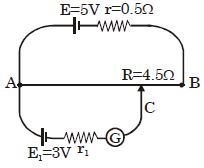
- 1In the given potentiometer circuit length of the wire $AB$ is $3\,m$ and resistance is $R = 4.5 \,\Omega.$ The length $AC$ for no deflection in galvanometer is ................ $\mathrm{m}$View Solution
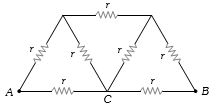
- 2In the circuit shown, the value of each resistance is $r$, then equivalent resistance of circuit between points $A$ and $B$ will beView Solution
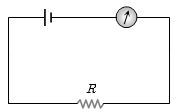
- 3A battery of $e.m.f.$ $10\, V$ and internal resistance $3\,\Omega $ is connected to a resistor as shown in the figure. If the current in the circuit is $0.5\, A$. then the resistance of the resistor will be ............. $\Omega$View Solution
- 4Resistance of $100\, cm$ long potentiometer wire is $10 \,\Omega$, it is connected to a battery ($2\, volt$) and a resistance $R$ in series. A source of $10\, mV$ gives null point at $40\, cm$ length, then external resistance $R$ is ........... $\Omega $View Solution
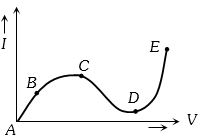
- 5From the graph between current $I$ and voltage $V$ shown below, identify the portion corresponding to negative resistanceView Solution
- 6$1.6\, mA$ current is flowing in conducting wire then the number of electrons flowing per second isView Solution
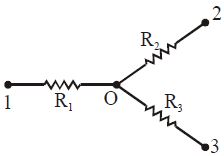
- 7.............. $A$ the current flowing through the resistance $R_2$ of the circuit shown in fig if the resistance are equal to $R_1 = 20\ \Omega, R_2 = 30 \ \Omega$ and $R_3 = 60 \ \Omega$ and potentials of points $1, 2$ and $3$ are equal to $V_1= 20\, V,$ $V_2 = 30\ V$ and $V_3 = 60\ V$View Solution
- 8A wire has a resistance of $12\, ohm$. It is bent in the form of equilateral triangle. The effective resistance between any two corners of the triangle isView Solution
- 9View SolutionIn potentiometer a balance point is obtained, when
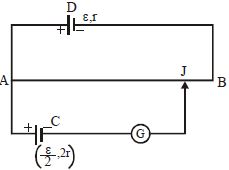
- 10In the figure, the potentiometer wire $AB$ of length $L$ and resistance $9r$ is joined to the cell $D$ of $emf$ $\varepsilon $ and internal resistance $r$. The cell $C's$ $emf$ is $\frac{\varepsilon }{2}$and its internal resistance is $2r$. The galvanometer $G$ will show no deflection when the length $AJ$ isView Solution