MCQ
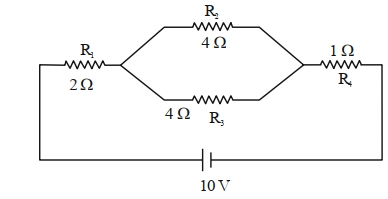
 In the given circuit, the current in resistance $\mathrm{R}_3 $ is : 
  •  $1 \mathrm{~A}$
  • B
     $1.5 \mathrm{~A}$
  • C
     $2 \mathrm{~A}$
  • D
     $2.5 \mathrm{~A}$

Answer

Correct option: A.
 $1 \mathrm{~A}$
a
$\mathrm{R}_{\mathrm{eq}}=2 \Omega+2 \Omega+1 \Omega=5 \Omega$

$\mathrm{i}=\frac{\mathrm{V}}{\mathrm{R}_{\mathrm{eq}}}=\frac{10}{5}=2 \mathrm{~A}$

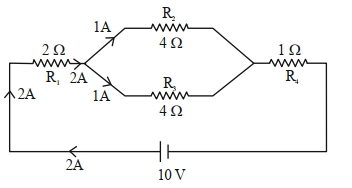
Current in resistance $\mathrm{R}_3=2 \times\left(\frac{4}{4+4}\right)$

$ =2 \times \frac{4}{8} $

$ =1 \mathrm{~A}$
Need a full question paper?

Generate a complete, print-ready paper with questions like this in minutes — across 16+ boards, with answer keys.
Start Generating Free

Similar questions

An electron is in an excited state in hydrogen-like atom. It has a total energy of $-3.4 \,eV.$ If the kinetic energy of the electron is $E$ and its de-Broglie wavelength is $\lambda ,$ then
The total charge on the system of capacitance $C _{1}=1\,\mu F , C _{2}=2\,\mu F , C _{3}=4\,\mu F$ and $C _{4}=3\,\mu F$ connected in parallel is $......\mu C$ (Assume a battery of $20\,V$ is connected to the combination)
A variable condenser is permanently connected to a 100 V battery. If the capacity is changed from 2μF to 10 μF, then change in energy is equal to
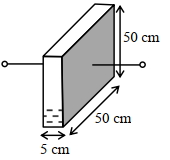
A container has a base of $50 \mathrm{~cm} \times 5 \mathrm{~cm}$ and height $50 \mathrm{~cm}$, as shown in the figure. It has two parallel electrically conducting walls each of area $50 \mathrm{~cm} \times 50 \mathrm{~cm}$. The remaining walls of the container are thin and non-conducting. The container is being filled with a liquid of dielectric constant $3$ at a uniform rate of $250 \mathrm{~cm}^3 \mathrm{~s}^{-1}$. What is the value of the capacitance of the container after $10$ seconds? [Given: Permittivity of free space $\in_0=9 \times 10^{-12} \mathrm{C}^2 \mathrm{~N}^{-1} \mathrm{~m}^{-2}$, the effects of the non-conducting walls on the capacitance are negligible]
When a glass rod is rubbed with a piece of silk cloth the rod ?
Hertz experiment is used for
Assertion : On going away from a point charge or a small electric dipole, electric field decreases at the same rate in both the cases.
Reason : Electric field is inversely proportional to square of distance from the charge or an electric dipole.
If the magnetic flux is expressed in weber, then magnetic induction can be expressed in
Which of the following statement is correct?
$512$ identical drops of mercury are charged to a potential of $2\, V$ each. The drops are joined to form a single drop. The potential of this drop is ......... $V.$