MCQ
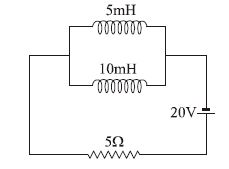
In the given circuit, the current through $5mH$ indicator in steady state is
  • A
    $4/3\, Amp$
  • $8/3\, Amp$
  • C
    $4\, Amp$
  • D
    $2/3\, Amp$

Answer

Correct option: B.
$8/3\, Amp$
b
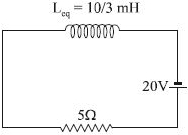
Leq. $=\frac{5 \times 10}{5 \times 10}=\frac{10}{3} \mathrm{\,mH}$

Current in steady start,

$I=\frac{20}{5}=4 \mathrm{\,A}$

As $L1$ and $L 2$ are in parallel

$I_{1}=I\left(\frac{I_{2}}{L_{1}+L_{2}}\right)=4 \times \frac{10}{10+5}$

$I_{1}=\frac{4 \times 10}{15}=\frac{8}{3} \,A$
Need a full question paper?

Generate a complete, print-ready paper with questions like this in minutes — across 16+ boards, with answer keys.
Start Generating Free

Similar questions

A point object is placed at a distance of $10\,cm$ and its real image is formed at a distance of $20\,cm$ from a concave mirror. If the object is moved by $0.1cm$ towards the mirror, the image will shift by about
If $\mathrm{R}_{\mathrm{p}}=7 \mathrm{~K} \Omega, \mathrm{gm}=2.5$ millimho, then on increasing plate voltage by 50 V, how much the grid voltage is changed so that plate current remains the same
If a rod has resistance 4 W and if rod is turned as half cycle then the resistance along diameter
If $m_1$ and $m_2$ are the refractive indices of the materials of core and cladding of an optical fibre, then the loss of light due to its leakage can be minimised by having
The slope of plate characteristic of a vacuum diode is $2 \times {10^{ - 2}}\,mA/V.$ The plate resistance of diode will be
Two identical current carrying coaxial loops, carry current I in an opposite sense. A simple amperian loop passes through both of them once. Calling the loop as C:
Which of the following parameters is the same for molecules of all gases at a given temperature?
Consider a uniform electric field in the $\hat{\text{Z}}$ direction. The potential is a constant:
A condenser of capacity $C$ is charged to a potential difference of $V_1$ . The plates of the condenser are then connected to an ideal inductor of inductance $L$. The current through the inductor when the potential difference across the condenser reduces to $V_2$ is
A concave mirror of radius $h$ is placed at the bottom of a tank containing a liquid of refractive index $μ$ upto a depth $d$ . An object $P$ is placed at height $h$ above the bottom of the mirror. Outside the liquid, an observer $O$ views the object and its image in the mirror. The apparent distance between these two will be