MCQ
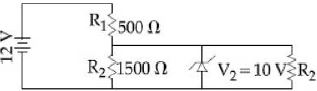
In the given circuit the current through Zener Diode is close to.......$mA$
  • $0$
  • B
    $6.7$
  • C
    $4$
  • D
    $6$

Answer

Correct option: A.
$0$
a
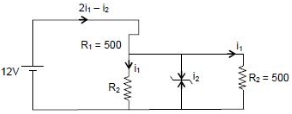
$12-500\left(2 i_{1}+i_{2}\right)-10=0$

$\Rightarrow \quad 2 i_{1}+i_{2}=\frac{2}{500}=\frac{1}{250}$

$< i_1$ when zenor has break down. $\mathrm{So}, \mathrm{i}_{2}=0$
Need a full question paper?

Generate a complete, print-ready paper with questions like this in minutes — across 16+ boards, with answer keys.
Start Generating Free

Similar questions

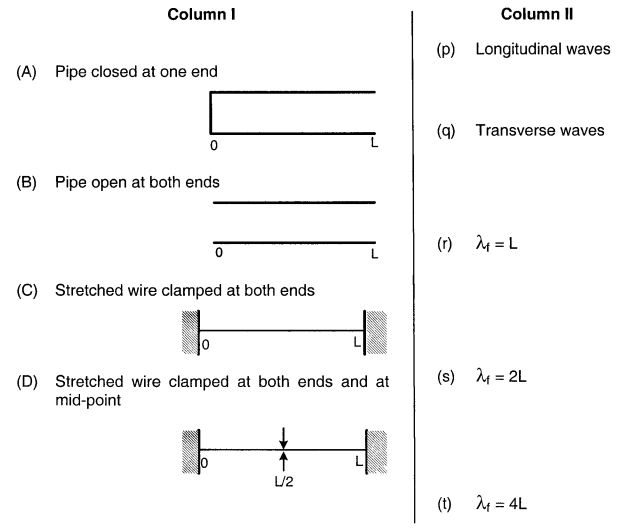
Column $I$ shows four systems, each of the same length $L$, for producing standing waves. The lowest possible natural frequency of a system is called its fundamental frequency, whose wavelength is denoted as $\lambda_{ f }$. Match each system with statements given in Column $II$ describing the nature and wavelength of the standing waves.
Two rotating bodies $A$ and $B$ of masses $m$ and $2\,m$ with moments of inertia $I_A$ and $I_B (I_B> I_A)$ have equal kinetic energy of rotation. If $L_A$ and $L_B$ be their angular momenta respectively, then
A galvanometer gives full scale reading of $50\ mA$ , when a $p.d.$ , across its terminals is $0.15\ V$ . It can be used as an ammeter of range $0 - 100\ A$ by connecting a shunt resistance of 
Which of the following is not the transverse wave
A current carrying coil is placed with its axis perpendicular to $N-S$ direction. Let horizontal component of earth's magnetic field be $H_0$ and magnetic field inside the loop be $H$. If a magnet is suspended inside the loop, it makes angle $\theta $ with $H$. Then $\theta =$
Which one of the following is a non-magnetic substance
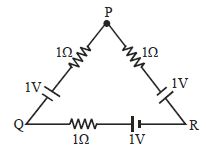
In given circuit find potential difference between $P$ and $Q$ .................. $V$
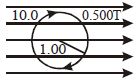
A single circular loop of radius $1.00\, m$ carries a current of $10.0\, mA$. It is placed in $a$ uniform magnetic field of magnitude $0.500\, T$ that is directed parallel to the plane of the loop as suggested in the figure. The magnitude of the torque exerted on the loop by the magnetic field is.
If a vector $\vec A$ is parallel to another vector $\vec B$ then the resultant of the vector $\vec A \times \vec B$ will be equal to
A particle of mass $m$  moving with velocity $v $ strikes a stationary particle of mass $2m$ and sticks to it. The speed of the system will be