MCQ
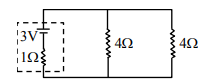
In the given circuit, the terminal potential difference of the cell is :
Image
  • A
    2 V
  • B
    4 V
  • C
    1.5 V
  • D
    3 V

Answer

Image
Image
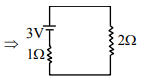
$\begin{aligned} i & =\frac{3}{1+2}=1 A \\ v & = E - ir \\ & =3-1 \times 1=2 V\end{aligned}$

Need a full question paper?

Generate a complete, print-ready paper with questions like this in minutes — across 16+ boards, with answer keys.
Start Generating Free

Similar questions

With what speed should a body be thrown upwards so that the distances traversed in $5^{\text {th }}$ second and $6^{\text {th }}$ second are equal $..........m/s$
Focal length of a convex lens of refractive index $1.5$ is $2 cm$. Focal length of lens when immersed in a liquid of refractive index of $1.25$ will be.......$cm$
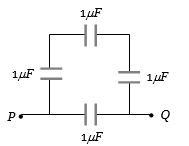
Four capacitors are connected as shown in the equivalent capacitance between the points $P$ and $Q$ is.......$\mu F$
Two simple pendulums whose lengths are $100 cm$ and $121 cm$ are suspended side by side. Their bobs are pulled together and then released. After how many minimum oscillations of the longer pendulum, will the two be in phase again
Equal charges are given to two spheres of different radii. The potential will
If the gravitational field in the space is given as $\left(-\frac{ K }{ r ^2}\right)$. Taking the reference point to be at $r =2\,cm$ with gravitational potential $V =10\,J / kg$. Find the gravitational potential at $r =3\,cm$ in $SI$ unit (Given, that $K =6\,J cm / kg$ )
In electromagnetic induction, the induced $e.m.f$. in a coil is independent of
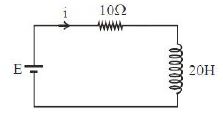
A $20\, Henry$ inductor coil is connected to a $10\, ohm$ resistance in series as shown in figure. The time at which rate of dissipation of energy (Joule’s heat) across resistance is equal to the rate at which magnetic energy is stored in the inductor, is
Antiparticle of electron is
In a certain region of space, variation of potential with distance from origin as we move along $x$-axis is given by $V=8 x^2+2$, where $x$ is the $x$-coordinate of a point in space. The magnitude of electric field at a point $(-4,0)$ is .......... $V / m$