MCQ
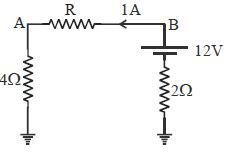
In the given circuit
  • A
    $R = 8\,\Omega $
  • $R = 6\,\Omega $
  • C
    $R = 10\,\Omega $
  • D
    $R = 20\,\Omega $

Answer

Correct option: B.
$R = 6\,\Omega $
b

Need a full question paper?

Generate a complete, print-ready paper with questions like this in minutes — across 16+ boards, with answer keys.
Start Generating Free

Similar questions

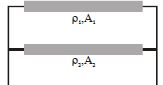
Two conductors of same length are connected in parallel as shown in figure. Their cross-sectional areas $A_1$ and $A_2$ and their resistivities are ${\rho _1}$ and  ${\rho _2}$ respectively. The equivalent resistivity of this combination is
In an interference experiment, third bright fringe is obtained at a point on the screen with a light of $700 \,nm$. What should be the wavelength of the light source in order to obtain 5th bright fringe at the same point......$nm$
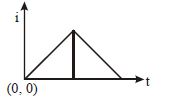
The current $'i'$ in an inductance coil varies with time $'t'$ according to following graph which of the following plots shows the variation of voltage in the coil
Li nucleus has three protons and four neutrons. Mass of lithium nucleus is $7.03.6005\ amu$. Mass of proton is $1.007277\ amu$ and mass of neutron is $1.008665\ amu$. Mass defect for lithium nucleus in amu is:
A long, straight wire of radius $a$ carries a current distributed uniformly over its cross-section. The ratio of the magnetic fields due to the wire at distance $\frac{a}{3}$ and $2 a,$ respectively from the axis of the wire is
In Young’s double slit experiment, the aperture screen distance is $2\,m$. The fringe width is $1\, mm$. Light of $600\, nm $ is used. If a thin plate of glass ($\mu = 1.5$) of thickness $0.06 \,mm$ is placed over one of the slits, then there will be a lateral displacement of the fringes by....$cm$
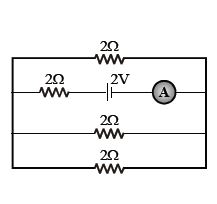
The reading of the ammeter as shown in figure
A house is served by 220 V supply line in a circuit protected by a 9 ampere fuse. The maximum number of 60 W lamps in parallel that can be turned on, is
When rate of change of current in a circuit is unity, the induced emf is equal to.
If $4 \times {10^{20}}eV$ energy is required to move a charge of $0.25$ coulomb between two points. Then what will be the potential difference between them......$V$