Question
Two dice are thrown simultaneously. What is the probability that:
  1. $5$ will not come up on either of them?
  2. $5$ will come up on at least one?
  3. $5$ will come up at both dice?

Answer

Given: Two dice are thrown
To Find: Probability of the following:
Let us first write the all possible events that can occur
$(1,1), (1,2), (1,3), (1,4), (1,5), (1,6),$
$(2,1), (2,2), (2,3), (2,4), (2,5), (2,6),$
$(3,1), (3,2), (3,3), (3,4), (3,5), (3,6),$
$(4,1), (4,2), (4,3), (4,4), (4,5), (4,6),$
$(5,1), (5,2), (5,3), (5,4), (5,5), (5,6),$
$(6,1), (6,2), (6,3), (6,4), (6,5), (6,6)$
Hence total number of events is $6^2 = 36$
Favorable events i.e. 5 will not come up on either of them
$(1, 1), (1, 2), (1, 3), (1, 4), (1, 6),$
$(2, 1), (2, 2), (2, 3), (2, 4), (2, 6),$
$(3, 1), (3, 2), (3, 3), (3, 4), (3, 6),$
$(4, 1), (4, 2), (4, 3), (4, 4), (4, 6),$
$(6, 1), (6, 2), (6, 3), (6, 4), (6, 6)$
Hence total number of favorable events i.e. $5$ will not come up on either of them is $25$

We know that $\text{Probability}=\frac{\text{Number of favourable event}}{\text{Total number of event}}$

Hence probability that 5 will not come up on either of them is equal to $=\frac{25}{36}$
  1. Favorable events i.e. 5 will come on at least once
$(1, 5), (2, 5), (3, 5), (4, 5),$
$(5, 1), (5, 2), (5, 3), (5, 4), (5, 5), (5, 6), (6, 5),$
Hence total number of favorable events i.e.$5$ will not come on at least once is $11$

We know that $\text{Probability}=\frac{\text{Number of favourable event}}{\text{Total number of event}}$

Hence probability of getting i.e. $5$ will come on at least once is equal to $=\frac{11}{36}$
  1. Favorable events i.e. $5$ will come on both side is $(5, 5)$
Hence total number of favorable events i.e. $5$ will come on both side is $1$

We know that $\text{Probability}=\frac{\text{Number of favourable event}}{\text{Total number of event}}$

Hence probability of getting $5$ will come on both side is equal to $=\frac{1}{36}$
Need a full question paper?

Generate a complete, print-ready paper with questions like this in minutes — across 16+ boards, with answer keys.

Start Generating Free

Similar questions

Find the sum of first n terms of an AP whose nth term is (5 - 6n). Hence, find the sum of its first 20 terms.
It is given that $\triangle\text{ABC}\sim\triangle\text{EDF}$ such that AB = 5cm, AC = 7cm, DF= 15cm and DE = 12cm. Find the lengths of the remaining sides of the triangles.
Draw the graphs of the equations $x-y+1=0$ and $3 x+2 y-12=0$. Write the co$-$ordinates of the vertices of the triangle formed by these lines and the $x -$axis and shade the corresponding triangular region.
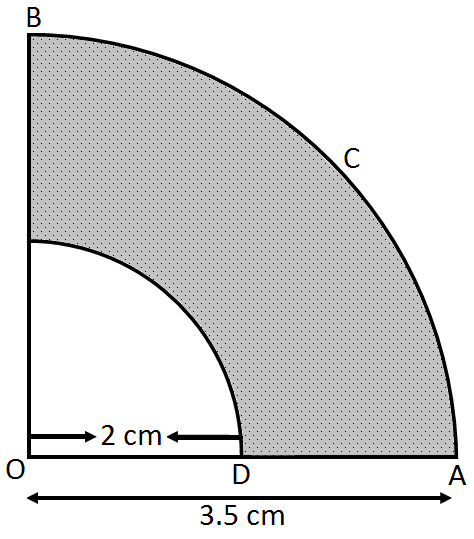
In the following figure, OACB is a quadrant of a circle with centre O and radius 3.5cm. If OD = 2cm, find the area of the: (i) Quadrant OACB (ii) Shaded region.
??The following table gives the frequency distribution of the percentage of marks obtained by 2300 students in a competitive examination.
Marks obtained (in per cent)
11-20
21-30
31-40
41-50
51-60
61-70
71-80
Number of students
141
221
439
529
495
322
153
  1. Convert the given frequency distribution into the continuous form.
  2. Find the median class and write its class mark.
  3. Find the modal class and write its cumulative frequency.
In a $\triangle\text{ABC, D}$ and E are points on the sides AB and AC respectively. For the following cases show that DE || BC:
AB = 10.8cm, BD = 4.5cm, AC = 4.8cm and AE = 2.8cm.
Prove that $\frac{\sin \theta-\cos \theta+1}{\sin \theta+\cos \theta-1}=\frac{1}{\sec \theta-\tan \theta}$
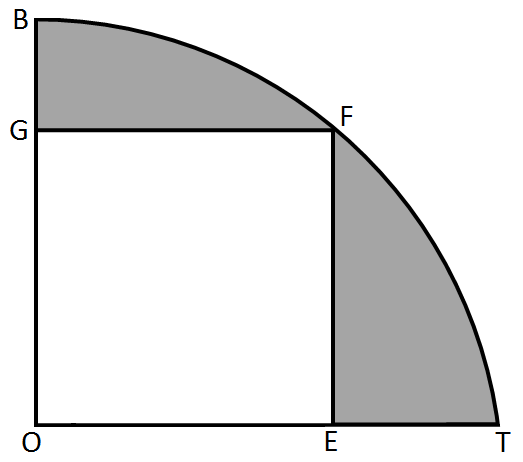
In the following figure, $O E=20 cm$. In sector $O S F T$, square $O E F G$ is inscribed. Find the area of the shaded region.
In a quadrilateral $ABCD$, given that $\angle\text{A}+\angle\text{D}=90^\circ.$ Prove that $AC^2 + BD^2 = AD^2 + BC^2.$
Peter throws two different dice together and finds the product of the two numbers obtained. Rina throws a die and squares the number obtained. Who has the better chance to get the number $25$ ?