Question
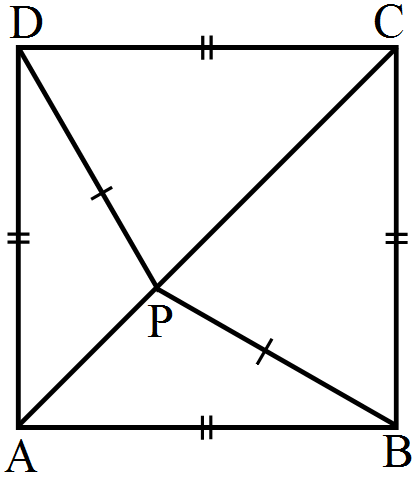
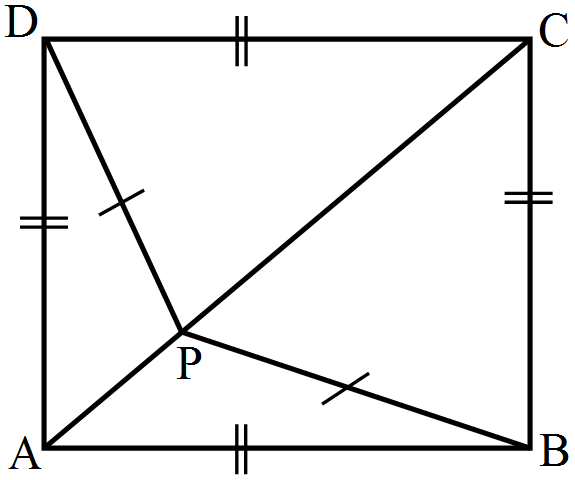
In the given figure, ABCD is a square and P is a point inside it such that PB = PD. Prove that CPA is a straight line.
Answer

Given: ABCD is a sqaure and P is a point inside it such that PB = PD To Prove: CPA is a straight line. Proof: In $\triangle\text{APD}$ and $\triangle\text{APB}$$\text{DA = AB}$ [$\therefore$ ABCD is a square]
$\text{AP = AP}$ [Common]
and, $\text{PB = PD}$ [Given] Thus by Side-Side-Side criterion of congruence, we have$\triangle\text{APD}\cong\triangle\text{APB}$
The corresponding parts of the congruent triangles are equal.$\therefore\angle\text{APD}=\angle\text{APB}...(1)$
Now consider the triangles, $\triangle\text{CPD}$ and $\triangle\text{CPB}.$$\text{CD = CB}$ [$\therefore$ ABCD is a square]
$\text{CP = CP}$ [Common]
and, $\text{PB = PD}$ [Given] Thus by Side-Side-Side criterion of congruence, we have$\triangle\text{CPD}\cong\triangle\text{CPB}$
The corresponding parts of the congruents triangle are equal. Hence we have$\angle\text{CPD}=\angle\text{CPB}....(2)$
Adding both sides of (1) and (2) we get$\angle\text{APD}+\angle\text{CPD}=\angle\text{APB}+\angle\text{CPB}...(3)$
Angles aronud the point P add upto 360°,$\Rightarrow\angle\text{APD}+\angle\text{CPD}+\angle\text{APB}+\angle\text{CPB}=360^{\circ}$
$\Rightarrow\angle\text{APB}+\angle\text{CPB}=360^{\circ}-(\angle\text{APD}+\angle\text{CPD})...(4)$
Substituting (4) in (3) we get,$\angle\text{APD}+\angle\text{CPD}=360^{\circ}-(\angle\text{APD}+\angle\text{CPD})$
i.e. $2(\angle\text{APD}+\angle\text{CPD})=360^{\circ}$$\angle\text{APD}+\angle\text{CPD}=\frac{360}{2}=180^{\circ}$
This proves that CPA is a straight line.

Need a full question paper?

Generate a complete, print-ready paper with questions like this in minutes — across 16+ boards, with answer keys.
Start Generating Free

Similar questions

Construct ∆ABC, in which BC = 6.2 cm, ∠ACB = 50°, AB + AC = 9.8 cm.
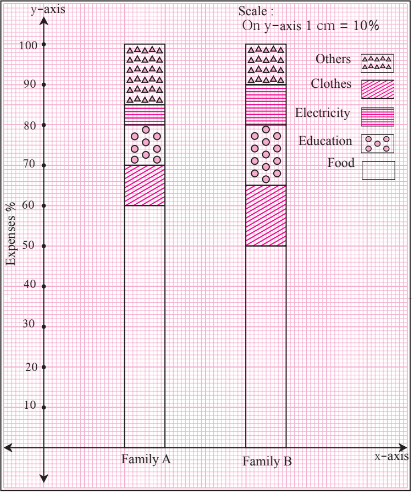
In the neighbouring figure, percentage bar-diagram is given. Percentage expenses on different items of two families are given.
Answer the following questions based on it :
(i) Write the percentage expenses of every component for each family.
(ii) Which family spends more percent of expenses on food as compared to the other and by how much ?
(iii) What are the percentage expenses on other items ?
(iv) Which family shows more percentage expenses on electricity?
(v) Which family's percentage expense is more on education ?

Image

$ABCD$ is a parallelogram. $P$ is the mid-point of $AB. BD$ and $CP$ intersect at $Q$ such that $CQ : QP = 3 : 1.$
If$\text{ar}(\triangle\text{PBQ})=10\text{cm}^2,$ find the area of parallelogram $ABCD.$
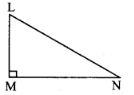
In right angled $\triangle LMN$, if $\angle N =\theta, \angle M =90^{\circ}, \cos \theta=\frac{24}{25}$, find $\sin \theta$ and $\tan \theta$. Similarly, find $\left(\sin ^2 \theta\right)$ and $\left(\cos ^2 \theta\right)$
Image
A two digit number is 4 times the sum of its digits. If we interchange the digits, the number obtained is 9 less than 4 times the original number. Then find the number.
Simplify the following expressions:$\big(\text{x}+\text{y}+\text{z}\big)^2+\Big(\text{x}+\frac{\text{y}}{2}+\frac{\text{z}}{3}\Big)^2-\Big(\frac{\text{x}}{2}+\frac{\text{y}}{3}+\frac{\text{z}}{4}\Big)^2$
K, L, M and N are points on the sides AB, BC, CD and DA respectively of a square ABCD such that AK = BL = CM = DN. Prove that KLMN is a square.
Which number should be subtracted from 12, 16 and 21 so that resultant numbers are in continued proportion?
In a circle of radius $5\ cm$, $AB$ and $CD$ are two parallel chords of lengths $8\ cm$ and $6\ cm$ respectively. Calculate the distance between the chords if they are:
  1. On the same side of the centre.
  2. On the opposite sides of the centre.
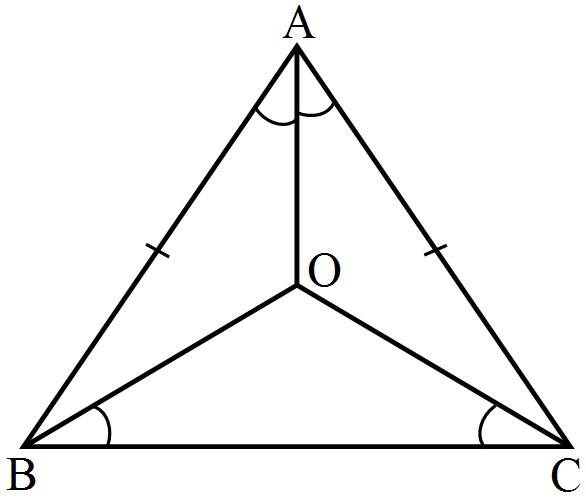
In $\triangle\text{ABC,}$ AB = AC and the bisectors of $\angle\text{B}$ and $\angle\text{C}$ meet at a point O. Prove that BO = CO and the ray AO is the bisector of $\angle\text{A}.$