MCQ
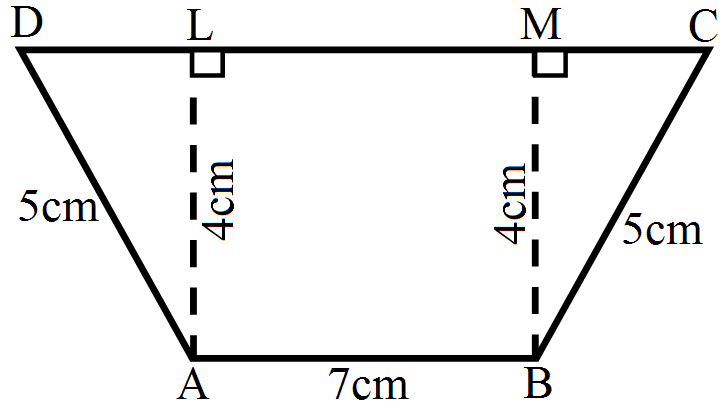
In the given figure $A B C D$ is a trapezium such that $A L \perp D C$ and $B M \perp D C$. If $A B=7 \mathrm{~cm}, B C=A D=5 \mathrm{~cm}$ and $A L=$ $B M=4 \mathrm{~cm}$, then $\operatorname{ar}($ trapezium $ABCD)=?$
  • A
    $24 \mathrm{~cm}^2$
  • $40 \mathrm{~cm}^2$
  • C
    $55 \mathrm{~cm}^2$
  • D
    $27.5 \mathrm{~cm}^2$

Answer

Correct option: B.
$40 \mathrm{~cm}^2$

In right $\triangle \mathrm{BMC}$,
By pythagoras theorem,
$\mathrm{BC}^2=\mathrm{BM}^2+C M^2$
$\Rightarrow \mathrm{CM}^2=\mathrm{BC}^2-\mathrm{BM}^2$
$\Rightarrow \mathrm{CM}^2=5^2-4^2$
$\Rightarrow \mathrm{CM}^2=25-16$
$\Rightarrow C M^2=9$
$\Rightarrow \mathrm{CM}=3 \mathrm{~cm}$
In right $\triangle \mathrm{ALD}$
By pythagoras theorem,
$A D^2=A L^2+D L^2$
$\Rightarrow D L^2=A D^2-A L^2$
$\Rightarrow D L^2=5^2-4^2$
$\Rightarrow D L^2=25-16$
$\Rightarrow D L^2=9$
$\Rightarrow D L=3 \mathrm{~cm}$
Since $AMML$ forms a rectangle, the opposite sides are equal.
So, $\mathrm{AB}=\mathrm{LM}=7 \mathrm{~cm}$
Area of a trapezium $=\frac{1}{2} \times$ (Sum of the parallel sides) $\times$ Distance between the parallel sides
$=\frac{1}{2} \times(\mathrm{AB} \times \mathrm{CD}) \times \mathrm{AL}$
$=\frac{1}{2} \times(3+7+3) \times 4$
$=40 \mathrm{~cm}^2$

Need a full question paper?

Generate a complete, print-ready paper with questions like this in minutes — across 16+ boards, with answer keys.

Start Generating Free