Question types

AreaAreas of Parallelograms and Triangles question types

75 questions across 6 question groups — pick any mix to generate a Maths paper with step-by-step answer keys.

75
Questions
6
Question groups
5
Question types
Sample Questions

AreaAreas of Parallelograms and Triangles questions

One sample from each question group in this chapter. Select any group above to see the full set with answer keys.

Q 1M.C.Q1 Mark
Look at the statements given below:
$i.$ A parallelogram and a rectangle on the same base and between the same parallels are equal in area.
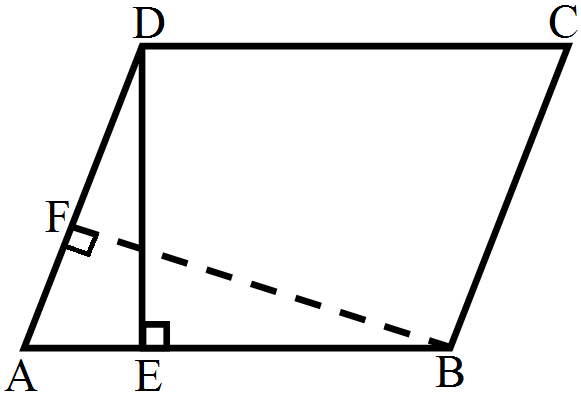
$ii.$ In a $\| gm \text{ABCD},$ it is given that $AB = 10\ cm.$
The altitudes $DE$ on $AB$ and $BF$ on $AD$ being $6\ cm$ and $8\ cm$ respectively, then $AD = 7.5\ cm.$
$iii.$ Area of a $\| gm =\frac{1}{2}\times\text{base}\times\text{altitude}.$
Which is true?
  • A
    $I$ only
     
  • B
    $II$ only
     
  • $I$ and $II$
     
  • D
    $II$ and $III$

Answer: C.

View full solution
Q 2M.C.Q1 Mark
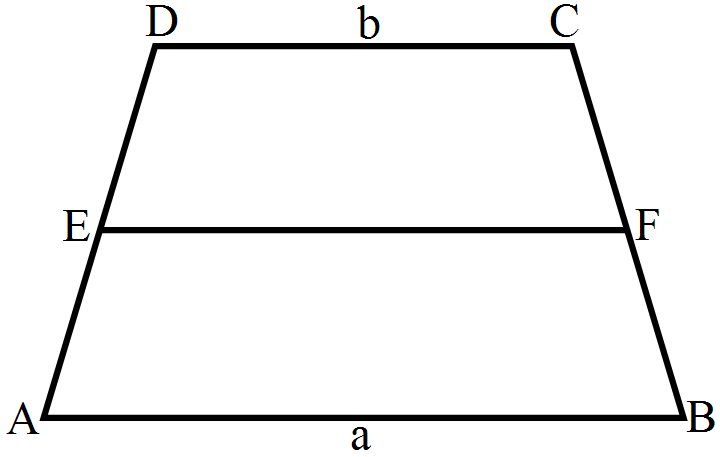
In the given figure $ABCD$ is a trapezium in which $AB || DC$ such that $AB = a\ cm$ and $DC = b\ cm.$ If $E$ and $F$ are the midpoints of $AD$ and $BC$ respectively. Then, $ar(ABFE) : ar(EFCD) = ?$
  • A
    $a : b$
  • B
    $(a + 3b) : (3a + b)$
  • $(3a + b) : (a + 3b)$
  • D
    $(2a + b) : (3a + b)$

Answer: C.

View full solution
Q 3M.C.Q1 Mark
If a triangle and a parallelogram are on the same base and between the same parallels, then the ratio of the area of the triangle to the area of the parallelogram is:
  • $1 : 2$
  • B
    $1 : 3$
  • C
    $1 : 4$
  • D
    $3 : 4$

Answer: A.

View full solution
Q 4M.C.Q1 Mark
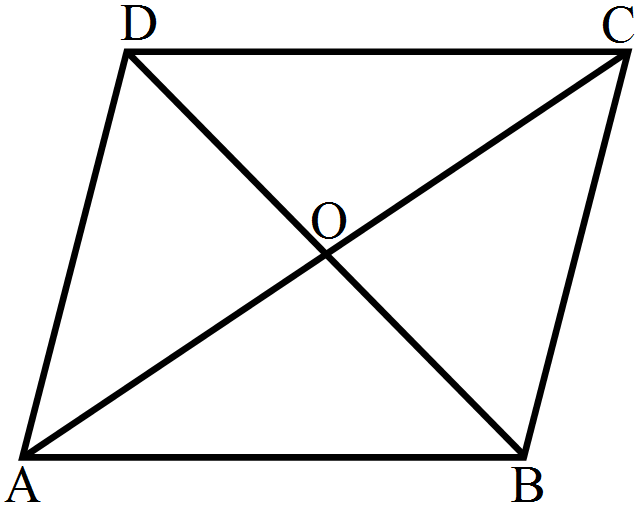
In the given figure, $A B C D$ is a $\| g m$ in which diagonals $A C$ and $B D$ intersect at $O$. If ar $(\| g m A B C D)$ is $52 \mathrm{~cm}^2$, then the $\operatorname{ar}(\triangle \mathrm{AOB})=$ ?
  • A
    $26 \mathrm{~cm}^2$
  • B
    $18.5 \mathrm{~cm}^2$
  • C
    $39 \mathrm{~cm}^2$
  • $13 \mathrm{~cm}^2$

Answer: D.

View full solution
Q 5M.C.Q1 Mark
Which of the following is a false statement$?$
 
  • A
    A median of a triangle divides it into two triangles of equal area.
  • B
    The diagonals of a ||gm divide it into four triangles of equal area.
  • C
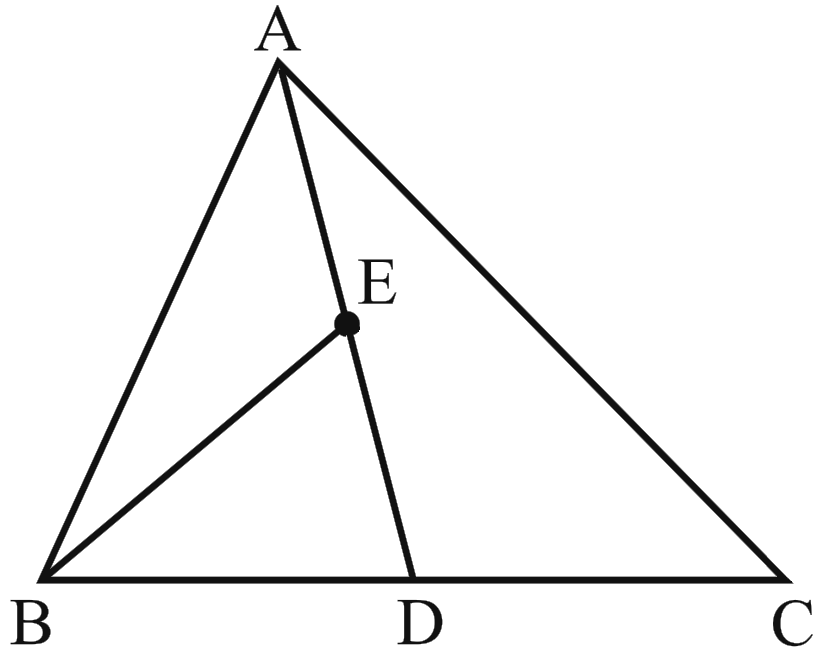
    In a $\triangle\text{ABC},$ if $E$ is the midpoint of median $AD$, then $\text{ar}(\triangle\text{BED})=\frac{1}{4}\text{ar}(\triangle\text{ABC}).$
  • In a trapezium $ABCD,$ it is given that $AB || DC$ and the diagonals $AC$ and $BD$ intersect at $O.$ Then, $\text{ar}(\triangle\text{AOB})=\text{ar}(\triangle\text{ABC}).$

Answer: D.

View full solution
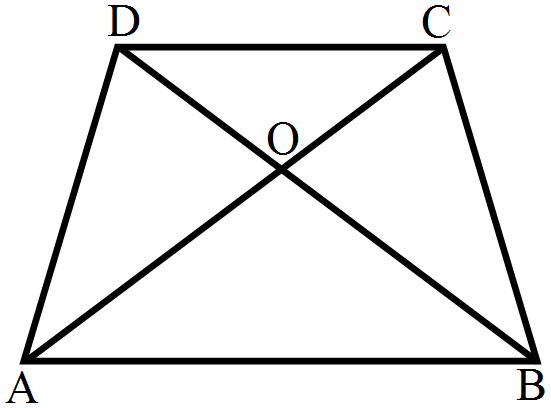
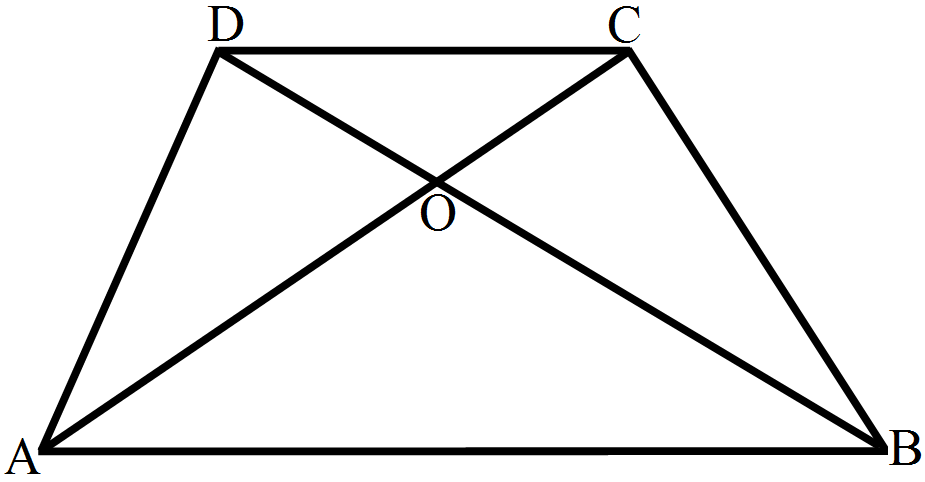
In the adjoining figure, $ABCD$ is a trapezium in which $AB \| DC$ and its diagonals $AC$ and $BD$ intersect at $O.$
Prove that $\text{ar}(\triangle\text{AOD})=\text{ar}\triangle\text{BOC}.$
View full solution
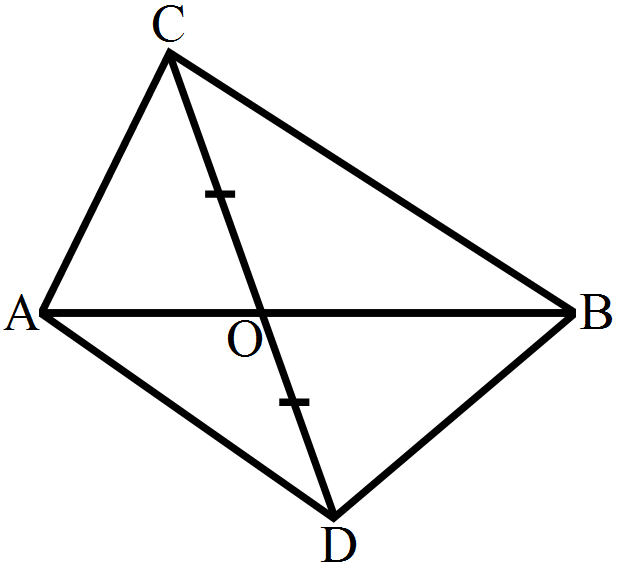
In the adjoining figure, $ABC$ and $ABD$ are two triangles on the same base $AB$. If line segment $CD$ is bisected by $AB$ at $O$, show that $\text{ar}(\triangle\text{ABC})=\text{ar}(\triangle\text{ABD}).$
View full solution
Q 163 Marks Question3 Marks
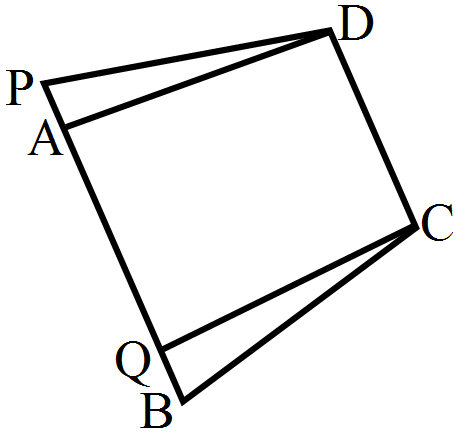
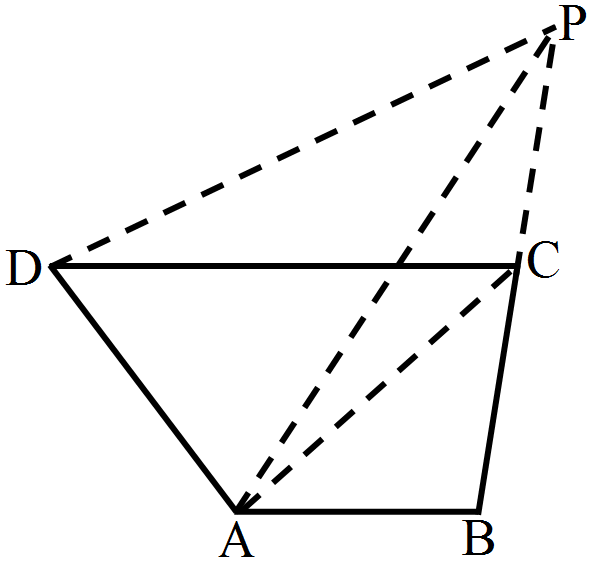
In the adjoining figure, $ABCD$ is a quadrilateral. A line through $D,$ parallel to $AC,$ meets $BC$ produced in $P.$ Prove that $\text{ar}(\triangle\text{ABP})=\text{ar}(\text{quadrilateral ABCD}).$
View full solution
Q 193 Marks Question3 Marks
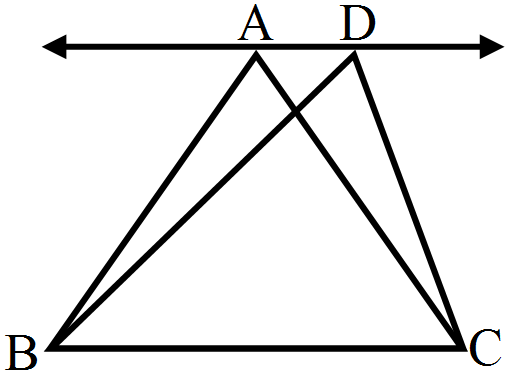
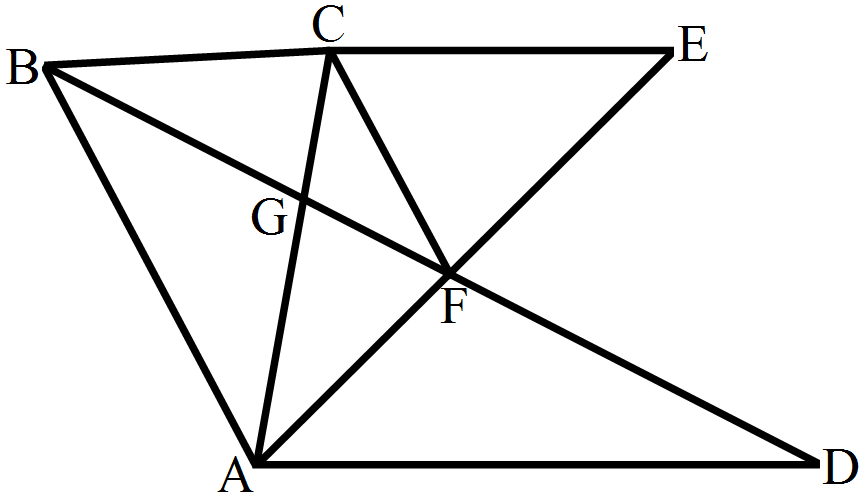
In the adjoining figure, $BD || CA, E$ is the midpoint of $CA$ and $\text{BD}=\frac{1}{2}\text{CA}.$ Prove that $\text{ar}(\triangle\text{ABC})=2\text{ar}(\triangle\text{DBC}).$
View full solution
Q 203 Marks Question3 Marks
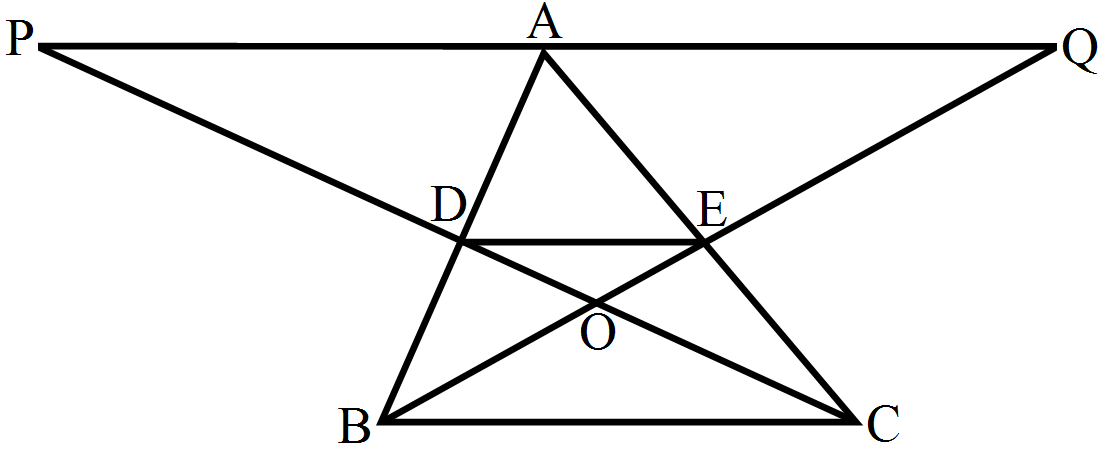
In the adjoining figure, $D$ and $E$ are respectively the midpoints of sides $AB$ and $AC$ of $\triangle\text{ABC}.$ If $PQ || BC$ and $CDP$ and $BEQ$ are straight lines then prove that$\text{ar}(\triangle\text{ABQ})=\text{ar}(\triangle\text{ACP}).$
View full solution
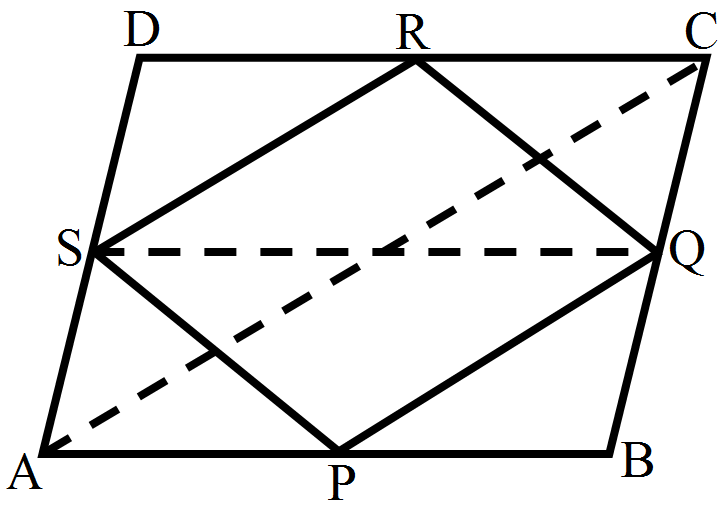
$P, Q, R, S$ are respectively the midpoints of the sides $AB, BC, CD$ and $DA$ of $||gm$ $ABCD$.
Show that $PQRS$ is a parallelogram and also show that $\text{ar}(||\text{gm PQRS})=\frac{1}{2}\times\text{ar}(||\text{gm ABCD}).$
View full solution
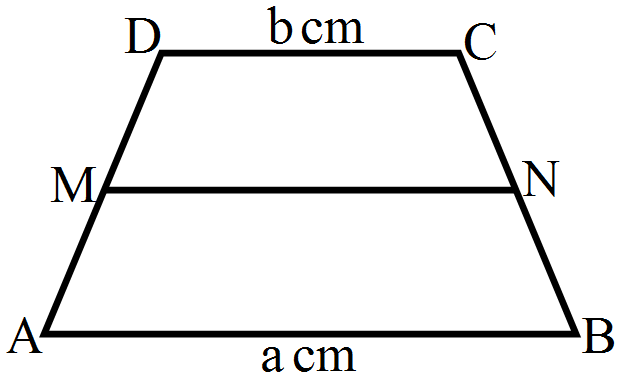
In a trapezium $ABCD, AB\ ||\ DC, AB = a\ cm$, and $DC = b\ cm$. If $M$ and $N$ are the midpoints ofthe nonparallel sides, $AD$ and $BC$ respectively then find the ratio of $ar(DCNM)$ and $ar(MNBA)$.
View full solution
$ABCD$ is a trapezium in which $AB\ ||\ CD, AB = 16\ cm$ and $DC = 24\ cm$. If $E$ and $F$ are respectively the midpoints of $AD$ and $BC$, prove that $\text{ar(ABFE)}=\frac{9}{11}\text{ar(EFCD)}.$
View full solution
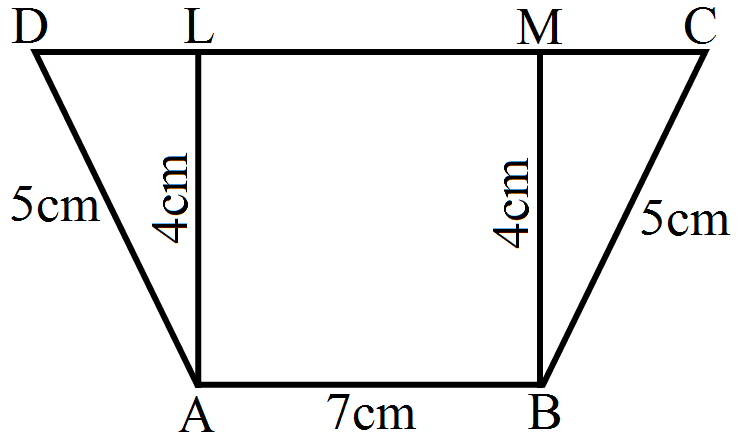
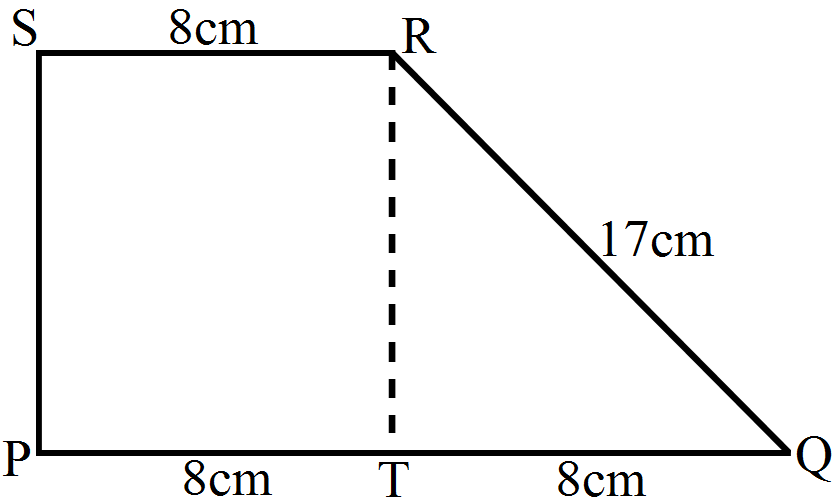
In the adjoining figure, $ABCD$ is a trapezium in which $AB || DC; AB = 7\ cm; AD = BC = 5\ cm$ and the distance between $AB$ and $DC$ is $4\ cm$. Find the length of $DC$ and hence, find the area of trap. $ABCD$.
View full solution
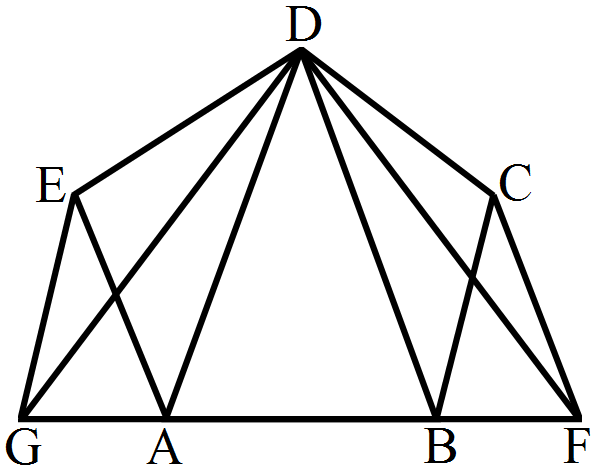
The given figure shows a pentagon $ABCDE$. $EG$, drawn parallel to $DA$, meets $BA$ produced at $G$, and $CF$, drawn parallel to $DB$, meets $AB$ produced at $F$. Show that: $\text{ar}(\text{pentagon ABCDE})=\text{ar}(\triangle\text{DGF}).$
View full solution
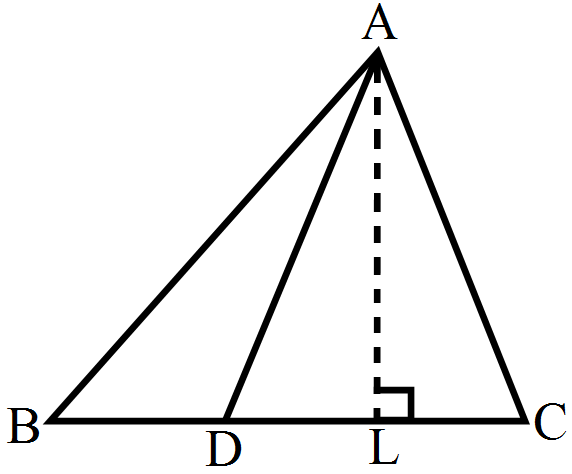
In the adjoining figure, the point $D$ divides the side $BC$ of $\triangle\text{ABC}$ in the ratio $m : n$. Prove that $\text{ar}(\triangle\text{ABD}):\text{ar}(\triangle\text{ADC})=\text{m}:\text{n}$.
View full solution
The base $BC$ of $\triangle\text{ABC}$ is divided at $D$ such that $\text{BD}=\frac{1}{2}\text{DC}.$ Prove that $\text{ar}(\triangle\text{ABD})=\frac{1}{3}\times\text{ar}(\triangle\text{ABC}).$
View full solution

Generate a AreaAreas of Parallelograms and Triangles paper free

Pick question groups from the list above, set marks and difficulty, and export a branded PDF with step-by-step answer keys. First 3 chapters free — no signup.

Download App