Question
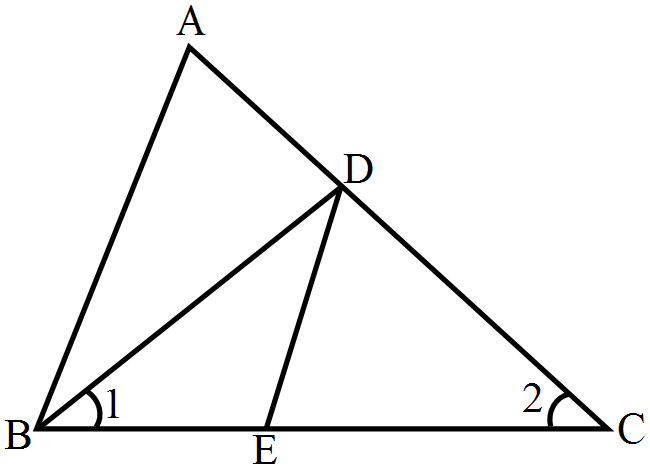
In the given figure, $\angle1=\angle2$ and $\frac{\text{AC}}{\text{BD}}=\frac{\text{CB}}{\text{CE}}$
Prove that $\triangle\text{ACB}\sim\triangle\text{DCE}.$
Answer


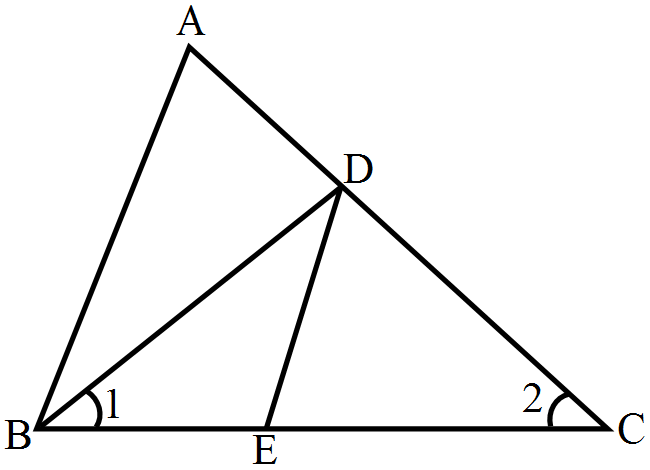
$\angle1=\angle2$ (given)
$\frac{\text{AC}}{\text{BD}}=\frac{\text{CB}}{\text{CE}}\Rightarrow\frac{\text{AC}}{\text{CB}}=\frac{\text{BD}}{\text{CE}}$ (given)
Also, $\angle2=\angle1$ $\big[\therefore\text{BD}=\text{DC}\big]$
Thus, $\frac{\text{AC}}{\text{CB}}=\frac{\text{BD}}{\text{CE}}$
and $\angle2=\angle1$
Therefore, by SAS similarity criterion $\triangle\text{ACB}\sim\triangle\text{DCE}$

Need a full question paper?

Generate a complete, print-ready paper with questions like this in minutes — across 16+ boards, with answer keys.
Start Generating Free

Similar questions

The angles of elevation and depression of the top and bottom of a light-house from the top of a 60 m high building are $30^{\circ}$ and $60^{\circ}$ respectively. Find
(i) The difference between the heights of the light-house and the building.
(ii) The distance between the light-house and the building.
$₹ 9000$ were divided equally among a certain number of persons. Had there been $20$ more persons, each would have got $₹ 160$ less. Find the original number of persons.
Find points on the x-axis, each of which is at a distance of 10 units from the point A(11, -8).
A carpet is laid on the floor of a room 8m by 5m. There is a border of constant width all around the carpet. If the area of the border is $12m^2$​​​​​​​, find its width.
Two dice are rolled together. Find the probability of getting such numbers on two dice whose product is a perfect square.
In a cyclic quadrilateral ABCD, it is given that $\angle\text{A}=(\text{2x}+4)^\circ,\ \angle\text{B}=(\text{y}+3)^\circ,$ $\angle\text{C}=(\text{2y}+10)^\circ$ and $\angle\text{D}=(\text{4x}-5)^\circ$ Find the four angles.
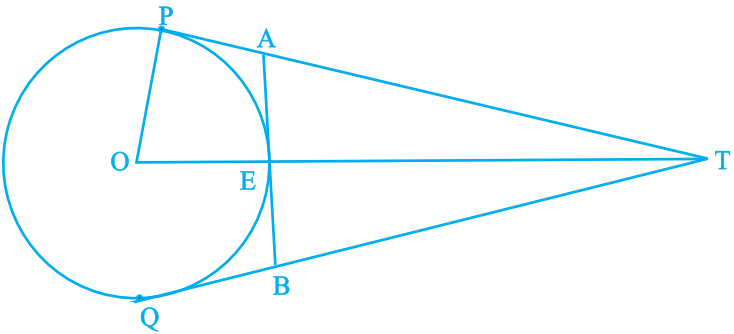
In Figure, O is the centre of a circle of radius 5cm, T is a point such that OT = 13cm and OT intersects the circle at E. If AB is the tangent to the circle at E, find the length of AB
.
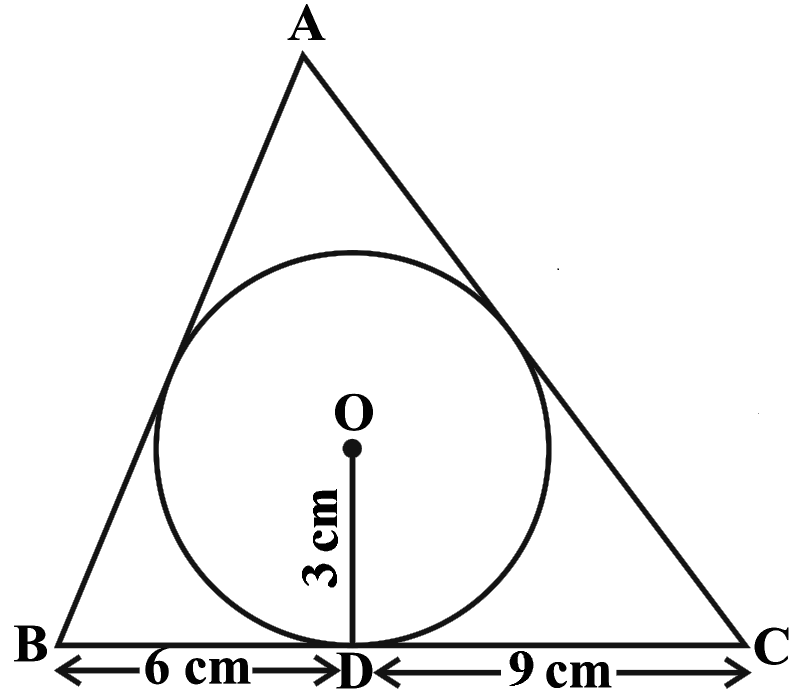
In the given figure, a triangle ABC is drawn to circumscribe a circle of radius 3cm such that the segments BD and DC into which BC is divided by the point of contact D are, of lengths 6cm and 9cm respectively. If the area of $\triangle\text{ABC}=54\text{cm}^2$then find the lengths of sides of AB and AC.
Sides $A B$ and $A C$ and median $A D$ of a $\triangle A B C$ are respectively proportional to sides PQ and PR and median PM of another $\triangle PQR$. Show that $\triangle ABC \sim \triangle PQR$.
Solve for x and y:
$\frac{\text{2x}+\text{5y}}{\text{xy}}=6,$
$\frac{\text{4x}-\text{5y}}{\text{xy}}=-3$