Question
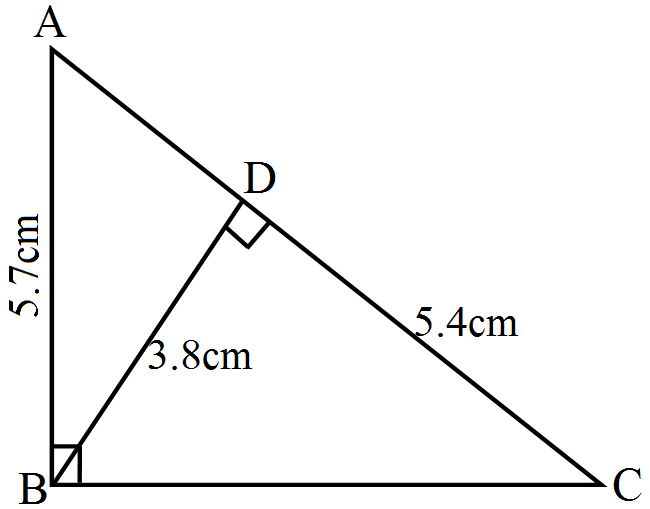
In the given figure, $\angle\text{ABC}=90^\circ$ and $\text{BD}\perp\text{AC}.$ If $AB = 5.7\ cm$, $BD = 3.8\ cm$, and $CD = 5.4\ cm$ find $BC.$
Answer


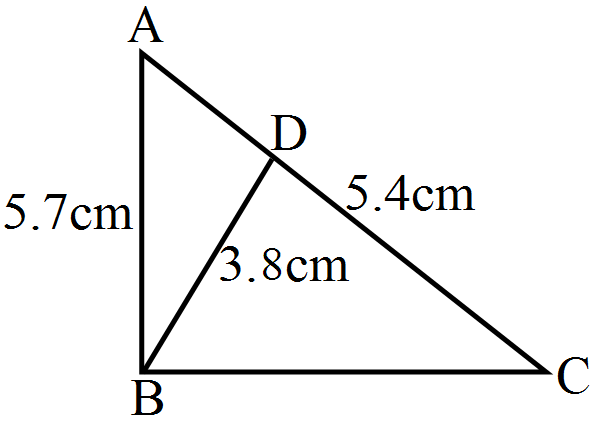
Given that $AB = 5.7\ cm, BD = 3.8\ cm$, and $CD = 5.4\ cm$
In $\triangle\text{CBA}$ and $\triangle\text{CDB}$
$\angle\text{CBA}=\angle\text{CDB}=90^\circ$
$\angle\text{C}=\angle\text{C}$ (common)
Therefore, $\triangle\text{CBA}\sim\triangle\text{CDB}$ (by $AA$ similarities)
$\Rightarrow\frac{\text{BC}}{\text{CD}}=\frac{\text{BA}}{\text{BD}}$
$\Rightarrow\frac{\text{BC}}{\text{5.4}}=\frac{\text{5.7}}{\text{3.8}}$
$\Rightarrow\text{BC}=\frac{\text{5.7}\times5.4}{\text{3.8}}$
$\therefore\text{BC}=8.1\text{cm}$
Hence, $BC= 8.1\ cm$

Need a full question paper?

Generate a complete, print-ready paper with questions like this in minutes — across 16+ boards, with answer keys.
Start Generating Free

Similar questions

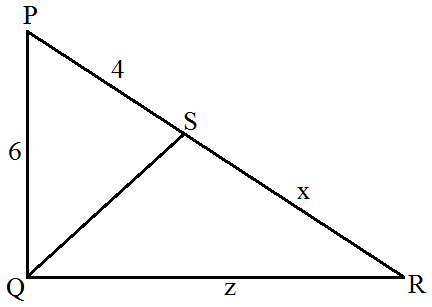
In the figures given below, an altitude is drawn to the hypotenuse by a right-angled triangle. The length of different line-segment are marked in figure. Determine$ x, y, z$ in case.
Find the area of a rhombus each side of the which measures $20\ cm$ and one of whose diagonals is $24\ cm.$
A conical hole is drilled in a circular cylinder of height $12\ cm$ and base radius $5\ cm$. The height and the base radius of the cone are also the same. Find the whole surface and volume of the remaining cylinder.
​The following table shows the marks scored by $80$ students in an examination:
Marks
Less than $5$
Less than $10$
Less than $15$
Less than $20$
Less than $25$
Less than $30$
Less than $35$
Less than $40$
Number of students
$3$
$10$
$25$
$49$
$65$
$73$
$78$
$80$
Calculate the mean marks correct to $2$ decimal places.
Find the values of a and b for which the following system of equations has infinitely many solutions:
$2x + 3y = 7$
$(a - 1)x + (a + 2)y = 3a$
Solve the following systems of equations:
$\frac{5}{\text{x}+1}-\frac{2}{\text{y}-1}=\frac{1}{2}$
$\frac{10}{\text{x}+1}+\frac{2}{\text{y}-1}=\frac{5}{2}$ Where $\text{x}\neq-1$ and $\text{y}\neq1.$
When $3$ is added to the denominator and $2$ is subtracted from the numerator a fraction becomes $\frac{1}{4}.$ And when $6$ is added to numerator and the denominator is multiplied by $3$, it becomes $\frac{2}{3}.$ Find the fraction.
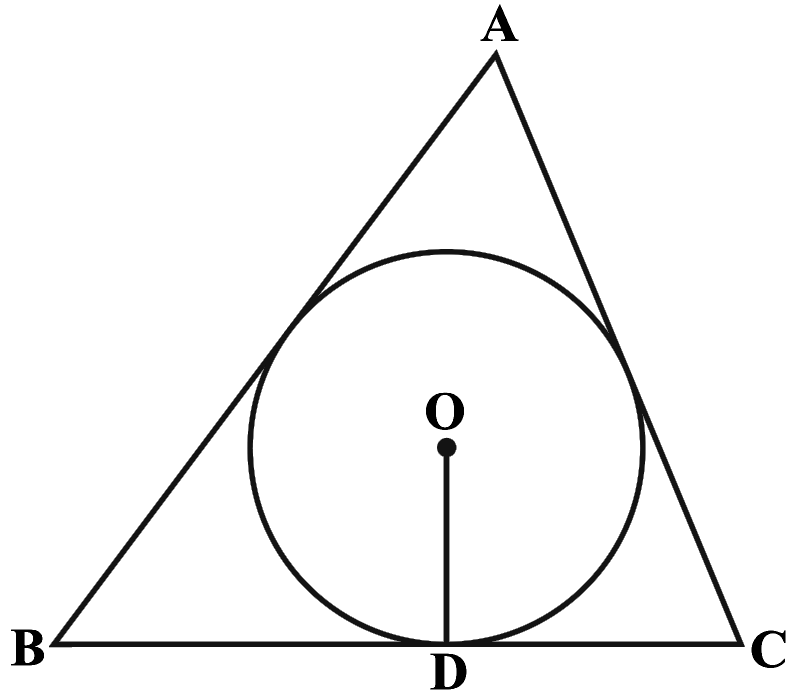
QUESIION In the given figure, a triangle $A B C$ is drawn to circumscribe a circle of radius $2 \ cm$ such that the segments $B D$ and $D C$ into which $B C$ is divided by the point of contact $D$, are of lengths $4 \ cm$ and $3 \ cm$ respectively. If the area of $\triangle A B C=21 cm^2$ then find the lengths of sides of $A B$ and $A C$.
If $G$ be the centroid of a triangle $ABC$ and $P$ be any other point in the plane, prove that $\mathrm{PA}^2+\mathrm{PB}^2+\mathrm{PC}^2=\mathrm{GA}^2+\mathrm{GB}^2+\mathrm{GC}^2+3 \mathrm{GP}^2$.
Write the expression $a_n- a_k$ for the $A.P.$ $a, a + d, a + 2d, ...$
Hence, find the common difference of the $A.P$. for which,
$20^{th}$ term is $10$ more than the $18^{th}$ term.