Question
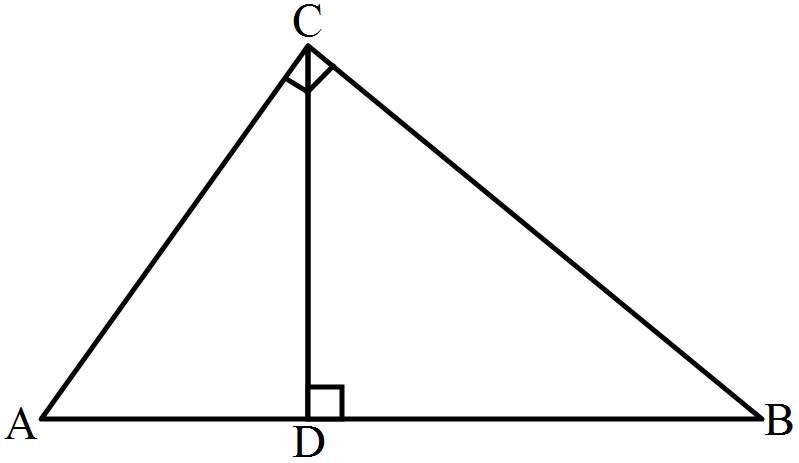
In the given figure, $\angle\text{ACB}=90^\circ$ and $\text{CD}\perp\text{AB}.$
Prove that $\frac{\text{BC}^2}{\text{AC}^2}=\frac{\text{BD}}{\text{AD}}.$
Answer

Given: $\angle\text{ACB}=90^\circ$ and $\text{CD}\perp\text{AB}$
To Prove: $\frac{\text{BC}^2}{\text{AC}^2}=\frac{\text{BD}}{\text{AD}}$
Proof:
In $\triangle\text{ACB}$ and $\triangle\text{CDB}$
$\angle\text{ACB}=\angle\text{CDB}=90^\circ$ (Given)
$\angle\text{ABC}=\angle\text{CBD}$ (common)
By AA similarity-criterion $\triangle\text{ACB}\sim\triangle\text{CDB}$
When two triangles are similar, the ratios of the lengths of their corresponding sides are proportional.
$\therefore\frac{\text{BC}}{\text{BD}}=\frac{\text{AB}}{\text{BC}}$
$\Rightarrow\text{BC}^2=\text{BD}.\text{AB}\ .....(1)$
In $\triangle\text{ACB}$ and $\triangle\text{ADC}$
$\angle\text{ACB}=\angle\text{ADC}=90^\circ$ (Given)
$\angle\text{CAB}=\angle\text{DAC}$ (common)
By AA similarity-criterion $\triangle\text{ACB}\sim\triangle\text{ADC}$
When two triangles are similar, then the ratios of the lengths of their corresponding sides are proportional.
$\therefore\frac{\text{AC}}{\text{AD}}=\frac{\text{AB}}{\text{AC}}$
$\Rightarrow\text{AC}^2=\text{AD}.\text{AB}\ .....(2)$
Divinding (2) by (1), we get
$\frac{\text{BC}^2}{\text{AC}^2}=\frac{\text{BD}}{\text{AD}}$

Need a full question paper?

Generate a complete, print-ready paper with questions like this in minutes — across 16+ boards, with answer keys.

Start Generating Free

Similar questions

The length of minute hand of a clock is 5cm. Find the area swept by the minute hand during the time period 6:05 AM and 6:40 AM.
An open metal bucket is in the shape of a frustum of a cone, mounted on a hollow cylindrical base made of the same metallic sheet. The diameters of the two circular ends of the bucket are 45cm and 25cm, the total vertical height of the bucket is 40cm and that of the cylindrical base is 6cm. Find the area of the metallic sheet used to make the bucket. Also, find the volume of water the bucket can hold, in litres.
Find the area of the rhombus, the lengths of whose diagonals are 3cm and 16cm. Also find the perimeter of the rhombus.
Given that $\text{x}-\sqrt{5}$ is a factor of the cubic polynomial $\text{x}^3-3\sqrt{5}\text{x}^2+13\text{x}-3\sqrt{5}$, find all the zeroes of the polynomial.
​The following table shows the marks scored by 80 students in an examination:
Marks
Less than 5
Less than 10
Less than 15
Less than 20
Less than 25
Less than 30
Less than 35
Less than 40
Number of students
3
10
25
49
65
73
78
80
Calculate the mean marks correct to 2 decimal places.
Find a point which is equidistant from the points A(-5, 4) and B(-1, 6)? How many such points are there?
Solve the following quadratic equation:
$\frac{1}{\text{x}-2}+\frac{2}{\text{x}-1}=\frac{6}{\text{x}}$ $\text{x}\neq0,\ 1,\ 2$
Solve the following systems of equations:
$\frac{\text{x}}{7}+\frac{\text{y}}{3}=5,$
$\frac{\text{x}}{2}-\frac{\text{y}}{9}=6.$
A bucket made up of a metal sheet is in the form of frustum of a cone. Its depth is 24cm and the diameters of the top and bottom are 30cm and 10cm, respectively. Find the cost of completely filling the bucket with milk at the rate of Rs. 20 per litre and the cost of metal sheet used if it costs Rs. 10 per $100cm^2$​​​​​​​. $\big[\text{Use }\pi=3.14\big]$
A group consists of 12 persons, of which 3 are extremely patient, other 6 are extremely honest and rest are extremely kind. A person from the group is selected at random. Assuming that each person is equally likely to be selected, find the probability of selecting a person who is
(i) extremely patient
(ii) extremely kind or honest.
Which of the above values you prefer more?