MCQ
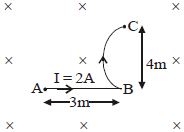
In the given figure force on wire $ABC$ will be $(B = 2T)$
  • A
    $4(3+2\pi ) N$
  • $20\,N$
  • C
    $10\,N$
  • D
    $40\,N$

Answer

Correct option: B.
$20\,N$
b
Force an $\mathrm{AB}=\mathrm{BI} \ell=12 \mathrm{\,N}$ (upward)

Force on $\mathrm{BC}=16 \mathrm{\,N}$ (left)

so force on $\mathrm{ABC}=\sqrt{(12)^{2}+(16)^{2}}=20 \mathrm{\,N}$

Need a full question paper?

Generate a complete, print-ready paper with questions like this in minutes — across 16+ boards, with answer keys.
Start Generating Free

Similar questions

The device that does not work on the principle of mutual induction is
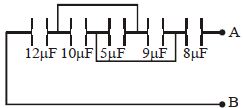
Five capacitors together with their capacitances are shown in the adjoining figure. The potential difference between the points $A$ and $B$ is $60\, volt.$ The equivalent capacitance between the point $A$ and $B$ and charge on capacitor $5\,\mu F$ will be respectively :-
In a hydrogen atom, the radius of $n^{th}$ Bohr orbit is $r_n$. The graph between $\log \,\left( {\frac{{{r_n}}}{{{r_1}}}} \right)$ and logn will be
A charge $+q$ is fixed at each of the points $x = x_0,\,x = 3x_0,\,x = 5x_0$, .... upto $\infty $ on $X-$  axis and charge $-q$ is fixed on each of the points $x = 2x_0,\,x = 4x_0,\,x = 6x_0$, .... upto $\infty $ . Here $x_0$ is a positive constant. Take the potential at a point due to a charge $Q$ at a distance $r$ from it to be $\frac{Q}{{4\pi {\varepsilon _0}r}}$. Then the potential at the origin due to above system of charges will be
A two metre wire is moving with a velocity of $1$ $m/sec$ perpendicular to a magnetic field of $0.5\, weber/m^2$. The e.m.f. induced in it will be.....$volt$
A voltmeter has resistance of $2000\, ohms$ and it can measure upto $2\,V$. If we want to increase its range to $10\, V$, then the required resistance in series will be ........... $\Omega $
A point charge $Q$ is moving in a circular orbit of radius $R$ in the $x$-y plane with an angular velocity $\omega$. This can be considered as equivalent to a loop carrying a steady current $\frac{Q_\omega}{2 \pi}$. A uniform magnetic field along the positive z-axis is now switched on, which increases at a constant rate from 0 to $B$ in one second. Assume that the radius of the orbit remains constant. The application of the magnetic field induces an emf in the orbit. The induced emf is defined as the work done by an induced electric field in moving a unit positive charge around a closed loop. It is known that, for an orbiting charge, the magnetic dipole moment is proportional to the angular momentum with a proportionally constant $\gamma$.

$1.$ The magnitude of the induced electric field in the orbit at any instant of time during the time interval of the magnetic field change is :

$(A)$ $\frac{B R}{4}$ $(B)$ $\frac{B R}{2}$ $(C)$ $BR$ $(D)$ $2BR$

$2.$ The change in the magnetic dipole moment associated with the orbit, at the end of the time interval of the magnetic field change, is:

$(A)$ $-\gamma B Q R^2$ $(B)$ $-\gamma \frac{B Q R^2}{2}$ $(C)$ $\gamma \frac{ BQR ^2}{2}$ $(D)$ $\gamma B Q R^2$

Give the answer question $1$ and $2.$

By what percentage will the illumination of the lamp decrease if the current drops by $20 \%$ ?
Thermal neutrons can cause fission in
A prism of refractive index $\sqrt 2 $ has refracting angle $60^o$. In order that a ray suffers minimum deviation it should be incident at an angle.......$^o$