Question
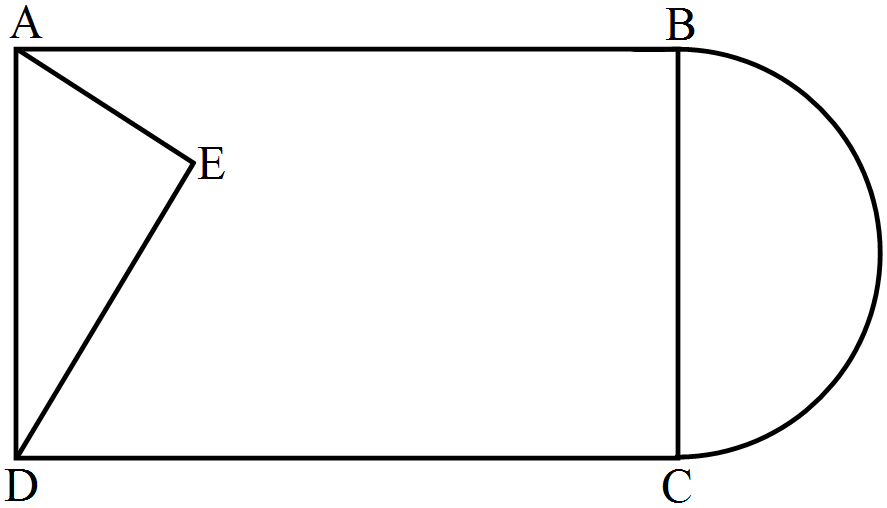
In the given figure, from a rectangular region ABCD with AB = 20cm, a right triangle AED with AE = 9cm and DE = 12cm, is cut off. On the other end, taking BC as diameter, a semicircle is added on outside the region. Find the area of the shaded region. $\big[\text{Use }\pi=3.14\big]$
Answer

In right-angled $\triangle\text{AED},$
$AD^2 = DE^2 + AE^2 = 12^2 + 9^2 = 144 + 81 = 225$
$\Rightarrow\text{AD}=\sqrt{225}=15\text{cm}$
Now, Area of $\triangle\text{AED}=\frac12\times\text{DE}\times\text{AE}=\frac12\times12\times9=54\text{cm}^2$
Length of rectangle ABCD = AB = 20cm
Breadth of rectangle ABCD = AD = 15cm
$\therefore$ Area of rectangle $ABCD = AB \times BC = 20 \times 15 = 300cm^2$​​​​​​​
Area of semi-circle $=\frac{1}{2}\pi\times\Big(\frac{15}{2}\Big)^2=\Big\{\frac12\times3.14\times7.5\times7.5\Big\}\text{cm}^2=88.3125\text{cm}^2$
Thus, Area of rectangle ABCD + Area of semi-circle - Area of $\triangle\text{AED}$
$= 300 + 88.31 - 54$
$= 334.31cm^2​​​​​​​$​​​​​​​

Need a full question paper?

Generate a complete, print-ready paper with questions like this in minutes — across 16+ boards, with answer keys.

Start Generating Free

Similar questions

Prove the following identities:
$\sin^6\theta+\cos^6\theta=1-3\sin^2\theta\cos^2\theta$
In the following, determine the set of values of k for which the given quadratic equation has real root:
$2x^2 - 5x - k = 0$
In a $\triangle\text{ABC},\ \angle\text{A}=\text{x}^\circ,$ $\angle\text{B}=(\text{3x}-2)^\circ,\ \angle\text{C}=\text{y}^\circ$ and $\angle\text{C}-\angle\text{B}=9^\circ$ Find the three angles.
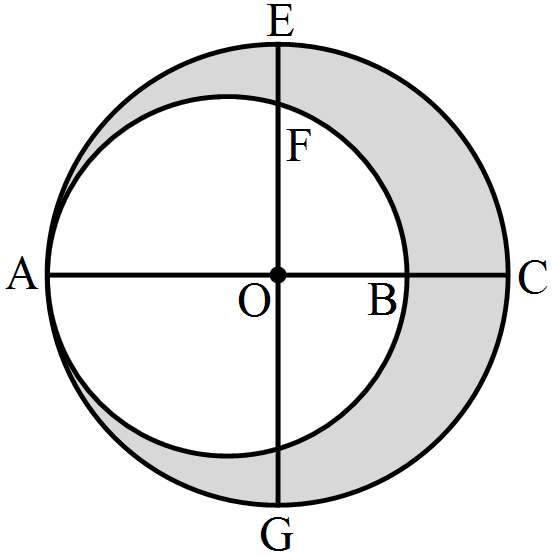
In the given figure, O is the centre of the bigger circle, and AC is its diameter. Another circle with AB as diameter is drawn. If AC = 54cm and BC = 10cm, find the area of the shaded region.
Draw a parallelogram ABCD in which BC = 5cm, AB = 3cm and $\angle\text{ABC}=60^\circ,$ divide it into triangles BCD and ABD by the diagonal BD. Construct the triangle BD'C' similar to $\triangle\text{BDC}$ with scale factor $\frac{4}{3}.$ Draw the line segment D'A' parallel to DA where A' lies on extended side BA. Is A'BC'D' a parallelogram?
A ladder rests against a wall at an angle $\alpha$ to the horizontal. Its foot is pulled away from the wall through a distance a, so that it slides a distance b down the wall making an angle $\beta$ with the horizontal. Show that, $\frac{\text{a}}{\text{b}}=\frac{\cos\alpha-\cos\beta}{\sin\beta-\sin\alpha}.$
Amita buys some books for ₹1920. If she had bought 4 more books for the same amount each book would cost her ₹ 24 less. How many books did she buy? What was the initial price of one book?
Prove the following identities:
$\frac{\sin\theta+1-\cos\theta}{\cos\theta-1+\sin\theta}=\frac{1+\sin\theta}{\cos\theta}$
A reservoir in the form of the frustum of a right circular cone contains $44 \times 10^7$ litres of water which fills it completely. The radii of the bottom and top of the reservoir are 50 metres and 100 metres respectively. Find the depth of water and the lateral surface area of the reservoir.
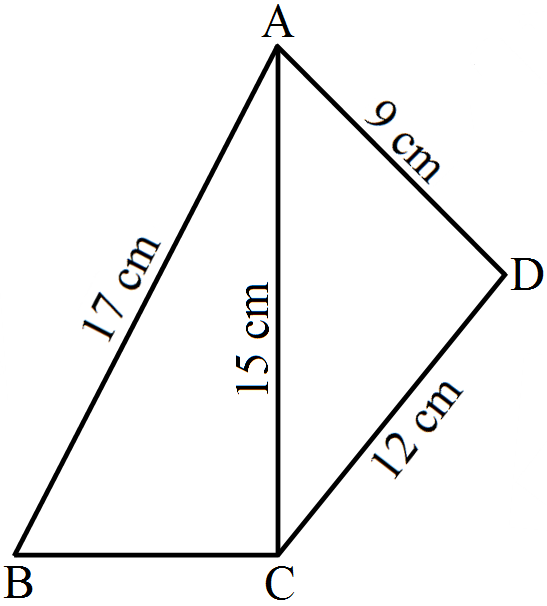
Find the perimeter and area of the quadrilateral ABCD in which AB = 17cm, AD = 9cm, CD = 12cm, $\angle\text{ACB} = 90^\circ$ and AC = 15cm.