Question
In the given figure :if $\angle PQS = 60^\circ ,$find$\angle QPR.$

Answer

In $\triangle PQS,$
$PQ = QS ....($given$)$
$\Rightarrow \angle QSP = \angle QPS ....($angles opposite to two equal sides are equal$)$
Now, $\angle PQS + QPS + \angle QPS = 180^\circ $
$\Rightarrow 60^\circ + 2\angle QSP = 180^\circ $
$\Rightarrow 2\angle QSP = 120^\circ $
$\Rightarrow \angle QSP = 60^\circ $
$\Rightarrow \angle QPS = 60^\circ $
In $\triangle PRS,$
$PS = SR ....($given$)$
$\Rightarrow \angle PRS = \angle RPS ....($angles opposite to two equal sides are equal$)$
By exterior angle property,
$\angle QSP = \angle RPS + \angle PRS$
$\Rightarrow 60^\circ = 2\angle RPS$
$\Rightarrow \angle RPS = 30^\circ $
Now,
$\angle QPR = \angle QPS + \angle RPS$
$= 60^\circ + 30^\circ = 90^\circ .$

Need a full question paper?

Generate a complete, print-ready paper with questions like this in minutes — across 16+ boards, with answer keys.
Start Generating Free

Similar questions

If 11 pens and 19 pencils together cost ₹ 502; while 19 pens and 11 pencils together cost ₹ 758, how much 3 pens and 6 pencils cost together?
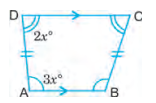
In the given figure, $A B C D$ is an isosceles trapezium in which $\angle CDA =2 x^{\circ}$ and $\angle BAD =3 x^{\circ}$.
Find all the angles of the trapezium.
Image
Simplify :$\frac{3 \times 27^{n+1}+9 \times 3^{3 n-1}}{8 \times 3^{3 n}-5 \times 27^n}$
A man invested $Rs. 35000$, a part of it at $12\%$ and the rest at $14\%$. If he received a total annual interest of $Rs. 4460$, how much did he invest at each rate?
Find
(i) the volume
(ii) the total surface area
(iii) the lateral surface area and
(iv) the length of the diagonal of a cube of side 10 cm.
Solve the following systems of equations by using the method of cross multiplication:
x + 2y + 1 = 0, 2x - 3y = 12
If $x=5-2 \sqrt{ 6} $, find $x^2+\frac{1}{x^2}$
Nikita invests $Rs.6,000$ for two years at a certain rate of interest compounded annually. At the end of first year it amounts to $Rs.6,720.$ Calculate:$(a)$ The rate of interest.$(b)$ The amount at the end of the second year.
Image
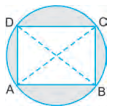
In the given figure, ABCD is a rectangle inscribed in a circle. If two adjacent sides of the rectangle be 8 cm and 6 cm, calculate :
(i) the radius of the circle; and
(ii) the area of the shaded region. (Take $\pi$ = 3.14 ).
$\left[\right.$ Hint. Radius $=\left(\frac{1}{2} \times\right.$ Diagonal $\left.)=5 cm\right]$
$\text{ABCD}$ is a parallelogram. The sides $AB$ and $AD$ are produced to $E$ and $F$ respectively, such produced to $E$ and $F$ respectively, such that $AB = BE$ and $AD = DF.$Prove that: $\triangle BEC \cong \triangle DCF.$