Questions

[4 marks sum]

🎯

Test yourself on this topic

11 questions · timed · auto-graded

Question 14 Marks
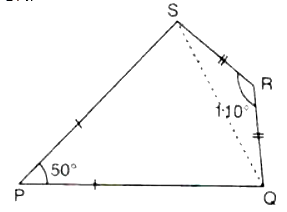
In a quadrilateral $\text{PQRS}, PQ = PS$ and $RQ = Rs$. If $\angle 50^\circ $ and $\angle R = 110^\circ $, find $\angle PSR.$
​​​​​​​
Answer
In $\triangle PQS,$
$PQ = PS$
$\therefore \angle PQS = \angle PSQ$
$\angle P + \angle PQS + \angle PSQ = 180^\circ $
$50^\circ + 2\angle PQS = 180^\circ $
$2\angle PQS = 130^\circ $
$\angle PQS = 65^\circ = \angle PSQ \dots......(i)$
In $\triangle SRQ,$
$SR = RQ$
$\therefore \angle RQS = \angle RSQ$
$\angle R + \angle RQS + \angle RSQ = 180^\circ $
$110^\circ + 2\angle RQS = 180^\circ $
$2\angle RQS = 70^\circ $
$\angle RQS = 35^\circ = \angle RSQ \dots......(ii)$
Adding $(i)$ and $(ii)$
$\angle PSQ + \angle RSQ = 65^\circ + 35^\circ $
$\angle PSR = 100^\circ .$
View full question & answer
Question 24 Marks
Prove that the medians corresponding to equal sides of an isosceles triangle are equal.
Answer

Let $\text{ABC}$ be an isosceles triangle with $AB = AC.$
Let $D$ and $E$ be the mid points of $AB$ and $AC.$
Join $BE$ and $CD.$
Then $BE$ and $CD$ are the medians of this isosceles triangle.
In $\triangle ABE$ and $\triangle ACD$
$AB = AC ...($given$)$
$AD = AE ...(D$ and $E$ are mid points of $AB$ and $AC)$
$\angle A = \angle A ...($common angle$)$
Therefore, $\triangle ABE \cong \triangle ACD ...(\text{SAS}$ criteria$)$
Hence, $BE = CD.$
View full question & answer
Question 34 Marks
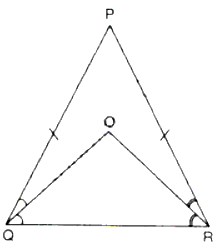
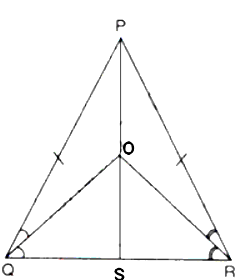
The bisector of the equal angles of an isosceles $\triangle PQR$ meet at $O$. If $PQ = PR$, prove that $PO$ bisects $\angle P.$
​​​​​​​
Answer

Join $PO$ and produce to meet $QR$ in $S.$
In $\triangle PQS$ and $\triangle PRS$
$PS = PS ...($common$)$
$PQ = PR ...($given$)$
$\angle Q = \angle R$
$\therefore \triangle PQS \cong \triangle PRS$
$\therefore \angle QPS = \angle RPS$
Hence, $PO$ bisects $\angle P.$
View full question & answer
Question 44 Marks
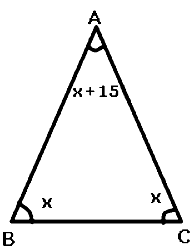
Each equal angle of an isosceles triangle is less than the third angle by $15^\circ $. Find the angles.
Answer

Let equal angles of the isosceles triangle be $x$ each. Therefore, non-equal angle $= x + 15^\circ $
Angles of a triangle $= 180^\circ $
$x + x + (x + 15^\circ ) = 180^\circ $
$3x + 15^\circ = 180^\circ $
$3x = 165^\circ $
$x = 55^\circ $
$x + 15 = 70^\circ $
Angles are $55^\circ , 55^\circ $ and $70^\circ .$
View full question & answer
Question 54 Marks
In the given figure :if $\angle PQS = 60^\circ ,$find$\angle QPR.$
Answer
In $\triangle PQS,$
$PQ = QS ....($given$)$
$\Rightarrow \angle QSP = \angle QPS ....($angles opposite to two equal sides are equal$)$
Now, $\angle PQS + QPS + \angle QPS = 180^\circ $
$\Rightarrow 60^\circ + 2\angle QSP = 180^\circ $
$\Rightarrow 2\angle QSP = 120^\circ $
$\Rightarrow \angle QSP = 60^\circ $
$\Rightarrow \angle QPS = 60^\circ $
In $\triangle PRS,$
$PS = SR ....($given$)$
$\Rightarrow \angle PRS = \angle RPS ....($angles opposite to two equal sides are equal$)$
By exterior angle property,
$\angle QSP = \angle RPS + \angle PRS$
$\Rightarrow 60^\circ = 2\angle RPS$
$\Rightarrow \angle RPS = 30^\circ $
Now,
$\angle QPR = \angle QPS + \angle RPS$
$= 60^\circ + 30^\circ = 90^\circ .$
View full question & answer
Question 64 Marks
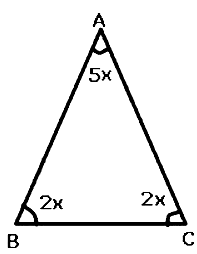
Find the angles of an isosceles triangle which are in the ratio $2:2:5.$
Answer

The equal angles and the non$-$equal angle are in the ratio $2:2:5.$
Let equal angles be $2x$ each, therefore non$-$equal angle is $5x$.
Angles of a triangle $= 180^\circ $
$\Rightarrow 2x + 2x + 5x = 180^\circ $
$\Rightarrow 9x = 180^\circ $
$\Rightarrow x = 20^\circ $
Therefore, $2x = 40^\circ $ and $5x = 100^\circ $
angles$ = 40^\circ , 40^\circ $ and $100^\circ .$
View full question & answer
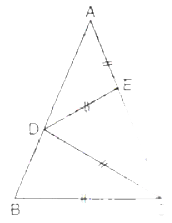
Question 74 Marks
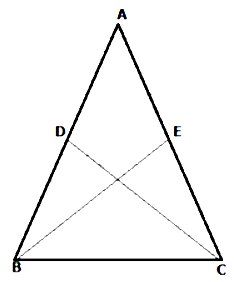
In the figure $\triangle ABC$ is isosceles with $AB = AC$. Prove that:$\angle A : \angle B = 1 : 3$
Answer
In $\triangle DEC$,
$\angle DEC =\angle ADE +\angle A =2 a \ldots ($ext. Angle to $\triangle ADE)$
$DE = DC$
$\Rightarrow \angle DEC =\angle DCE =2 a$
In $\triangle B D C$, let $\angle B=b$
$ D C=B C$
$\Rightarrow \angle B D C=\angle B=b$
In $\triangle A B C$
$\angle A D B=\angle A D E+\angle E D C+\angle B D C$
$180=a+\angle E D C+b \text { (iii) }$
$\angle E D C=180^{\circ}-a-b \ldots \ldots(iv)$ and $(iii))$
Now again in $\triangle DEC$
$ 180^{\circ}=\angle EDC +\angle DCE +\angle DEC \ldots($from $(ii))$
$180^{\circ}=\angle EDC +2 a +2 a$
$\angle EDC =180^{\circ}-4 a$
Equality $(iv)$ and $(v)$
$180^{\circ}- a - b =180^{\circ}-4 a$
$3 a = b \ldots . .( vi )$
$\frac{ a }{ b }=\frac{1}{3}=\frac{\angle A }{\angle B } $
Hence, $\angle A: \angle B=1: 3$.
View full question & answer
Question 84 Marks
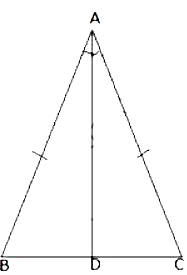
Prove that the bisector of the vertex angle of an isosceles triangle bisects the base perpendicularly.
Answer

In $\triangle ADB$ and $\triangle ADC$
$AB = AC ...($given$)$
$AD = AD ...($common$)$
$\angle BAD = \angle CAD ...(AD$ bisects $\angle BAC)$
Therefore, $\triangle ADB \cong \triangle ADC$
Hence, $BD = Dc$ and $\angle BDA = \angle CDA$
But $\angle BDA + \angle CDA = 180^\circ $
$\Rightarrow \angle BDA = \angle CDA = 90^\circ $
Therefore, $AD$ bisects $BC$ perpendicularly.
View full question & answer
Question 94 Marks
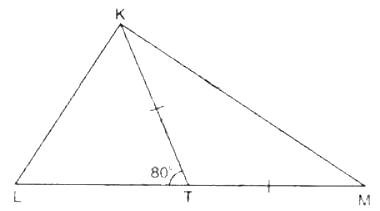
In $\triangle KLM , KT$ bisects $\angle LKM$ and $KT = TM$. If $\angle LTK$ is $80^\circ $, find the value of $\angle LMK$ and $\angle KLM.$
Answer
In $\triangle KTM,$
$KT = TM \dots...($given$)$
Therefore, $\angle TKM = \angle TMK \dots....(i)$
Now, $\angle KTl = \angle TKM + \angle TMK$
$80 = \angle TKM + \angle TKM = 2\angle TKM \dots...$(from $(i))$
$\angle TKM = 40^\circ = \angle TMK = \angle LMK ........(ii)$
But $\angle TKM = \angle TKL \dots...(KT$ is the angle bisector$)$
Therefore, $\angle TKL = 40^\circ $
In $\triangle KTL,$
$\angle TKL +\angle KTL + \angle KLT = 180^\circ $
$40^\circ + 80^\circ + \angle KLT = 180^\circ $
$\angle KLT = 60^\circ = \angle KLM$
$\angle KLM = 60^\circ $ and $\angle LMK = 40^\circ .$
View full question & answer
Question 104 Marks
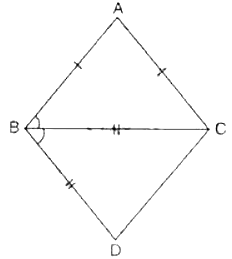
$\triangle ABC$ is an isosceles triangle with $AB = AC$. Another $\triangle BDC$ is drawn with base $BC = BD$ in such a way that $BC$ bisects $\angle B$. If the measure of $\angle BDC$ is $70^\circ $, find the measures of $\angle DBC$ and $\angle BAC.$
Answer
In $\triangle BDC,$
$\angle BDC = 70^\circ $
$BD = BC$
Therefore, $\angle BDC = \angle BCD$
$\Rightarrow \angle BCD = 70^\circ $
Now $\angle BCD + \angle BDC + \angle DBC = 180^\circ $
$70^\circ + 70^\circ + \angle DBC = 180^\circ $
$\angle DBC = 40^\circ $
$\angle DBC =\angle ABC ...(BC$ is the angle bisector$)$
$\Rightarrow \angle ABC = 40^\circ $
In $\triangle ABC,$
Since $AB = AC, \angle ABC = \angle ACB \Rightarrow \angle ACB = 40^\circ $
$\angle ACB + \angle ABC + \angle BAC = 180^\circ $
$40^\circ + 40^\circ + \angle BAC = 180^\circ $
$\angle BAC = 100^\circ$
Hence, $\angle BAC = 100^\circ $ and $\angle DBC = 40^\circ .$
View full question & answer
Question 114 Marks
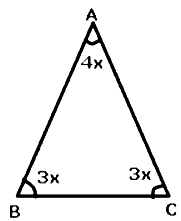
Find the angles of an isosceles triangle whose equal angles and the non $-$ equal angles are in the ratio $3: 4.$
Answer

The equal angles and the non$-$equal angle are in the ratio $3: 4$.
Let equal angles be $3 x$ each, therefore non$-$equal angle is $4 x$.
Angles of a triangle $=180^{\circ}$
$\Rightarrow 3 x +3 x +4 x =180^{\circ} $
$\Rightarrow 10 x =180^{\circ} $
$\Rightarrow x =18^{\circ}$
Therefore, $3 x=54^{\circ}$ and $4 x=72$
Angles $=54^{\circ}, 54^{\circ}$ and $72^{\circ}$.
View full question & answer
[4 marks sum] - MATHEMATICS STD 9 Questions - Vidyadip