Question
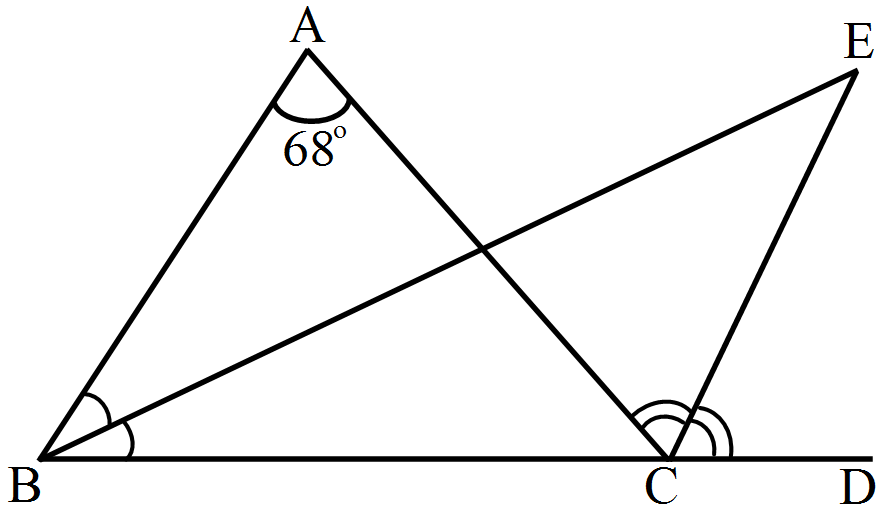
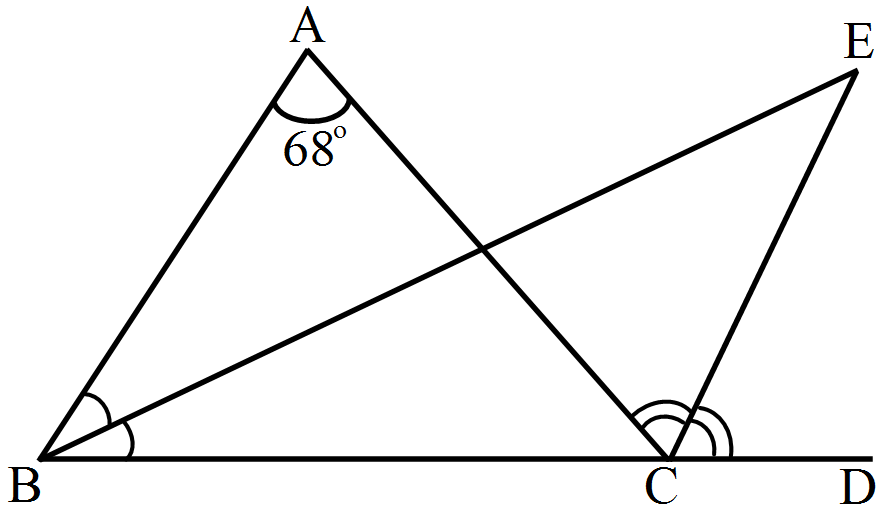
In the given figure, side BC of $\triangle\text{ABC}$ is produced to point D such that bisectors of $\angle\text{ACD}$ meet at a point E. If $\angle\text{BAC}=68^\circ,$ find $\angle\text{BEC}.$
Answer

In the given figure, bisectors of $\angle\text{ABC}$ and $\angle\text{ACD}$ meet at E and $\angle\text{BAC}=68^\circ$ We need to find $\angle\text{BEC}$ Here, using the property: an exterior angle of the triangle is equal to the sum of the opposite interior angles. In $\triangle\text{ABC}$ with $\angle\text{ACD}$ as its exterior angle$\text{ext}.\angle\text{ACD}=\angle\text{A}+\angle\text{ABC}\dots(1)$
Similarly, in $\triangle\text{BE}$ with $\angle\text{ECD}$ as its exterior angle$\text{ext}.\angle\text{ECD}=\angle\text{EBC}+\angle\text{BEC}$
$\frac{1}{2}\angle\text{ACD}=\frac{1}{2}\angle\text{ABC}+\angle\text{BEC}$ $($CE and BE are the bisectors of $\angle\text{ACD}$ and $\angle\text{ABC})$
$\angle\text{BEC}=\frac{1}{2}\angle\text{ACD}-\frac{1}{2}\angle\text{ABC}\dots(2)$
Now, multiplying both sides of (1) by $\frac{1}{2}$ We get,$\frac{1}{2}\angle\text{ACD}=\frac{1}{2}\angle\text{A}+\frac{1}{2}\angle\text{ABC}$
$\frac{1}{2}\angle\text{A}=\frac{1}{2}\angle\text{ACD}-\frac{1}{2}\angle\text{ABC}\dots(3)$
From (2) and (3) we get,$\angle\text{BEC}=\frac{1}{2}\angle\text{A}$
$\angle\text{BEC}=\frac{1}{2}(68^\circ)$
$\angle\text{BEC}=34^\circ$
Thus, $\angle\text{BEC}=34^\circ$

Need a full question paper?

Generate a complete, print-ready paper with questions like this in minutes — across 16+ boards, with answer keys.

Start Generating Free

Similar questions

Simplify:$\frac{7+3\sqrt5}{3+\sqrt5}-\frac{7-3\sqrt5}{3-\sqrt5}$
The number of books in different shelves of a library is as follows:
30, 32, 28, 24, 20, 25, 38, 37, 40, 45, 16, 20
19, 24, 27, 30, 32, 34, 35, 42, 27, 28, 19, 34
38, 39, 42, 29, 24, 27, 22, 29, 31, 19, 27, 25
28, 23, 24, 32, 34, 18, 27, 25, 37, 31, 24, 23
43, 32, 28, 31, 24, 23, 26, 36, 32, 29, 28, 21
Prepare a cumulative frequency distribution table using 45 - 49 as the last class-interval.
Prove that the angle in a segment shorter than a semicircle is greater than a right angle.
ABCD is a cyclic qudrilateral in which:$\text{BC}\parallel\text{AD},\ \angle\text{ADC}=110^\circ$ and $\angle\text{BAC}=50^\circ.$ Find $\angle\text{DAC}.$
The monthly wages of 30 workers in a factory are given below:
83.0, 835, 890, 810, 835, 836, 869, 845, 898, 890, 820, 860, 832, 833, 855, 845, 804, 808, 812, 840, 885, 835, 836, 878, 840, 868, 890, 806, 840, 890.
Represent the data in the form of a frequency distribution with class size 10.
The ratio between the radius of the base and the height of a cylinder is $2:3$.
Find the total surface area of the cylinder, if its volume is $1617cm^2.$
Prove that the medians of an equilateral triangle are equal.
In a hot water heating system, there is a cylindrical pipe of length 28m and diameter 5cm.
Find the total radiating surface in the system.
Find the values of a and b if:$\frac{7+3\sqrt{5}}{3+\sqrt{5}}-\frac{7-3\sqrt{5}}{3-\sqrt{5}}=\text{a}+\text{b}\sqrt{5}$
In an isosceles triangle, if the vertex angle is twice the sum of the base angles, calculate the angles of the triangle.