Questions

4 Mark Question

Take a timed test

15 questions · self-marked practice — reveal the answer and mark yourself.

Question 14 Marks
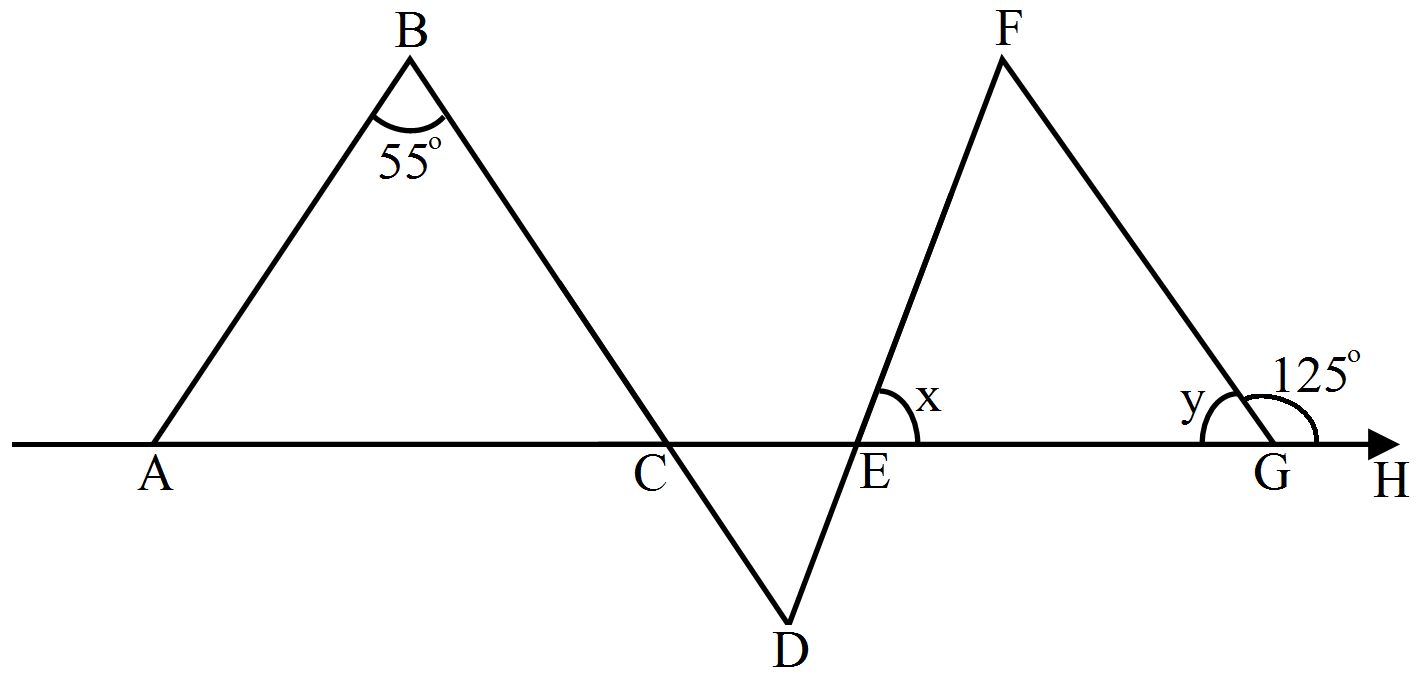
In the given figure, if $\text{AB }||\text{ DE}$ and $\text{BD }||\text{ FG}$ such that $\angle\text{FGH}=125^\circ$ and $\angle\text{B}=55^\circ,$ find x and y.
Answer
In the given figure, if$\text{AB }||\text{ DE},\text{BD }||\text{ FG},\angle\text{FGH}=125^\circ$ and$\angle\text{B}=55^\circ$ We need to find the value of x and y Here, as AB || DE and BD is the transversal, so according to the property, "alternate interior angles are equal", we get$\angle\text{D}=\angle\text{B}$
$\angle\text{D}=55^\circ\dots(1)$
Similarly, as BD || FG and DF is the transversal$\angle\text{D}=\angle\text{F}$
$\angle\text{F}=55^\circ(\text{Using 1})$
Further, EGH is a straight line. So, using the property, angles forming a linear pair are supplementary$\angle\text{FGE}=\angle\text{FGH}=180^\circ$
$\text{y}+125^\circ=180^\circ$
$\text{y}=180^\circ-125^\circ$
$\text{y}=55^\circ$
Also, using the property, "an exterior angle of a triangle is equal to the sum of the two opposite interior angles", we get, In $\triangle\text{EFG}$ with $\angle\text{FGH}$ as its exterior angle$\text{ext.}\angle\text{FGH}=\angle\text{F}+\angle\text{E}$
$125^\circ=55^\circ+\text{x}$
$\text{x}=125^\circ-55^\circ$
$\text{x}=70^\circ$
Thus, $\text{x}=70^\circ$ and $\text{y}=55^\circ$
View full question & answer
Question 24 Marks
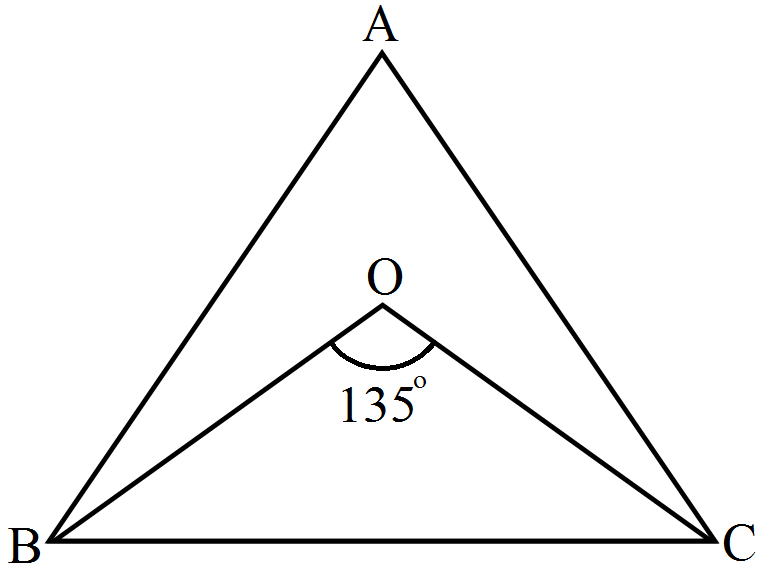
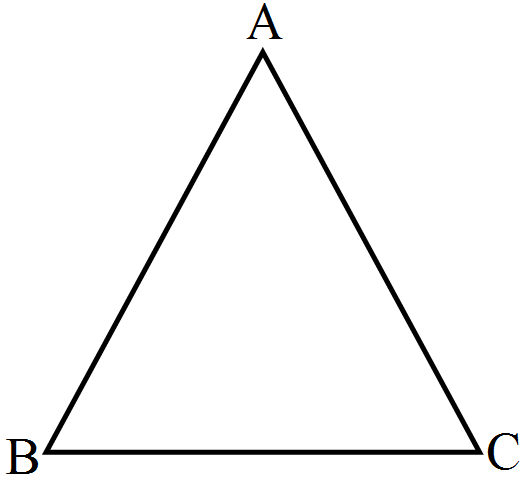
If the bisectors of the base angles of a triangle enclose an angle of 135°, prove that the triangle is a right angle.
Answer
Given the bisectors of the base angles of a triangle enclose an angle of 135° $\text{i.e}.,\angle\text{BOC}=135^\circ$
But, We know that$\angle\text{BOC}=90^\circ+\frac{1}{2}\angle\text{A}$
$\Rightarrow135^\circ=90^\circ+\frac{1}{2}\angle\text{A}$
$\Rightarrow\frac{1}{2}\angle\text{A}=135^\circ-90^\circ$
$\Rightarrow\angle\text{A}=45^\circ(2)$
$\Rightarrow\angle\text{A}=90^\circ$
Therefore, $\triangle\text{ABC}$ is a right angle triangle that is right angled at A.
View full question & answer
Question 44 Marks
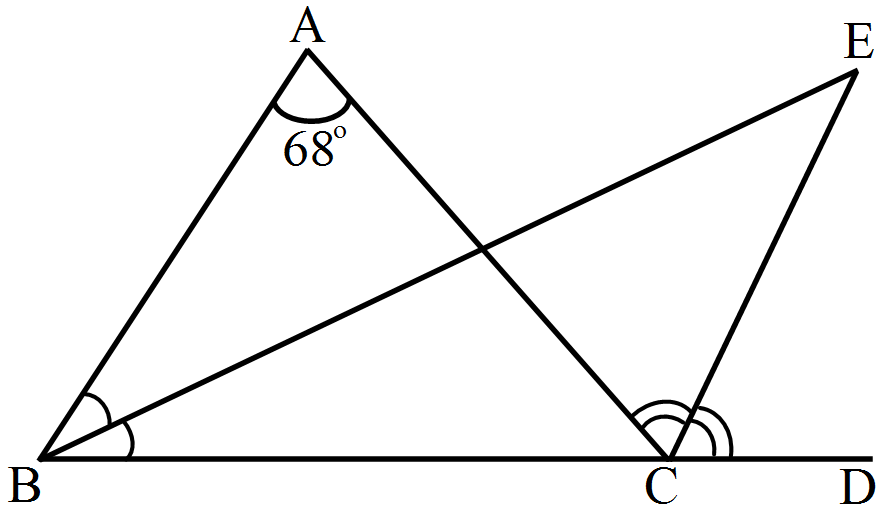
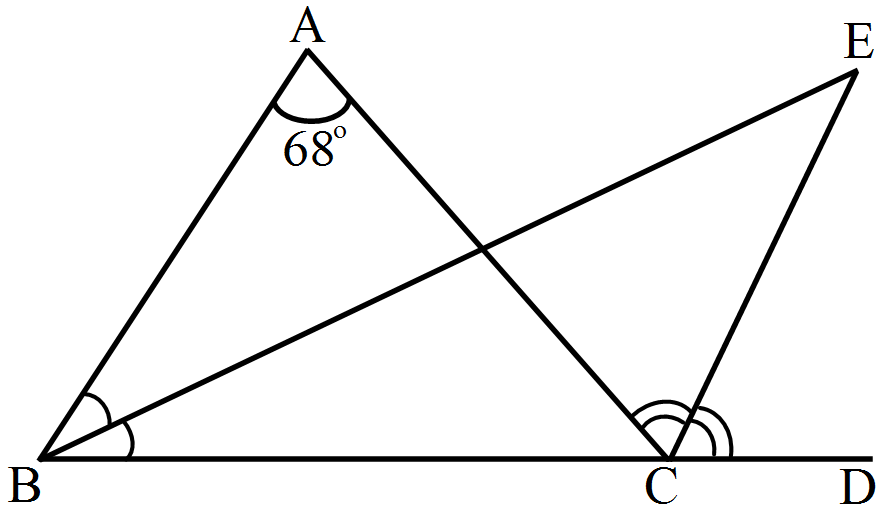
In the given figure, side BC of $\triangle\text{ABC}$ is produced to point D such that bisectors of $\angle\text{ACD}$ meet at a point E. If $\angle\text{BAC}=68^\circ,$ find $\angle\text{BEC}.$
Answer
In the given figure, bisectors of $\angle\text{ABC}$ and $\angle\text{ACD}$ meet at E and $\angle\text{BAC}=68^\circ$ We need to find $\angle\text{BEC}$ Here, using the property: an exterior angle of the triangle is equal to the sum of the opposite interior angles. In $\triangle\text{ABC}$ with $\angle\text{ACD}$ as its exterior angle$\text{ext}.\angle\text{ACD}=\angle\text{A}+\angle\text{ABC}\dots(1)$
Similarly, in $\triangle\text{BE}$ with $\angle\text{ECD}$ as its exterior angle$\text{ext}.\angle\text{ECD}=\angle\text{EBC}+\angle\text{BEC}$
$\frac{1}{2}\angle\text{ACD}=\frac{1}{2}\angle\text{ABC}+\angle\text{BEC}$ $($CE and BE are the bisectors of $\angle\text{ACD}$ and $\angle\text{ABC})$
$\angle\text{BEC}=\frac{1}{2}\angle\text{ACD}-\frac{1}{2}\angle\text{ABC}\dots(2)$
Now, multiplying both sides of (1) by $\frac{1}{2}$ We get,$\frac{1}{2}\angle\text{ACD}=\frac{1}{2}\angle\text{A}+\frac{1}{2}\angle\text{ABC}$
$\frac{1}{2}\angle\text{A}=\frac{1}{2}\angle\text{ACD}-\frac{1}{2}\angle\text{ABC}\dots(3)$
From (2) and (3) we get,$\angle\text{BEC}=\frac{1}{2}\angle\text{A}$
$\angle\text{BEC}=\frac{1}{2}(68^\circ)$
$\angle\text{BEC}=34^\circ$
Thus, $\angle\text{BEC}=34^\circ$
View full question & answer
Question 54 Marks
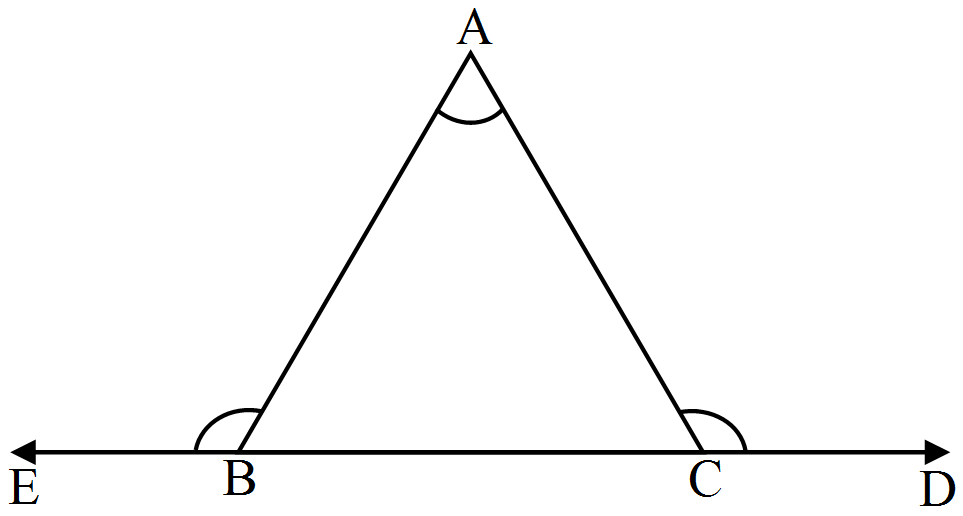
If the side BC of $\triangle\text{ABC}$ is produced on both sides, then write the difference between the sum of the exterior angles so formed and $\angle\text{A}.$
Answer
In the given problem, we need to find the difference between the sum of the exterior angles and $\angle\text{A}.$ Now, according to the exterior angle theorem$\text{ext}.\angle\text{C}=\angle\text{A}+\angle\text{B}\dots(1)$
Also,$\text{ext}.\angle\text{B}=\angle\text{A}+\angle\text{C}\dots(2)$
Further, adding (1) and (2)$\text{ext}.\angle\text{C}+\text{ext}.\angle\text{B}=\angle\text{A}+\angle\text{B}+\angle\text{A}+\angle\text{C}$
$=2\angle\text{A}+\angle\text{B}+\angle\text{C}\dots(3)$
Also, according to the angle sum property of the triangle, we get,$\angle\text{A}+\angle\text{B}+\angle\text{C}=180^\circ\dots(4)$
Now, we need to find the difference between the sum of the exterior angles and $\angle\text{A}.$ Thus,$(\text{ext}.\angle\text{C}+\text{ext}.\angle\text{B})-\angle\text{A}=(2\angle\text{A}+\angle\text{B}+\angle\text{C})-\angle\text{A}$
$=\angle\text{A}+\angle\text{B}+\angle\text{C}$
$=180^\circ(\text{Using 4})$
Therefore, $(\text{ext}.\angle\text{C}+\text{ext}.\angle\text{B})-\angle\text{A}=180^\circ$
View full question & answer
Question 64 Marks
If the angles A, B and C of $\triangle\text{ABC}$ satisfy the relation B − A = C − B, then find the measure of $\angle\text{B}.$
Answer
In the given $\triangle\text{ABC},$ $\angle\text{A},\angle\text{B}$and $\angle\text{C}$ satisfy the relation $\text{B}-\text{A}=\text{C}-\text{B}$
We need to fine the measure of $\angle\text{B}.$ As,$\text{B}-\text{A}=\text{C}-\text{B}$
$\text{B}+\text{B}=\text{C}+\text{A}$
$2\text{B}=\text{C}+\text{A}$
$2\text{B}-\text{A}=\text{C}\dots(1)$
Now, using the angle sum property of the triangle, we get,$\text{A}+\text{B}+\text{C}=180^\circ$
$2\text{B}-\text{A}+\text{A}+\angle\text{B}=180^\circ(\text{Using 1})$
$3\text{B}=180^\circ$
$\text{B}=\frac{180^\circ}{3}$
$=60^\circ$
Therefore, $\angle\text{B}=60^\circ$
View full question & answer
Question 74 Marks
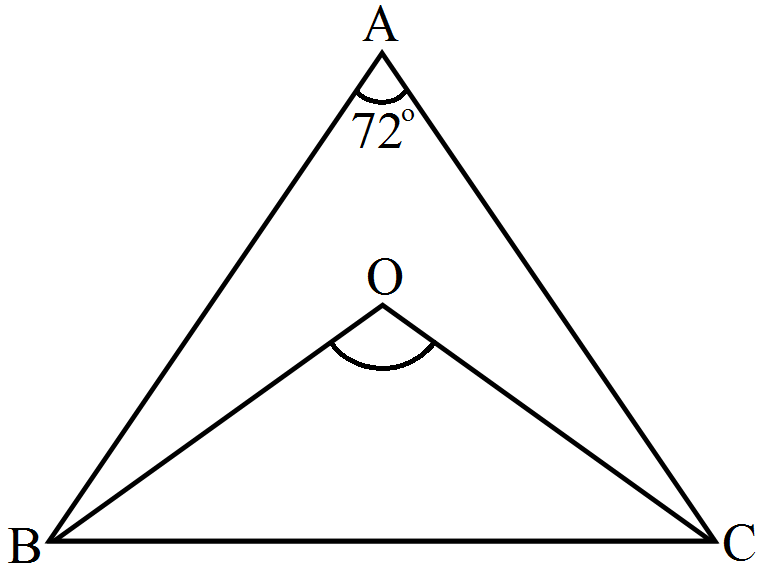
ABC is a triangle in which $\angle\text{A}=72^\circ,$ the internal bisectors of angles B and C meet in O. Find the magnitude of $\angle\text{BOC}.$
Answer
Given, ABC is a triangle where $\angle\text{A}=72^\circ$ and the internal bisector of angles B and C meeting O. In $\triangle\text{ABC},$$\angle\text{A}+\angle\text{B}+\angle\text{C}=180^\circ$
$\Rightarrow72^\circ+\angle\text{B}+\angle\text{C}=180^\circ$
$\Rightarrow\angle\text{B}+\angle\text{C}=180^\circ-72^\circ$
Dividing bith side by '2'$\Rightarrow\frac{\angle\text{B}}{2}+\frac{\angle\text{C}}{2}=\frac{108^\circ}{2}$
$\Rightarrow\angle\text{OBC}+\angle\text{OCB}=54^\circ$
Now, In $\triangle\text{BOC}\Rightarrow\angle\text{OBC}+\angle\text{OCB}+\angle\text{BOC}=180^\circ$$\Rightarrow540^\circ+\angle\text{BOC}=180^\circ$
$\Rightarrow\angle\text{BOC}=180^\circ-54^\circ=126^\circ$
$\therefore\angle\text{BOC}=126^\circ.$
View full question & answer
Question 84 Marks
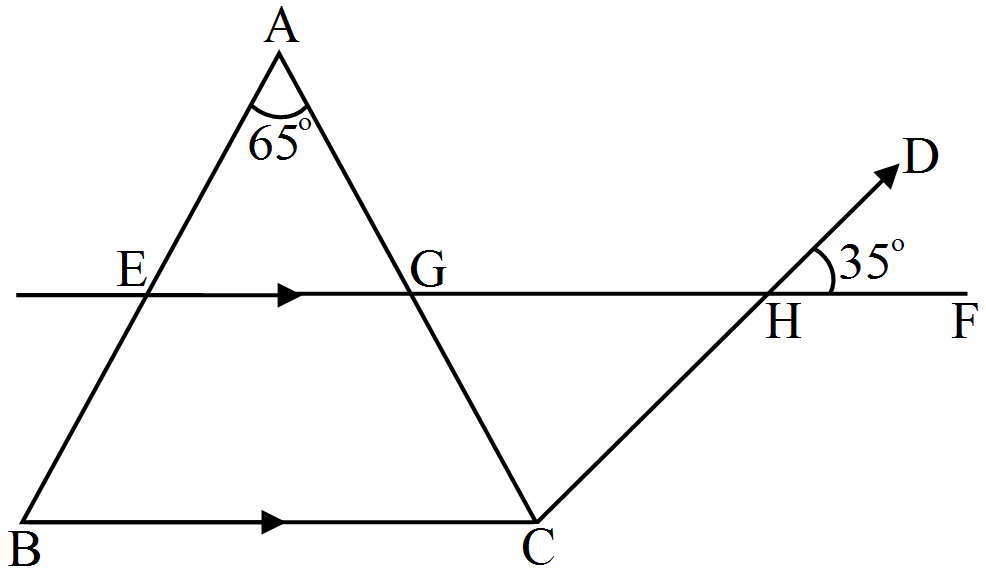
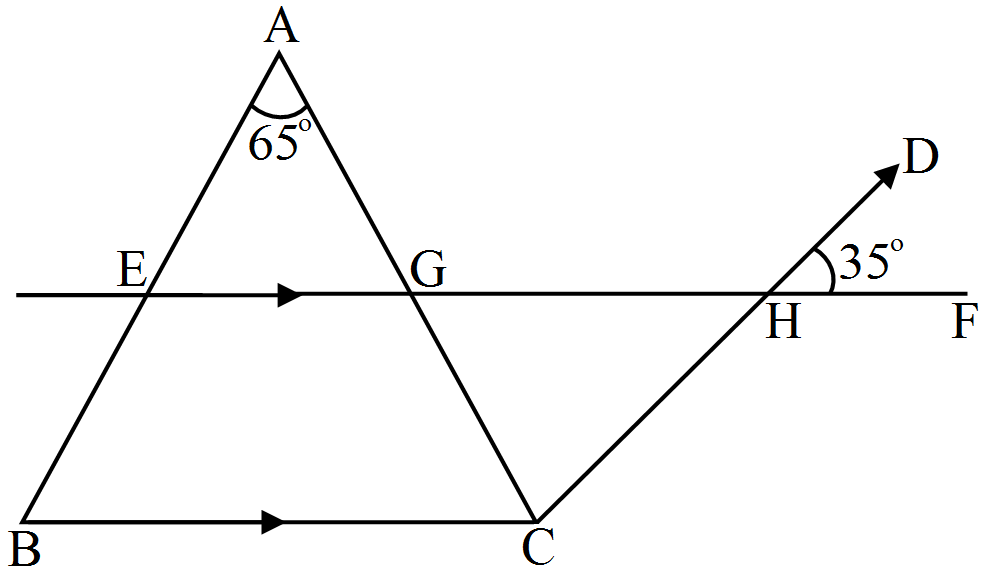
In the given figure, if $\text{AB }||\text{ CD},\text{EF }||\text{ BC},\angle\text{BAC}=65^\circ$ and $\angle\text{DHF}=35^\circ,$ find $\angle\text{AGH}.$
Answer
In the given figure, if $\text{AB }||\text{ CD},\text{EF }||\text{ BC},\angle\text{BAC}=65^\circ$ and $\angle\text{DHF}=35^\circ$ We need to find $\angle\text{AGH}.$ Here, GF and CD are straight lines intersecting at point H, so using the property, "vertically opposite angles are equal", we get,$\angle\text{DHF}=\angle\text{GHC}$
$\angle\text{GHC}=35^\circ$
Further, as AB || CD and AC is the transversal Using the property, "alternate interior angles are equal"$\angle\text{BAC}=\angle\text{ACD}$
$\angle\text{BAC}=65^\circ$
Further applying angle sum property of the triangle In $\triangle\text{GHC}$$\angle\text{DHF}+\angle\text{HCG}+\angle\text{CGH}=180^\circ$
$\angle\text{CGH}+35^\circ+65^\circ=180^\circ$
$100^\circ+\angle\text{CGH}=180^\circ$
$\angle\text{CGH}=180^\circ-100^\circ$
$\angle\text{CGH}=80^\circ$
Hence, applying the property, "angles forming a linear pair are supplementary" As AGC is a straight line$\angle\text{CGH}+\angle\text{AGH}=180^\circ$
$\angle\text{AGH}+80^\circ=180^\circ$
$\angle\text{AGH}=180^\circ-80^\circ$
$\angle\text{AGH}=100^\circ$
Therefore,$\angle\text{AGH}=100^\circ$
View full question & answer
Question 94 Marks
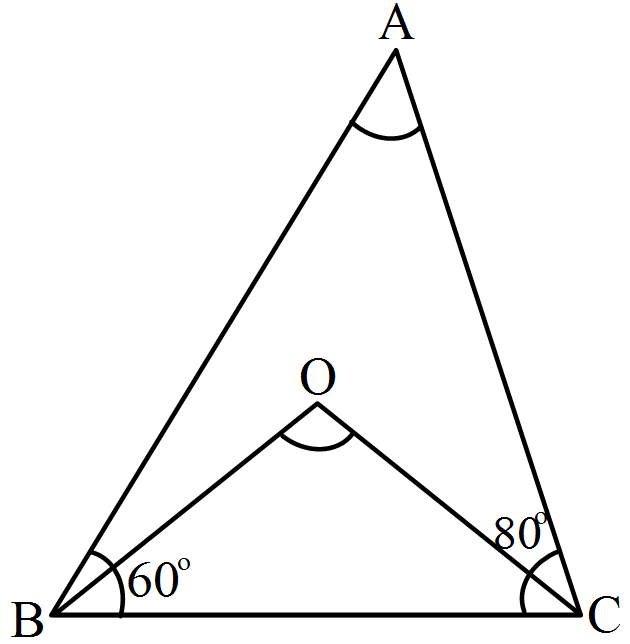
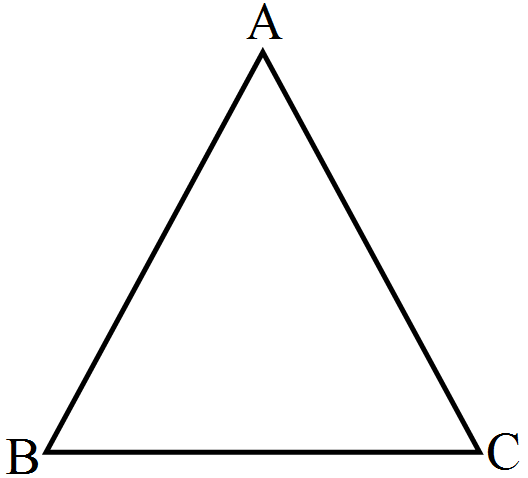
In $\triangle\text{ABC},$ if $\angle\text{B}=60^\circ,\angle\text{C}=80^\circ$ and the bisectors of angles $\angle\text{ABC}$ and $\angle\text{ACB}$ meet at a point O, then find the measure of $\angle\text{BOC}.$
Answer
In $\triangle\text{ABC},$ if $\angle\text{B}=60^\circ,\angle\text{C}=80^\circ$ and the bisectors of $\angle\text{B}$ and $\angle\text{C}$ meet at O. We need to find the measure of $\angle\text{BOC}$ Since, BO is the bisector of $\angle\text{B}$$\angle\text{OBC}=\frac{1}{2}\angle\text{B}$
$=\frac{1}{2}(60^\circ)$
$=30^\circ$
Similarly, CO is the bisector of $\angle\text{C}$$\angle\text{OCB}=\frac{1}{2}\angle\text{C}$
$=\frac{1}{2}(80^\circ)$
$=40^\circ$
Now, applying angle sum property of the triangle, in $ \triangle\text{BOC},$ we get,$\angle\text{OCB}+ \angle\text{OBC}+ \angle\text{BOC}=180^\circ$
$30^\circ+40^\circ+ \angle\text{BOC}=180^\circ$
$\angle\text{BOC}=180^\circ-70^\circ$
$=110^\circ$
Therefore, $\angle\text{BOC}=110^\circ.$
View full question & answer
Question 104 Marks
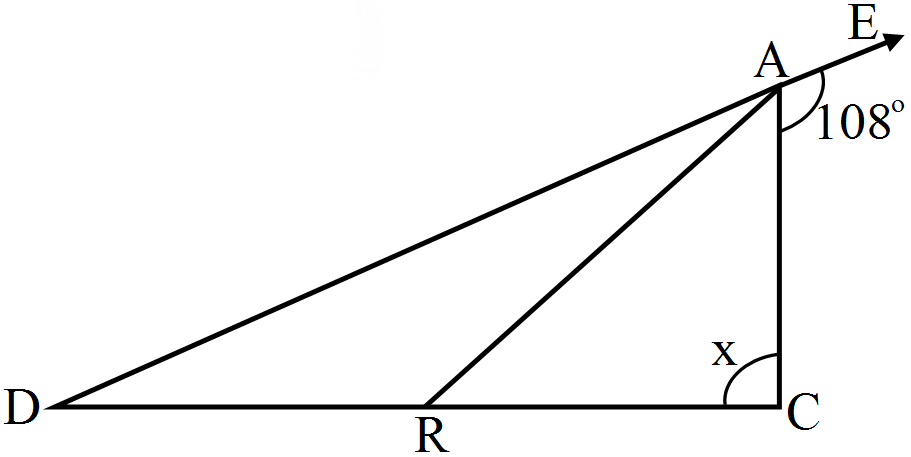
In figure AB divides $\angle\text{DAC}$ in the ratio 1 : 3 and AB = DB. Determine the value of x.
Answer
Let $\angle\text{BAD}=\text{Z},\angle\text{BAC}=3\text{Z}$$\Rightarrow\angle\text{BDA}=\angle\text{BAD}=\text{Z} $ $(\therefore\text{AB}=\text{DB})$
Now $\angle\text{BAD}+\angle\text{BAC}+108^\circ$ [Linear pair]$\Rightarrow\text{Z} + 3\text{Z} + 108° =180°$
$\Rightarrow 4\text{Z} = 72°$
$\Rightarrow \text{Z} = 18°$
Now, In $\triangle\text{ADC}$$\angle\text{ADC}+\angle\text{ACD}=180^\circ$ [Exterior angle property]
View full question & answer
Question 114 Marks
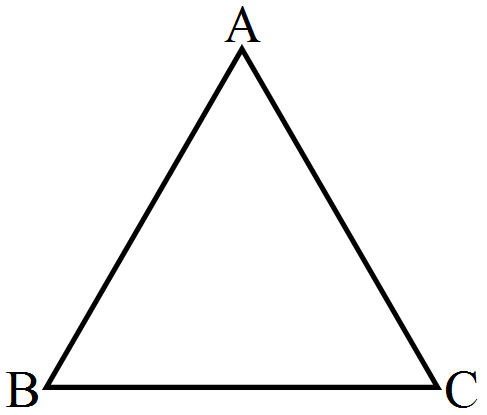
The sum of two angles of a triangle is equal to its third angle. Determine the measure of the third angle.
Answer
In the given problem, the sum of two angles of a triangle is equal to its third angle. We need to find the measure of the third angle. Thus, it is given, in $\triangle\text{ABC}$ $\text{A}+\text{B}=\text{C}\dots(\text{i})$ Now, according to the angle sum property of the triangle, we get,$\angle\text{A}+\angle\text{B}+\angle\text{C}=180^\circ$
$\angle\text{C}+\angle\text{C}=180^\circ (\text{Using i})$
$2\angle\text{C}=180^\circ$
$\angle\text{C}=\frac{180^\circ}{2}$
$\angle\text{C}=90^\circ$
Therefore, the measure of the third angle is $\angle\text{C}=90^\circ$
View full question & answer
Question 124 Marks
The angles of a triangle are arranged in ascending order of magnitude. If the difference between two consecutive angles is 10°, find the three angles.
Answer
Given that,
The difference between two consecutive angles is 10°
Let x, x + 10°, x + 20° be the consecutive angles that differ by 10°
We know that,
Sum of all angles in a triangle is 180°
x + x + 10° + x + 20° = 180°
3x + 30° = 180°
⇒ 3x = 180° - 30°
⇒ 3x = 150°
⇒ x = 50°
Therefore, the required angles are
x = 50°
x + 10° = 50° + 10° = 60°
x + 20° = 50° + 20° = 70°
As the difference between two consecutive angles is 10°, the three angles are 50°, 60°, 70°.
View full question & answer
Question 134 Marks
If the angles of a triangle are in the ratio 2 : 1 : 3, then find the measure of smallest angle.
Answer
In the given problem, angles of $\triangle\text{ABC}$ are in the ratio 2:1:3 We need to find the measure of the smallest angle. Let,$\angle\text{A}=2\text{x}$
$\angle\text{B}=\text{x}$
$\angle\text{C}=3\text{x}$
According to the angle sum property of the triangle, in $\triangle\text{ABC},$ we get,$2\text{x}+1\text{x}+3\text{x}=180^\circ$
$6\text{x}=180^\circ$
$\text{x}=\frac{180^\circ}{6}$
$\text{x}=30^\circ$
Thus,$\angle\text{A}=2(30^\circ)=60^\circ$
$\angle\text{B}=1(30^\circ)=30^\circ$
$\angle\text{C}=3(30^\circ)=90^\circ$
Since, the measure of $\angle\text{B}$ is the smallest of all the three angles. Therefore, the measure of the smallest angle is 30º.
View full question & answer
Question 144 Marks
If one angle of a triangle is equal to the sum of the other two, show that the triangle is a right angle triangle.
Answer
If one angle of a triangle is equal to the sum of the other two angles$\Rightarrow\angle\text{B}=\angle\text{A}+\angle\text{C}$
In $\triangle\text{ABC},$ Sum of all angles of a triangle is 180°$\Rightarrow\angle\text{A}+\angle\text{B}+\angle\text{C}=180^\circ$
$\Rightarrow\angle\text{B}+\angle\text{B}=180^\circ[\angle\text{B}=\angle\text{A}+\angle\text{C}]$
$\Rightarrow2\angle\text{B}=180^\circ$
$\Rightarrow\angle\text{B}=\frac{180^\circ}{2}$
$\Rightarrow\angle\text{B}=90^\circ$
Therefore, ABC is a right angled triangle
View full question & answer
Question 154 Marks
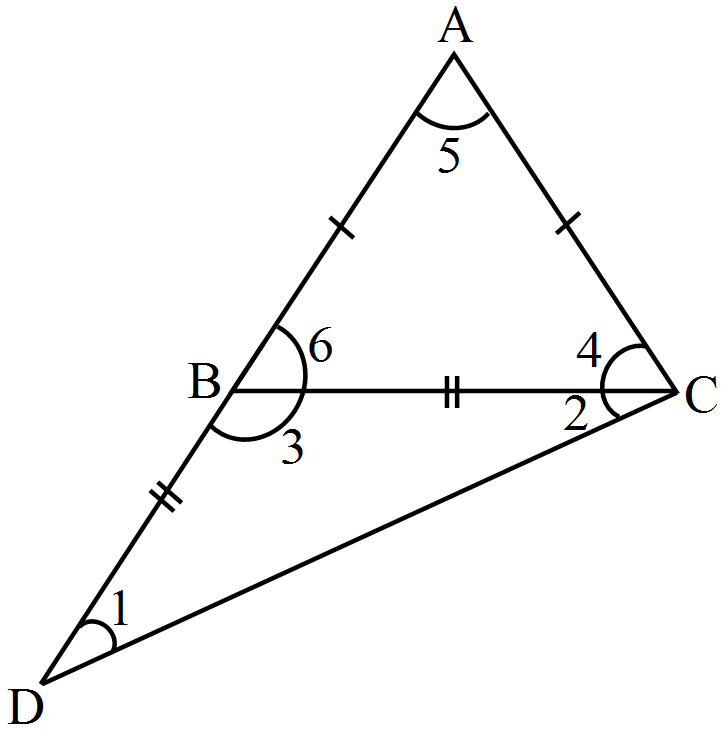
In a triangle ABC, if AB = AC and AB is produced to D such that BD = BC, find $\angle\text{ACD}:\angle\text{ADC}.$
Answer
In the given $\triangle\text{ABC},\text{AB}=\text{AC}$ and $\text{AB}$ is produced to D such that BD = BC We need to find $\angle\text{ACD}:\angle\text{ADC}$ Now, using the property, "angles opposite to equal sides are equal" As AB = AC$\angle6=\angle4\dots({1})$
Similarly, As AB = AC$\angle1=\angle4\dots({2})$
Also, using the property, "an exterior angle of the triangle is equal to the sum of the two opposite interior angle" In $\triangle\text{BDC}$$\text{ext}.\angle\text{6}=\angle\text{1}+\angle\text{2}$
$\text{ext}.\angle\text{6}=\angle\text{1}+\angle\text{1}(\text{Using 2})$
$\text{ext}.\angle\text{6}=2\angle\text{1}$
From (1), we get$\angle\text{4}=2\angle\text{1}\dots(3)$
Now, we need to find $\angle\text{ACD}:\angle\text{ADC}$ That is,$(\angle\text{4}+\angle\text{2}):\angle\text{1}$
$(2\angle\text{1}+\angle\text{2}):\angle\text{1}(\text{Using 3})$
$(2\angle\text{1}+\angle\text{1}):\angle\text{1}(\text{Using 2})$
$3\angle\text{1}:\angle\text{1}$
Eliminating $\angle1$ from both the sides, we get 3:1 Thus, the ratio of $\angle\text{ACD}:\angle\text{ADC} $ is $3 : 1$
View full question & answer