Question
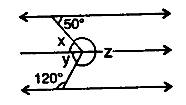
In the given figure, the directed lines are parallel to each other. Find the unknown angles.
Answer

∵ Lines are parallel
∴ x = 50° ...........(alternate angles)
and y + 120° = 180° .......(co-interior angles)
∴ y = 180°− 120° = 60°
But x + y + z = 360° .........(angles at a point)
⇒ 50° + 60° + x = 360°
⇒ 110° + z = 360°
⇒ z = 360°− 110° = 250°
Hence x = 50°, y = 60°, z = 250°

Need a full question paper?

Generate a complete, print-ready paper with questions like this in minutes — across 16+ boards, with answer keys.

Start Generating Free

Similar questions

Simplify and express the Solution in the positive exponent form:
$-\frac{128}{2187}$
Subtract the sum of $3a^2 – 2a + 5$ and $a^2 – 5a – 7$ from the sum of $5a^2 -9a + 3$ and $2a – a^2 – 1 $
In India, the Census is held every 10 years to count the whole population of the country. In a particular Census, the data of the number of children in 25 families of a village was provided as :
1, 2, 4, 2, 0, 2, 3, 3, 1, 0, 2, 3, 4, 3, 1, 1, 2, 1, 2, 3, 2, 4, 1, 2, 2.
Rahul works in the analytics department of the Census. He was given the task of analysing this data of the 25 families of this village.
Q.1. How many families have 3 children?
(a) 2 $\quad$$\quad$(b) 3$\quad$$\quad$ (c) 5$\quad$$\quad$ (d) 6
Q.2. The cumulative frequency of families having 3 children is :
(a) 13$\quad$$\quad$(b) 17$\quad$$\quad$ (c) 18$\quad$$\quad$ (d) 22
Q.3. The mean number of children in these 25 families is :
(a) 1.96 $\quad$$\quad$(b) 2.04$\quad$$\quad$ (c) 2.85$\quad$$\quad$ (d) 3.15
Q.4. The median of the number of children in these 25 families is :
(a) 1 $\quad$$\quad$(b) 2 $\quad$$\quad$(c) 3$\quad$$\quad$ (d) 4
Today is Eid. Ameena is very happy. Everyone in her family gave her a few coins in her bag. She now has 25 one rupee coins, 20 two rupee coins and 15 five rupee coins in her bag.
Q.1. The number of five rupee coins is what per cent of the total number of coins in the bag?
(a) $15 \%$ $\quad$$\quad$(b) $20 \%$ $\quad$$\quad$(c) $25 \%$ $\quad$$\quad$(d) $30 \%$
Q.2. The value of two rupee coins is what per cent of the total value of coins in the bag?
(a) $4 \frac{3}{4} \%$ $\quad$$\quad$(b) $33 \frac{1}{3} \%$ $\quad$$\quad$(c) $32 \%$ $\quad$$\quad$(d) $28 \frac{4}{7} \%$
Q.3. The number of five rupee coins is what per cent less than that of two rupee coins?
(a) $17 \frac{1}{2} \%$ $\quad$$\quad$(b) $20 \%$ $\quad$$\quad$(c) $25 \%$$\quad$$\quad$ (d) $33 \frac{1}{3} \%$
Q.4. The value of five rupee coins is what per cent more than that of two rupee coins?
(a) $70 \%$ $\quad$$\quad$(b) $75 \frac{1}{2} \%$$\quad$$\quad$ (c) $80 \%$ $\quad$$\quad$(d) $87 \frac{1}{2} \%$
Evaluate: 18 -(20 - 15 ÷ 3)
The following table shows number of males and number of females of a small locality in different age groups.
Age in years 10-20 21-50 Above 50
Male 8 12 6
female 6 10 4
If one of the persons, from this locality, is picked at random, what is the probability that
(a) the person picked is a male?
(b) the person picked is a female?
(c) the person picked is a female aged 21-50?
(d) the person is a male with age up to 50 years?
An article is marked 60% above the cost price and sold at 20% discount. Find the profit percent made.
Find the solution set of inequation : $-5<\frac{x}{2}-3<\frac{5}{2}, x \in Z$
Construct an isosceles ∆ PQR such that PQ = PR = 6.5 cm and ∠PQR = 75°. Using a ruler and compasses only constructs a circumcircle to this triangle.
Shaheed can prepare one wooden chair in 3 days and Shaif can prepare the same chair in 4 days. If they work together, in how many days will they prepare:
(i) one chair?
(ii)14 chairs of the same kind?